

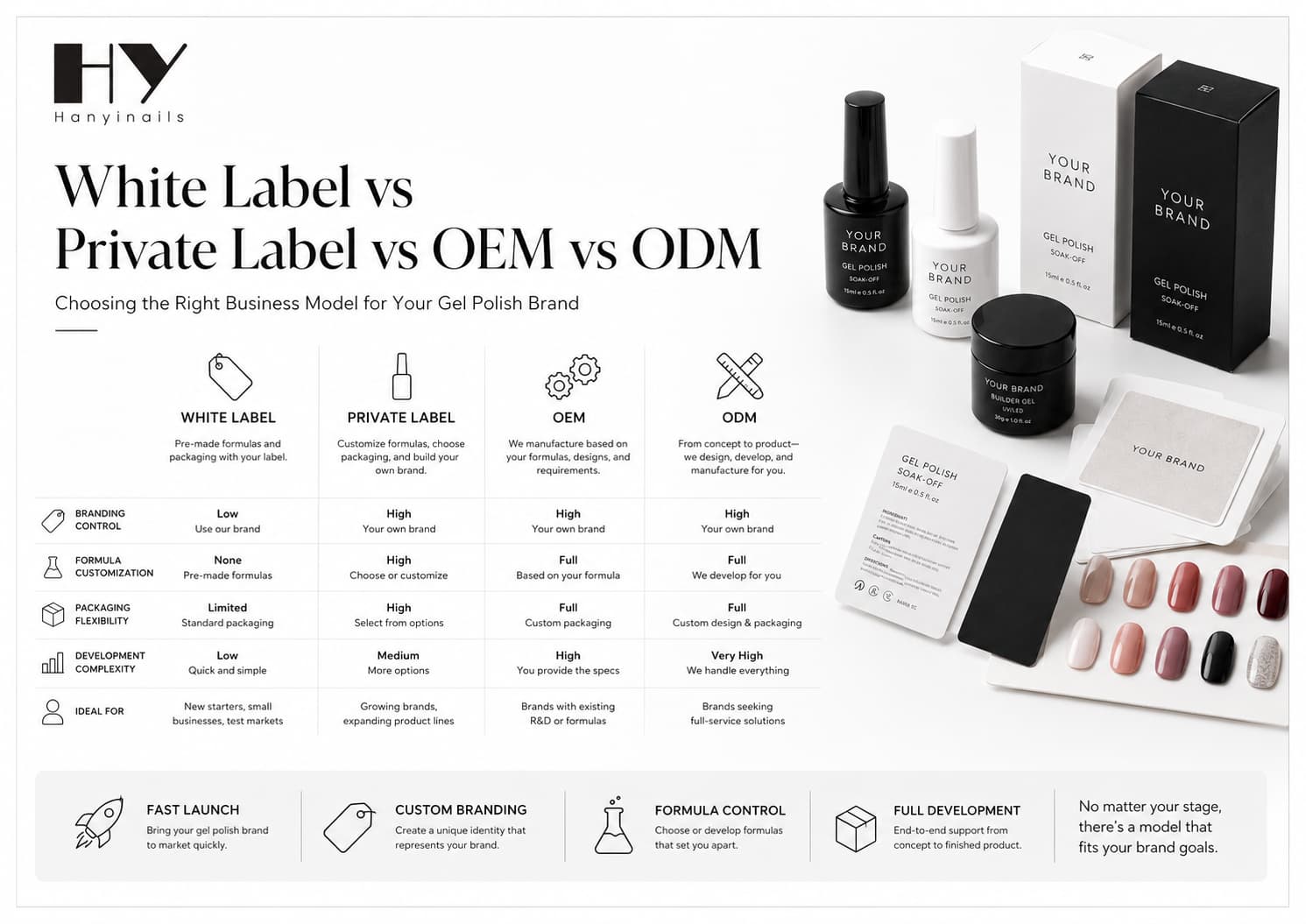
1. Choose Your Gel Polish Business Model
This decision shapes the rest of the project. Manufacturers may use the terms white label, private label, OEM, ODM, and contract manufacturing differently, so treat the labels as a starting point rather than universal definitions.
The final agreement should define formula ownership, exclusivity, permitted modifications, artwork ownership, minimum quantities, validation responsibilities, and whether the same or a similar formula may be supplied to other brands.
Private label is often a practical starting route for a new brand because it can balance customization, development time, and initial investment. Brands requiring a distinctive formula, finish, or performance characteristic may need an OEM or ODM route.
Hanyinails supports different levels of brand development through its gel nail polish brand creation service and professional contract manufacturing capabilities.
Do You Need to Manufacture Gel Polish Yourself?
No. Starting a gel polish brand does not require the brand owner to formulate chemistry, build a laboratory, or operate a production factory.
Private label allows a brand to work with an existing formula and manufacturing system. OEM or ODM development may support additional customization, including a specific finish, viscosity, ingredient position, color system, or product format.
Custom formulation requires professional chemistry, compatibility evaluation, manufacturing controls, and market-specific documentation. It should be handled with a qualified formulation and manufacturing partner rather than treated as a simple home-mixing project.
2. Define Your Target Market and Brand Position
Before selecting colors or packaging, define the customer and sales channel the brand is intended to serve.
- Salons and nail technicians: Professional performance, system compatibility, technical information, and repeat supply may be priorities.
- Home users: Application clarity, kits, user instructions, and accessible product selection may be more important.
- Direct-to-consumer brands: Packaging, visual identity, reviews, online content, and fulfillment costs affect the business model.
- Amazon or marketplace brands: Platform fees, packaging requirements, inventory planning, and review management should be included in the launch plan.
- Distributors and wholesalers: Product range, carton quantities, documentation, margins, and reorder reliability matter.
The brand may be positioned around luxury, fashion trends, professional salon performance, value, nail art, or verified ingredient attributes such as selected HEMA-free options where available. Avoid using broad terms such as "clean" unless the brand can clearly define and support the claim.
The brand name, logo, packaging, claims, and product range should follow this market position rather than being developed separately from it.
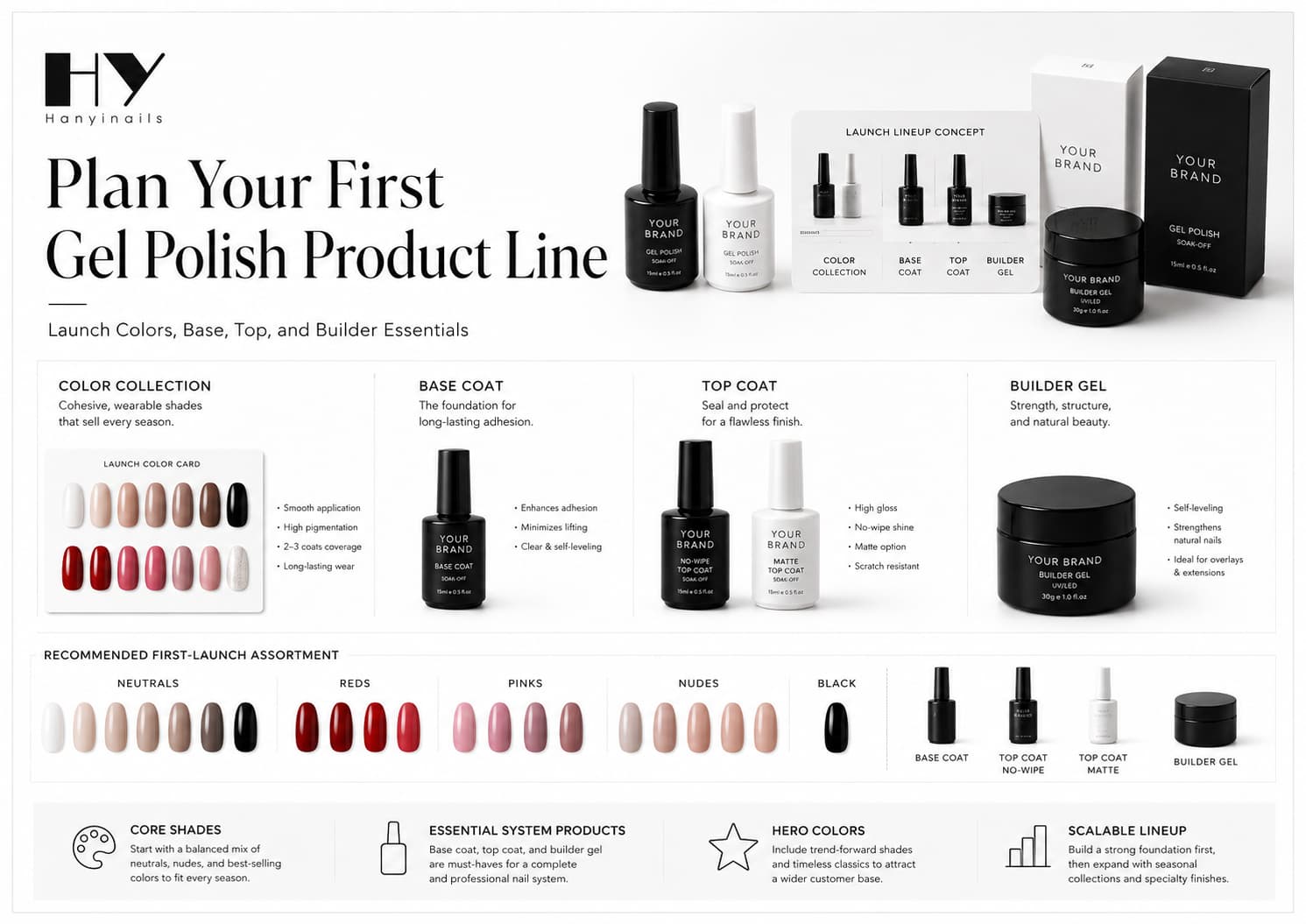
3. Plan a Focused Launch Product Line
A common startup mistake is launching too many shades and product types before the brand has real sales data.
A practical launch range depends on MOQ, channel, customer, and working capital:
- Small market test: A limited group of carefully selected shades - for example, around 6 to 12 colors - when MOQ and cash flow make that range practical.
- Standard brand launch: A curated core palette, selected trend shades, and compatible base and top products.
- Salon or distributor collection: A broader system designed around the products professional buyers expect to stock, which may include builder gel, nail art gel, or specialty finishes.
Decide whether the first line will sell single bottles, color sets, salon systems, or kits. Each additional SKU increases inventory, artwork, packaging, testing, and reorder complexity.
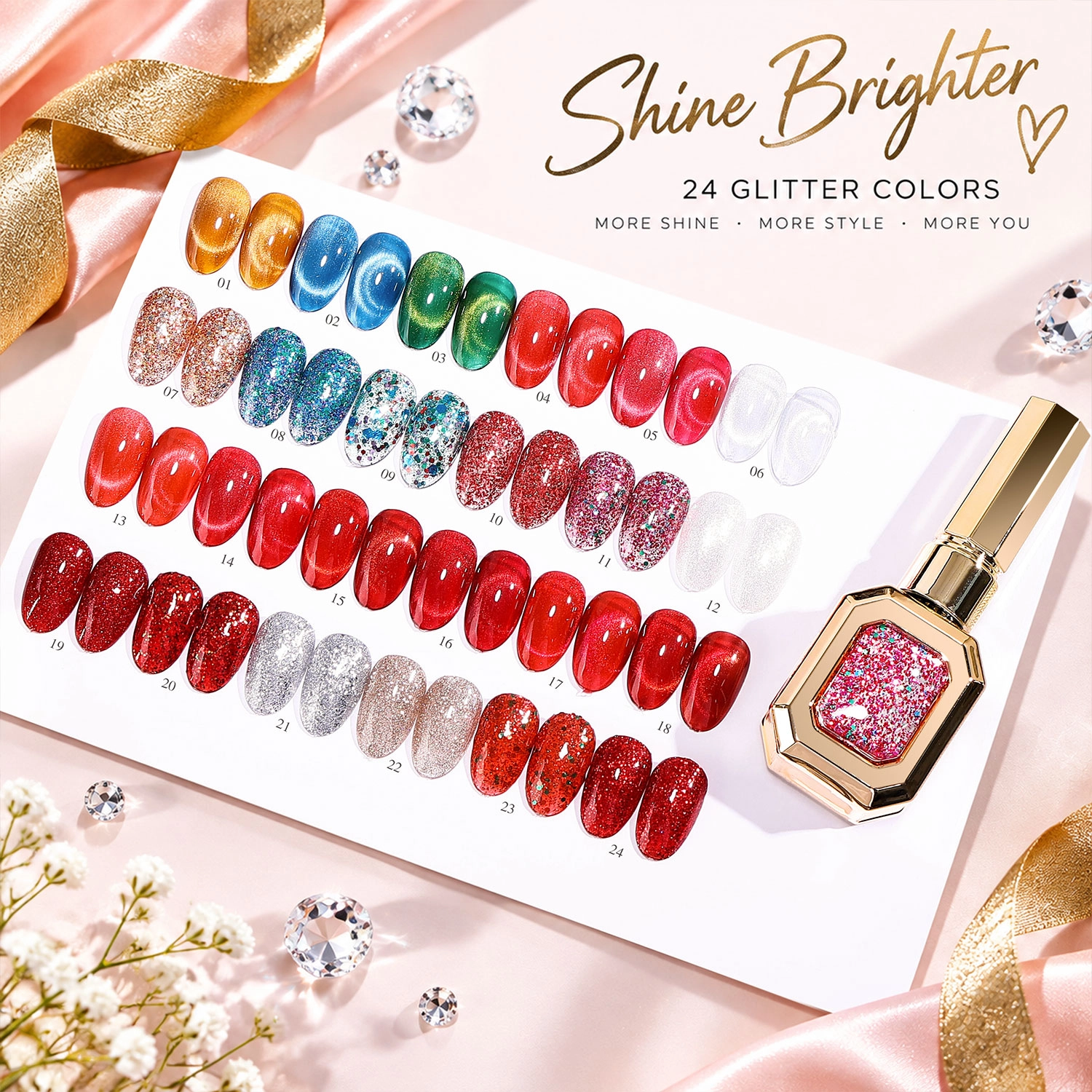
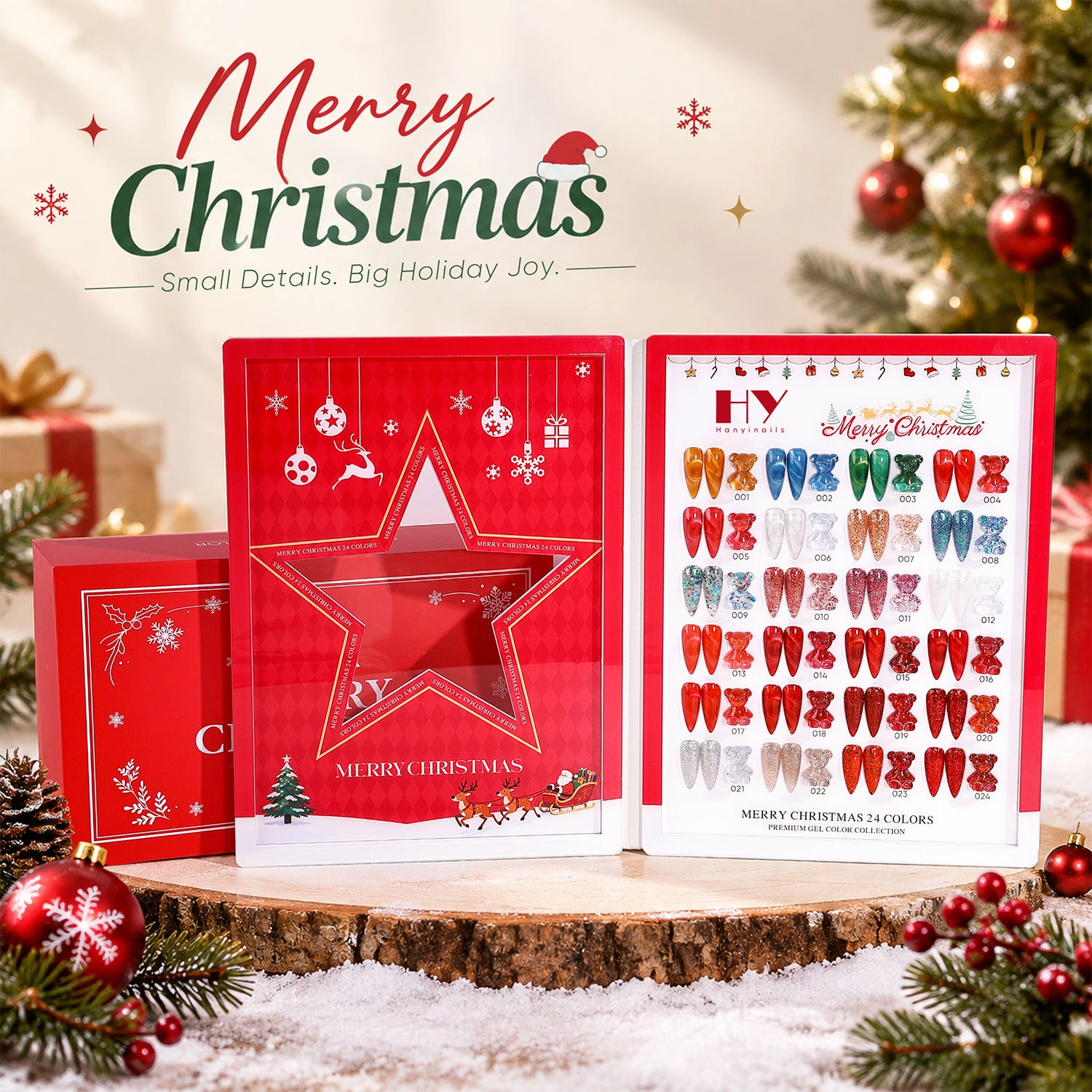
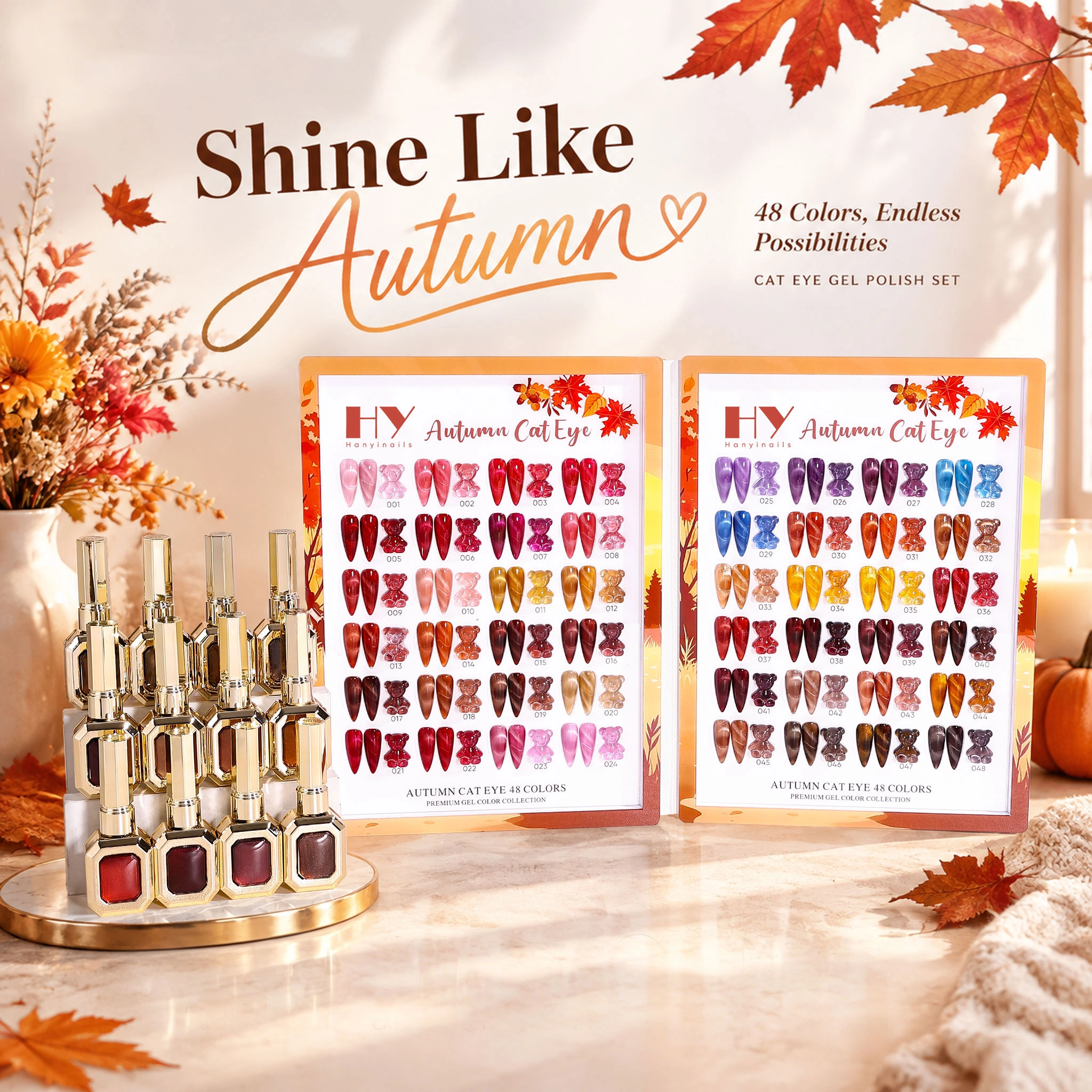
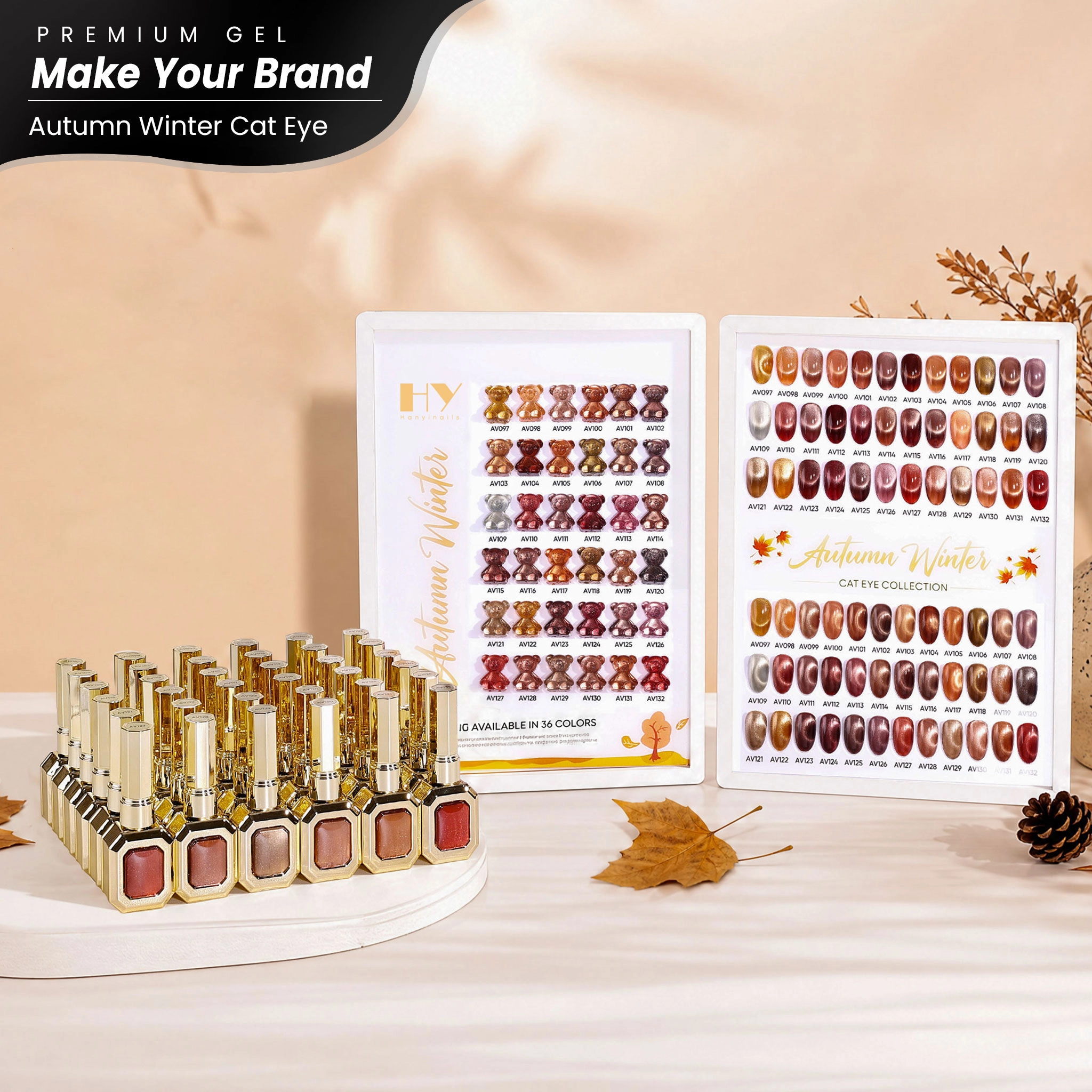
Brands can review gel polish colors and finishes when planning a core collection and identifying suitable seasonal or specialty products.
4. Build a Realistic Budget and Margin Model
A low MOQ or low bottle price does not show the full amount required to launch and restock a brand. Build the budget around all major project and sales costs.
Do not compare suppliers using bottle price alone. Compare total landed cost, channel fees, fulfillment, discounts, returns, and other variable selling costs against the net selling price.
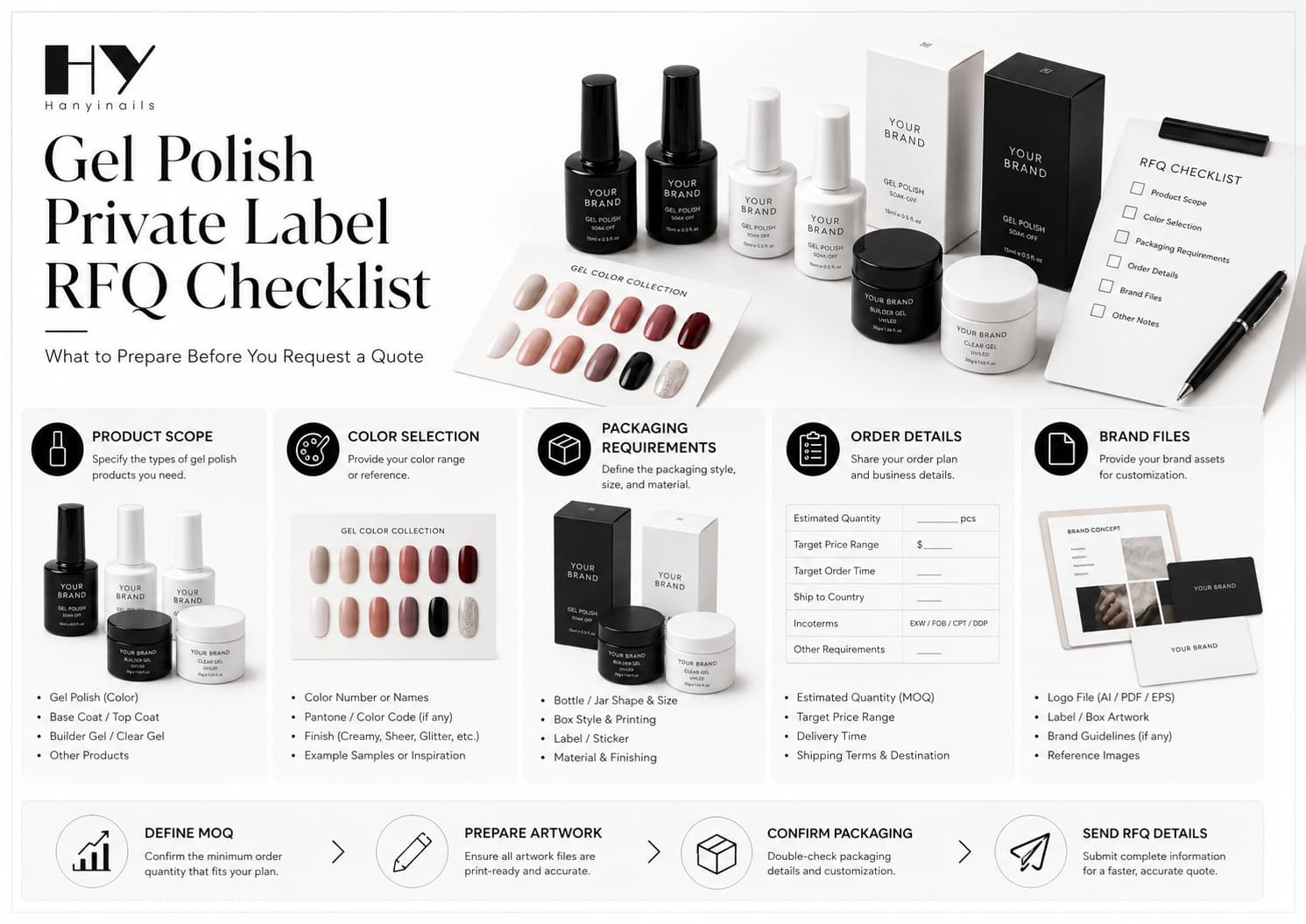
5. Prepare a Product and Brand Brief
A detailed brief helps the manufacturer understand the project and provide a more accurate quotation.
Prepare the following information before requesting a quote:
- Target market and sales channel
- Product categories
- Estimated number of SKUs
- Estimated quantity per SKU
- Formula or ingredient requirements
- Target colors, reference shades, or effect samples
- Bottle capacity and style preference
- Logo and available artwork files
- Label, box, kit, and color-card requirements
- Target launch date
- Delivery country
- Required documentation
- Budget or target price range
6. Find and Evaluate a Manufacturer
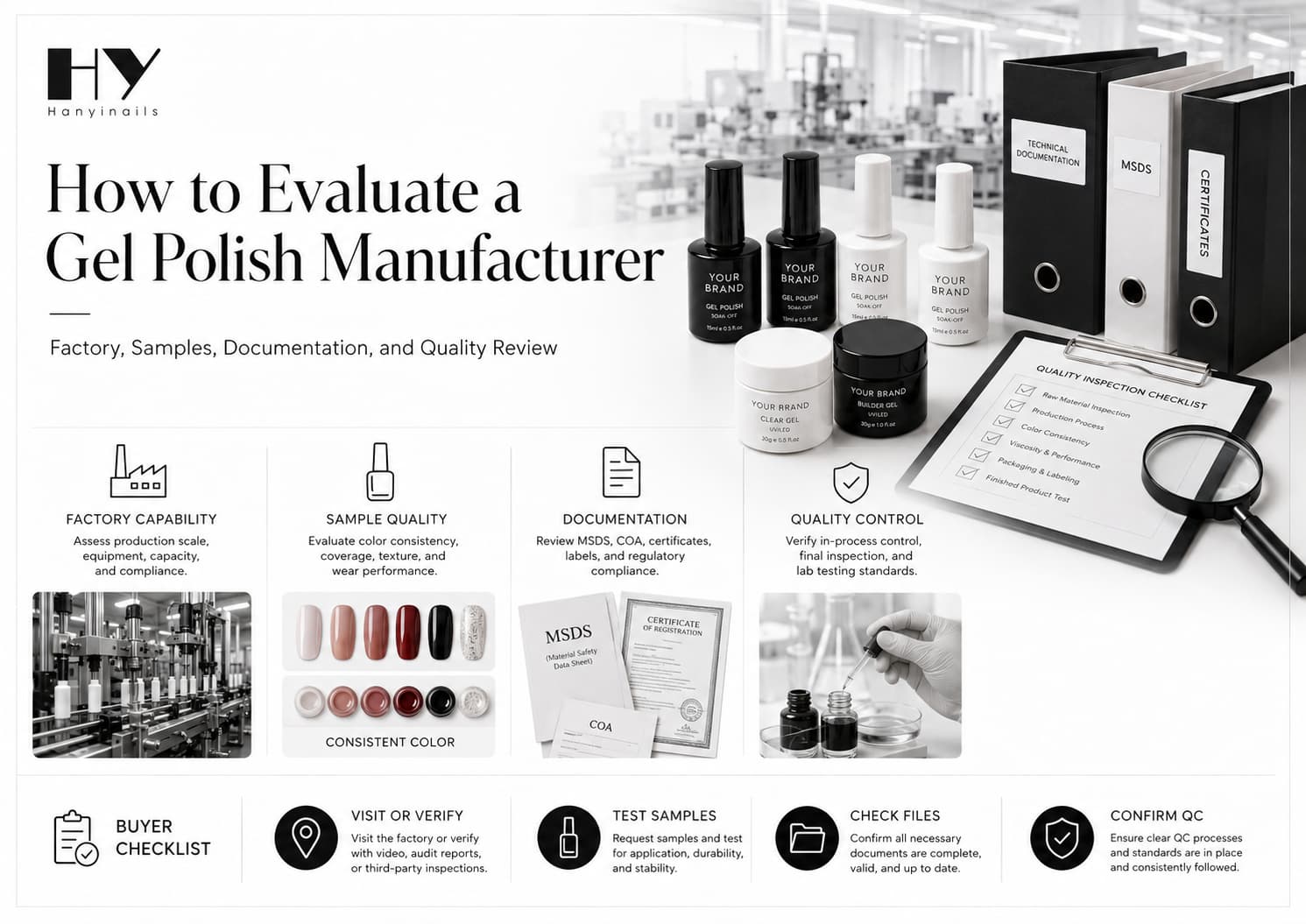
Evaluate manufacturers through specific project and quality questions rather than marketing claims alone.
- Can the manufacturer provide product, packaging, and production-reference samples?
- Can colors and formulas be reproduced consistently against an approved reference?
- Are the products compatible with the intended UV/LED lamp and application system?
- What quality checks apply to raw materials, filling, finished product, printing, and packaging?
- Can the supplier provide the documents needed for the selected market and product type?
- How is MOQ calculated for formula, color, bottle, printing, box, and kit components?
- What are the sampling, revision, artwork, and production timelines?
- How are defects, shortages, claims, and replacement orders handled?
- Can the manufacturer support larger reorders if demand increases?
A useful supplier assessment should also consider communication quality, specification control, sample tracking, artwork approval, and whether changes are documented before production.
The private label gel polish manufacturer guide provides additional criteria for comparing potential production partners.
7. Request and Test Samples
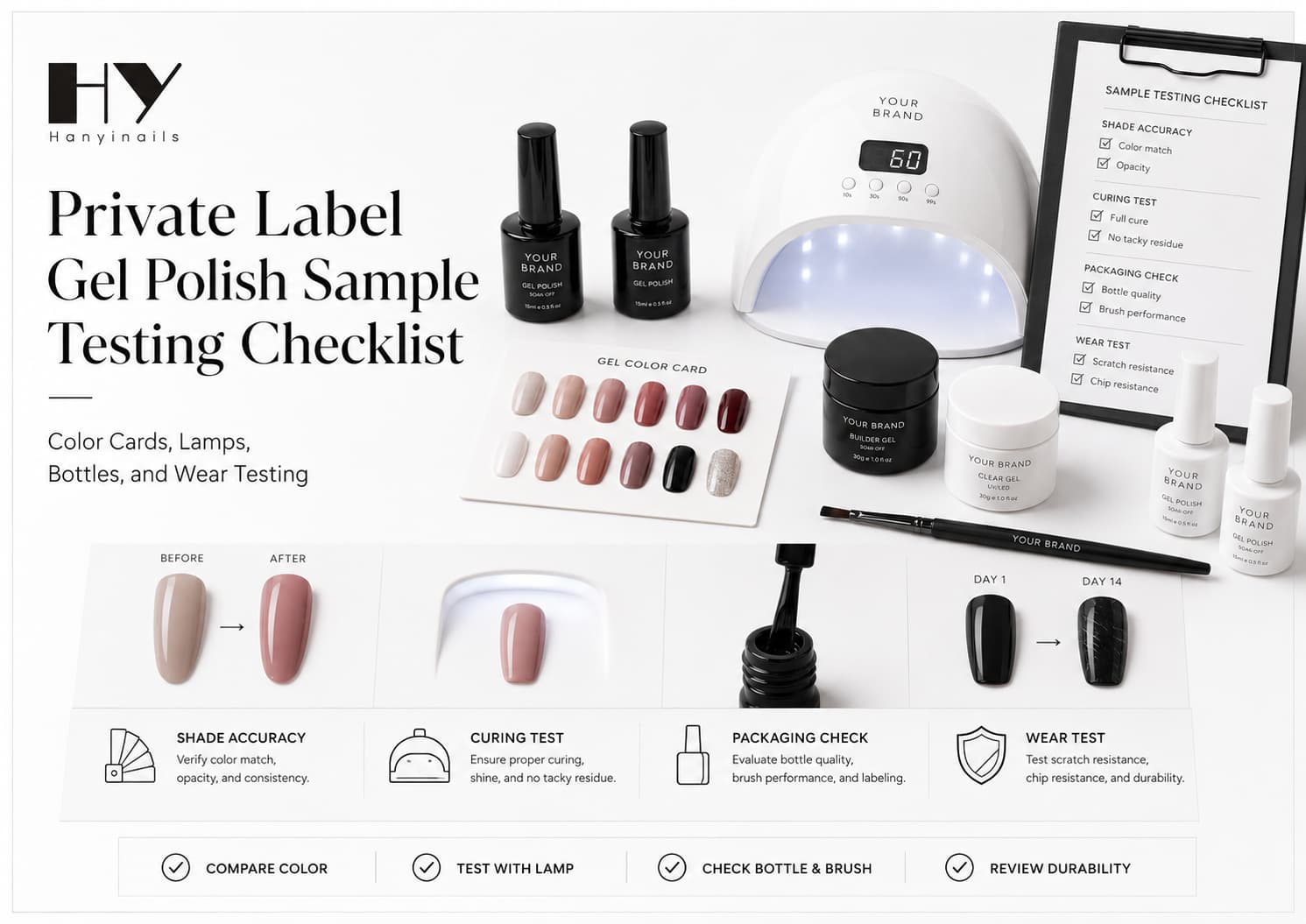
Color is only one part of sample approval. The product should be tested as part of the intended gel system, using the planned base coat, top coat, lamp, curing time, application thickness, and removal method.
A practical sample evaluation should include:
- Color accuracy, opacity, and coverage
- Viscosity and self-leveling behavior
- Brush shape, brush flexibility, bottle-neck fit, and wiper performance
- UV/LED curing under the intended lamp
- Shrinkage, pooling, wrinkling, or incomplete curing
- Gloss, color stability, and appearance during the intended wear cycle
- Adhesion and the specified soak-off or file-off removal method
- Bottle sealing, leakage, light protection, and material compatibility
- Label resistance to handling, cleanser, and normal product contact
- Packaging integrity during simulated or actual transport
A single development sample cannot prove batch-to-batch consistency. Keep an approved reference sample and compare pre-production or bulk-production samples against it. Where practical, request samples from separate production batches and retain coded samples for future comparison.
8. Finalize Packaging, Artwork and Label Information
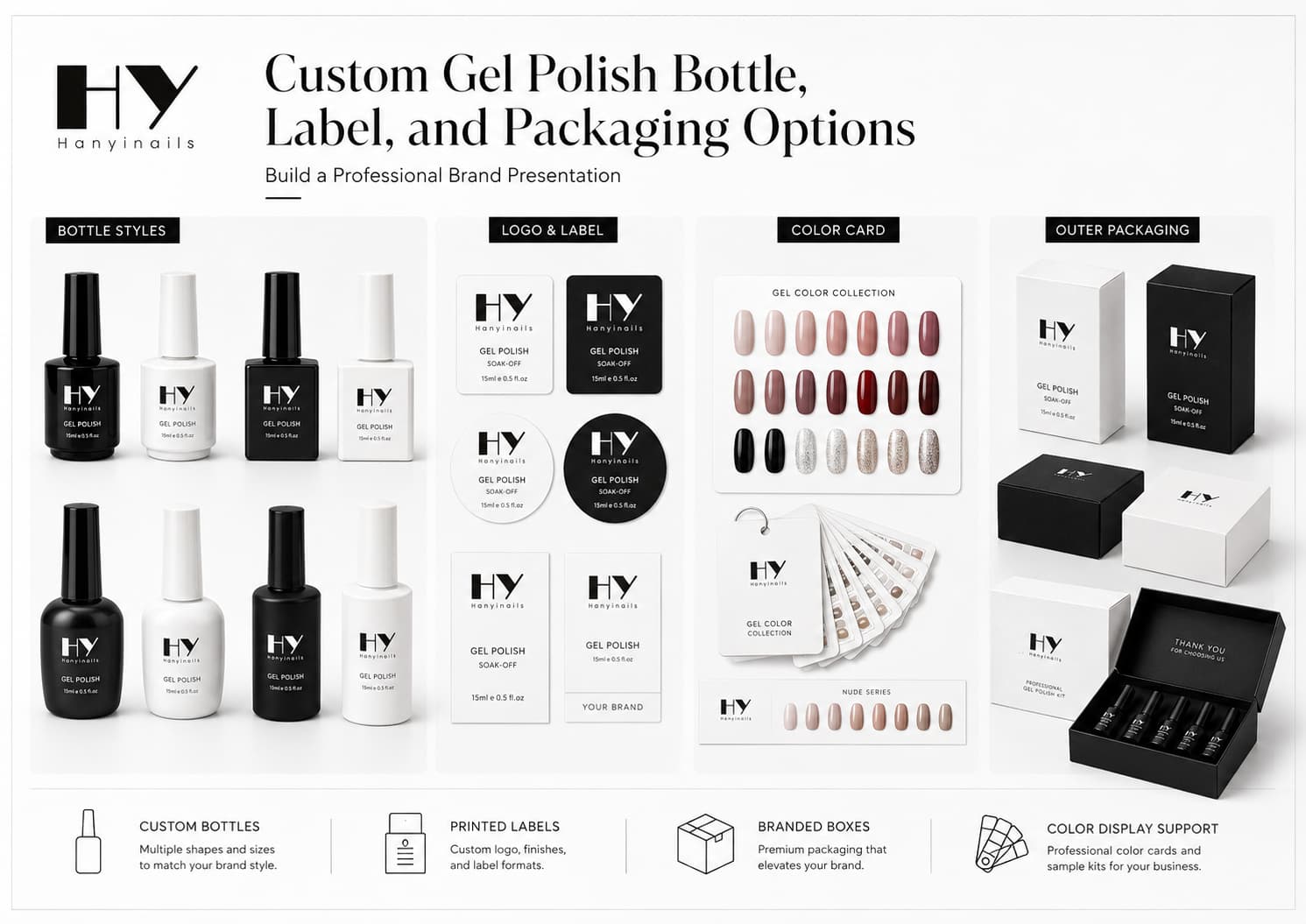
After the formula and colors are approved, confirm the packaging system and print files.
- Bottle and cap style, including stock or custom components
- Brush, stem, wiper, bottle-neck, and cap compatibility
- Bottle sealing, leakage resistance, and light protection
- Compatibility between the gel formula and all product-contact materials
- Logo position and printing method, such as screen printing, label, foil, or UV printing
- Color chart, box, insert, kit, and shipping packaging
- Label information and market-specific product information
- Print-ready artwork, dimensions, colors, and version approval
- Label resistance to handling, cleaners, and product contact
- Transit testing for bottles, caps, boxes, inserts, and finished kits
Packaging should be approved for function as well as appearance. A visually attractive bottle is not suitable if the cap leaks, the wiper removes too much product, the brush does not match the formula, or the label degrades during normal salon use.
9. Confirm Quote, MOQ, Timeline and Quality Terms
Before placing the first production order, confirm the commercial, technical, and quality terms in writing.
- Itemized MOQ by formula, color, bottle, printing method, box, and packaging component
- Approved formula, color, packaging, and pre-production reference samples
- Product specification sheet and artwork version
- Acceptable color, fill-weight, and quantity tolerances
- Packaging appearance and defect criteria
- Payment milestones
- Sampling, production, and packaging timelines
- Batch identification and traceability information
- Quality inspection or pre-shipment inspection process
- Retention samples for future comparison
- Defect, shortage, and claim-reporting window
- Reorder and replacement handling
- Shipping, customs, and delivery responsibility
Manufacturer documents support the project, but the brand owner, importer, distributor, or local responsible party should confirm market-specific labeling, notification, product-claim, and documentation requirements with an appropriate compliance professional.
10. Launch, Measure and Reorder
Once the first order enters production or is shipped, prepare the commercial launch and feedback process.
- Arrange product photography and application content.
- Prepare the website, product pages, social channels, and sales materials.
- Send controlled samples to nail technicians, salons, distributors, or content partners.
- Collect reviews and structured performance feedback.
- Track sales by SKU, collection, customer type, and channel.
- Monitor returns, complaints, cure issues, packaging issues, and color preferences.
- Use the results to plan reorders, discontinue weak SKUs, and expand proven products.
Reserve enough working capital for reorders before the first collection sells out. Production and shipping lead times may require the next order to be placed before current inventory reaches a low level.
Common Gel Polish Brand Startup Mistakes
- Launching too many colors before validating demand
- Comparing manufacturers using bottle price rather than total landed cost
- Skipping lamp and system-compatibility testing
- Approving packaging before the formula, brush, bottle, and wiper are confirmed
- Assuming one sample proves batch consistency
- Failing to confirm market-specific labeling and documentation responsibilities
- Launching without working capital for reorders
- Treating marketing terms such as "professional grade" or "clean" as technical specifications
- Failing to define formula ownership, exclusivity, and permitted modifications


Hanyinails
Hanyinails
Hanyinails
Hanyinails