Soft Gel Tips vs Acrylic Nails: Key Differences, Wear & Removal
Thursday, 01/22/2026
Soft Gel Tips vs Acrylic Nails: compare application, wear, upkeep and removal to choose the set that fits your routine and learn how each is taken off with less risk of nail damage.
Soft gel tips and acrylic nails can both create nail extensions, but they use very different product systems.
Soft gel tips are preformed full-cover tips applied over the natural nail with a compatible gel adhesion system.
Acrylic extensions are created from liquid monomer and polymer powder that is shaped into the intended structure.
Neither system is universally better.
The useful comparison is how the extension is created, how it fits and behaves in service, how it is maintained or removed, and which system best suits the intended salon workflow.
For salons, nail professionals and product buyers, those differences matter more than simply asking which system is “stronger.”
Quick Answer
Soft Gel Tips vs Acrylic Nails
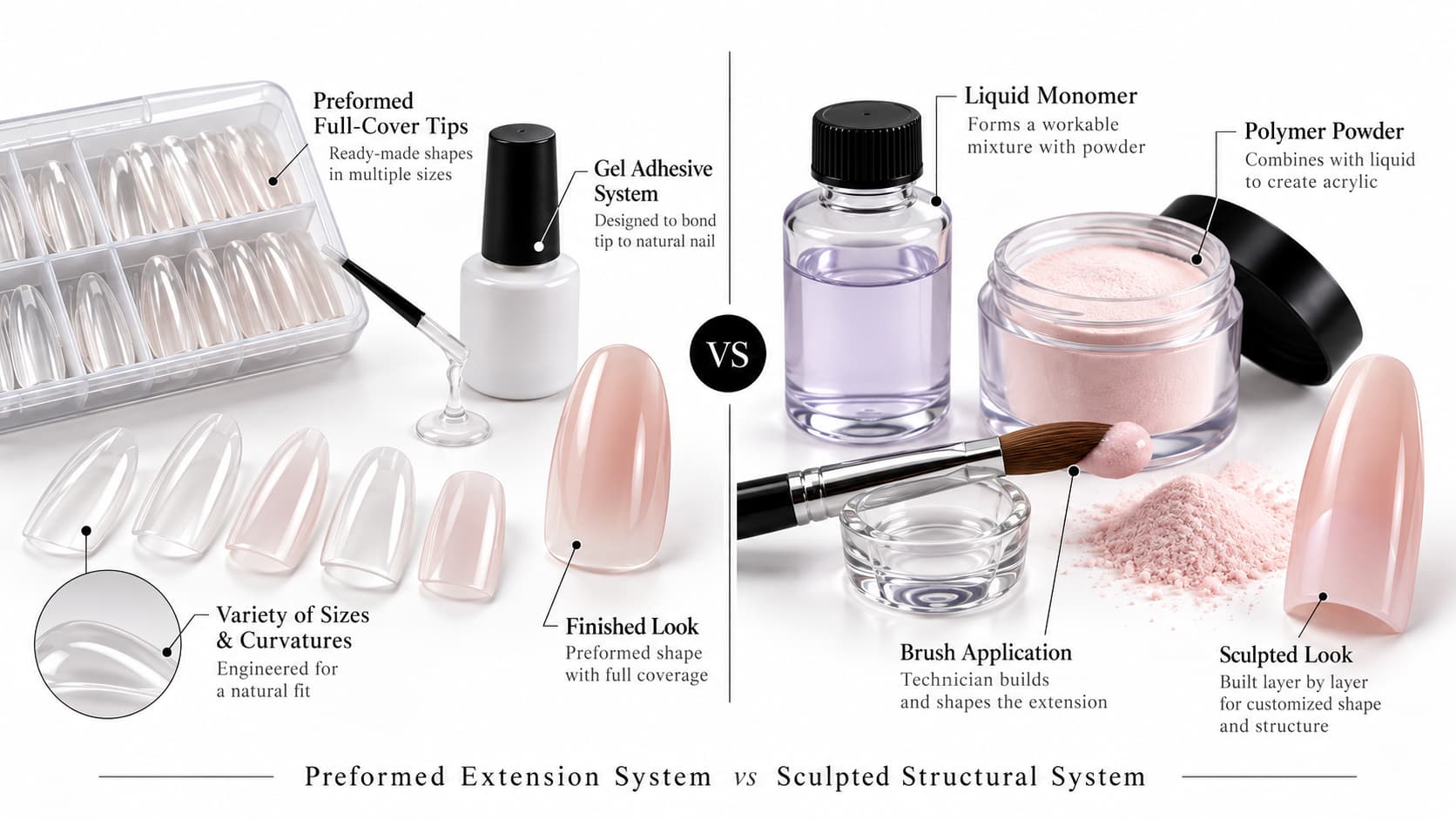
Soft gel tips are pre-shaped full-cover extensions attached with a compatible gel system. Acrylic extensions are sculpted using a liquid-and-powder system, giving the technician more control over architecture during application.
Soft Gel Tips
preformed full-cover shape;
gel-based adhesion system;
ready-made shapes and lengths;
fit depends strongly on size and curvature;
maintenance and removal depend on the exact system.
Acrylic Nails
sculpted structural enhancement;
liquid monomer + polymer powder;
custom length and architecture;
structure is built during application;
maintenance and removal depend on the acrylic system.
Desired Service → Nail Fit → Length & Shape → Structural Requirement → Maintenance → Removal → Salon Workflow
1. What Are Soft Gel Nail Tips?
Soft gel nail tips are full-cover extension tips made from a gel-based material.
Unlike traditional partial tips, which cover only part of the nail and require another product to build the remaining structure, full-cover soft gel tips extend from the cuticle area to the free edge.
They are commonly available in different:
widths;
lengths;
shapes;
curvatures;
and apex profiles.
A complete soft-gel-tip system may involve:
Natural Nail Preparation → Compatible Gel Adhesion System → Full-Cover Soft Gel Tip → Product-Specific Curing → Color or Nail Art → Finishing System
Soft Gel Tips Are Not the Same as Every “Nail Tip”
The search term nail tips is broad. It may refer to traditional extension tips, half-cover tips, full-cover tips, press-on nails, soft gel tips or other preformed nail extensions.
In this guide, soft gel tips means full-cover gel-based extension tips used with a compatible gel application system.
2. Is Gel-X the Same as Soft Gel Tips?
They are closely related terms, but they are not exactly the same.
Soft gel tips describe the broader product category. Gel-X® is a branded full-cover soft gel extension system.
In search behavior, users may use terms such as Gel-X tips, gel x nails, soft gel tips, gel tips, full-cover gel tips and soft gel extensions.
Soft Gel Tips = Broad Category Gel-X® = One Branded Soft Gel Extension System
Different soft gel tip systems can use different:
tip materials;
shapes;
curvatures;
adhesion products;
preparation requirements;
curing instructions;
and removal methods.
Do not assume instructions from one branded system apply to all soft gel tips.
Pre-engineered tip architecture plus adhesion system
Technician builds the architecture
Flexibility / Rigidity
Depends on exact tip and gel system
Depends on acrylic formulation and structure
Curing / Setting
Gel components require product-specific curing
Acrylic hardens through its chemical reaction
Maintenance
Depends on the exact system and salon approach
Can often be maintained through rebalance/fill procedures
Removal
Depends on the exact tip and adhesive system
Depends on acrylic system and service method
Salon Workflow
Can reduce some sculpting steps
Offers extensive custom sculpting control
The important difference is not simply “gel is flexible and acrylic is strong.” Both categories contain different products. The useful comparison is the complete extension system.
Soft gel tips use a preformed full-cover extension with a compatible gel adhesion system, while acrylic extensions are sculpted from a liquid-and-powder structural system.
4. How Do the Application Systems Differ?
Soft gel tips and acrylic extensions create length in fundamentally different ways.
Soft Gel Tip System
The extension already has a preformed shape.
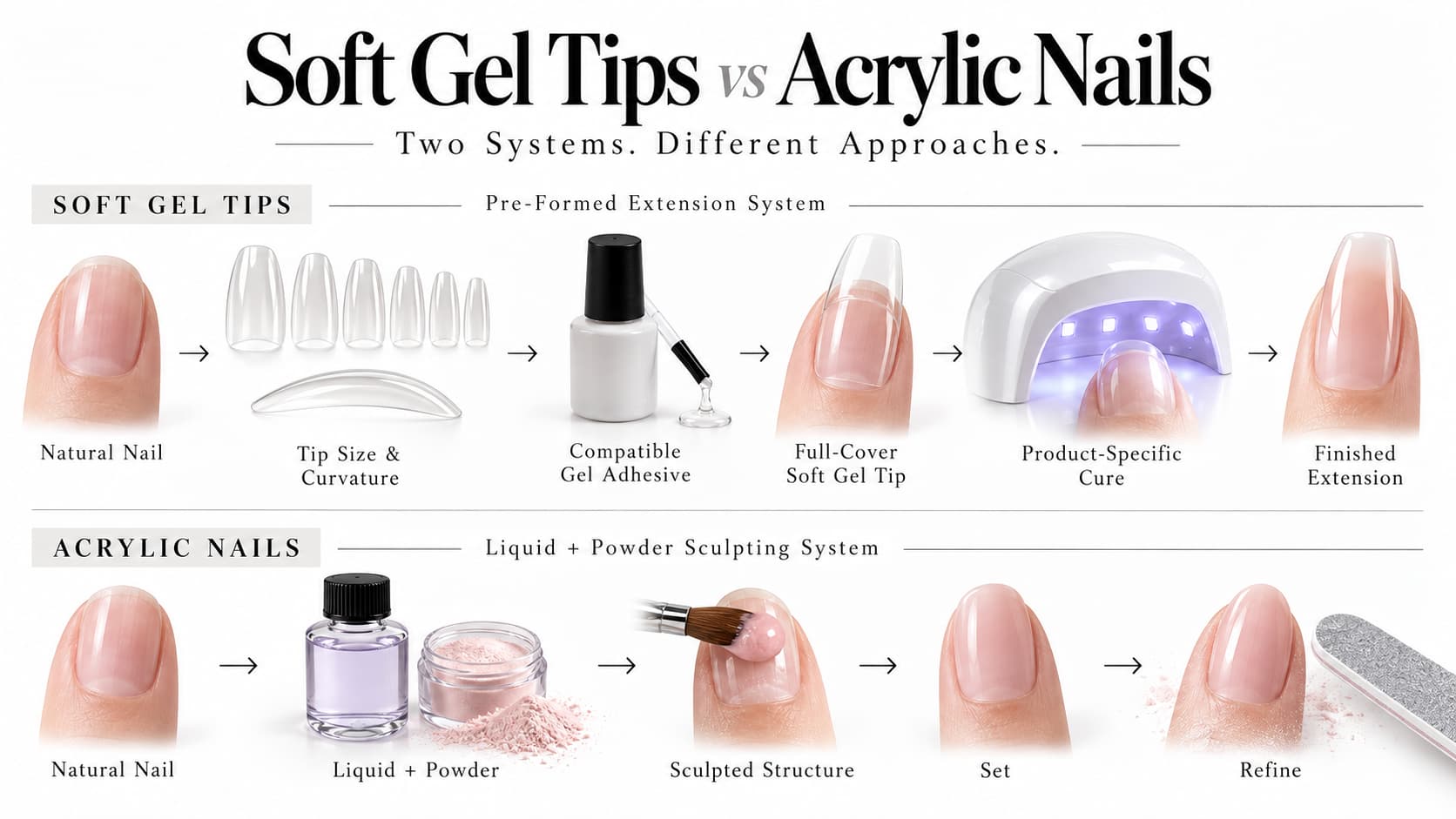
Prepare Natural Nail → Select Correct Tip Size & Curvature → Prepare Tip if Required → Apply Compatible Gel Adhesion System → Position Tip → Cure According to Product Instructions → Finish
This can reduce the amount of freehand sculpting needed for the initial extension shape.
Performance still depends on:
correct sizing;
nail-bed fit;
curvature;
cuticle-area fit;
adhesive distribution;
avoiding air gaps;
and complete curing.
Acrylic Extension System
Acrylic uses liquid monomer and polymer powder to create a workable bead that is shaped before it hardens.
Prepare Natural Nail → Apply Required Preparation / Adhesion Products → Create Extension Foundation if Needed → Build Acrylic Structure → Allow Product to Set → Refine Shape → Finish
This gives the technician substantial control over:
length;
apex;
sidewalls;
free edge;
shape;
and overall architecture.
Soft gel tips rely on accurate fit, compatible gel adhesion and product-specific curing, while acrylic extensions are built by sculpting liquid-and-powder material into the intended structure.
5. Flexibility, Structure & Feel: Which Is Better?
There is no universal winner. The appropriate system depends on the intended service.
Soft Gel Tips May Fit When:
a lightweight full-cover extension is preferred;
repeatable preformed shapes are useful;
the salon wants to reduce some sculpting steps;
multiple ready-made shapes and lengths are required;
a gel-based extension workflow suits the service menu.
The exact flexibility depends on tip material, thickness, curvature, length and adhesion system.
Acrylic May Fit When:
customized structure is important;
sculpted architecture is required;
the service needs unusual shapes or lengths;
nail architecture needs correction;
a rebalance/fill workflow is preferred.
Its final behavior depends on product formulation, product placement, extension length, apex construction and overall service design.
More flexible does not automatically mean better. The stronger question is whether the completed system provides the structure required for the intended length, shape and client use.
6. How Long Do Soft Gel Tips and Acrylic Nails Last?
There is no reliable universal wear period for every soft gel tip or acrylic service.
Wear depends on factors such as:
exact product system;
nail preparation;
natural nail condition;
extension length;
tip fit;
structural design;
application quality;
curing where applicable;
client activity;
maintenance;
and aftercare.
For soft gel tips, poor fit or incomplete adhesion can contribute to lifting, gaps, loss of retention or premature separation.
For acrylic, retention also depends on preparation, adhesion, product application, structure and maintenance.
Instead of relying on one advertised wear period, ask whether the intended service can be applied and maintained consistently using the exact product system.
7. Which Is Better for Natural Nails: Soft Gel Tips or Acrylic?
Neither category should automatically be described as damage-free or damaging.
Natural-nail condition is influenced by:
preparation;
application;
product compatibility;
maintenance;
lifting management;
removal;
and repeated service technique.
Soft Gel Tips
Some soft gel tip systems use components designed for soak-off or other defined removal procedures. Removal instructions depend on the exact tip and adhesive system.
Do not assume every soft gel tip uses the same removal process.
Acrylic
Acrylic maintenance or removal may involve reducing existing product, filing, acetone or a combination, depending on the product and service method.
Removal Technique Matters
Natural nails can be compromised when enhancements are:
peeled;
forced off;
over-filed;
improperly reduced;
or removed without following the intended procedure.
The useful comparison is not “Soft Gel = Safe / Acrylic = Damaging,” but which system can be prepared, maintained and removed correctly for the intended service.
8. Can You Put Acrylic Over Soft Gel Tips?
It may be technically possible to combine acrylic with some nail-tip systems, but applying acrylic over soft gel tips changes the product system and should not automatically be assumed to be necessary or compatible.
Before combining them, first define why acrylic is being added.
Possible reasons may include:
additional structure;
a design requirement;
repair;
reshaping;
or a specific salon technique.
What Should Be Checked First?
tip material;
prepared tip surface;
adhesion between systems;
required structural thickness;
differences in flexibility;
maintenance method;
and eventual removal.
A soft gel tip already forms part of a complete extension system. Adding acrylic simply because “more product means more strength” is not a reliable approach.
If products from different systems are combined, the combination should be tested as a complete service rather than assumed to be compatible.
9. Are Soft Gel Tips Better Than Acrylic Nails?
Soft gel tips can be better for some services, while acrylic can be better for others.
Soft Gel Tips May Be Better When:
a preformed full-cover extension is preferred;
consistent ready-made shapes are important;
the salon wants to reduce freehand sculpting;
standard shapes and lengths suit the menu;
a gel-based extension workflow is preferred.
Acrylic May Be Better When:
highly customized sculpting is required;
nail architecture needs more individual control;
unusual shapes or lengths are requested;
a rebalance/fill workflow is preferred;
the technician wants to build the structure from the beginning.
Nail Type → Desired Shape → Desired Length → Structural Requirement → Maintenance Preference → Removal Strategy
10. Which System Fits Different Salon Services?
Soft gel tips and acrylic do not have to compete for exactly the same service.
Soft Gel Tips Can Fit:
full-cover extension services;
standardized extension menus;
predefined shapes and lengths;
workflows using preformed structure;
nail-art services needing a consistent full-cover surface.
11. What Should Nail Brands & Private Label Buyers Compare?
For buyers, the main task is to determine whether the soft gel tip system fits the intended customer and service.
Evaluation Area
What to Review
Tip Format
Full-cover design and intended service
Shape Range
Target shapes such as almond, square, coffin or stiletto
Length Range
Short, medium, long or other intended lengths
Size Coverage
Fit across target nail-bed widths
Curvature
Suitability for flatter or more curved nails
Cuticle Area
Thickness, contour and fit
Apex / Structure
Preformed architecture and support
Free Edge
Thickness and structural behavior
Flexibility
Fit for the intended service
Surface Preparation
Pre-etched, matte or other preparation needs
Adhesive Compatibility
Compatible gel adhesion system
Curing Information
Exact instructions for the gel components
Removal
Complete tip-and-adhesive removal route
Packaging
Size organization, quantity and pack format
Documentation
Product instructions and relevant technical information
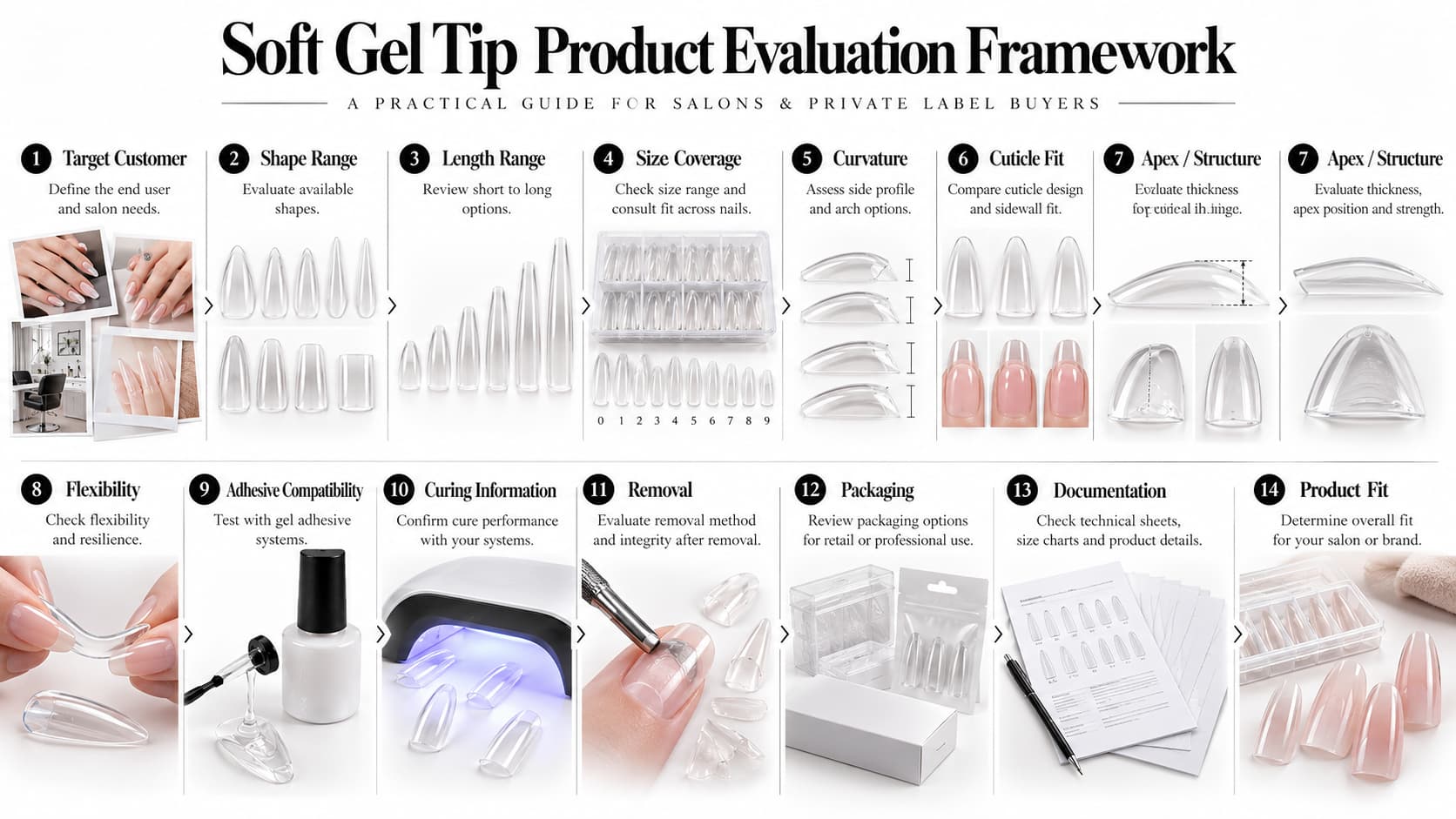
Define Target Customer → Select Shapes & Lengths → Evaluate Size Coverage → Test Nail-Bed Fit → Verify Adhesive Compatibility → Test Application & Curing → Review Removal → Review Packaging & Documentation → Approve the System
Soft gel tips should be evaluated as a complete extension system, including fit, size coverage, curvature, structural design, adhesive compatibility, curing information, removal, packaging and documentation.
12. Why Sample Testing Matters for Soft Gel Tips
Full-cover tips are highly dependent on fit.
A tip can look correct in product photography but perform poorly if its width, sidewall shape, cuticle contour, apex or curvature does not suit the target nail.
Test Different Nail Types
Use samples across different:
nail-bed widths;
curvatures;
lengths;
and shapes.
Check Size Coverage
Do not evaluate a commercial set only by the total number of tips.
A better question is: Does the size distribution cover the nail beds the product is intended to serve?
Test the Complete Adhesion System
Use the actual gel adhesion system planned for the product range.
Review:
positioning;
adhesive distribution;
air gaps;
curing access;
cuticle fit;
and edge stability.
Verify Removal
Test removal using the complete tip-and-adhesive system and the intended product procedure.
For commercial use, fit and repeatability matter more than one successful application.
Product Development
Planning a Soft Gel Tip Product Range?
For brands and private label buyers, a useful project brief should define more than “soft gel tips.”
Frequently Asked Questions About Soft Gel Tips vs Acrylic
What is the main difference between soft gel tips and acrylic nails?
Soft gel tips use a preformed full-cover tip with a compatible gel adhesion system. Acrylic nails are built from liquid monomer and polymer powder, allowing the technician to sculpt the extension structure during application.
Are soft gel tips the same as Gel-X?
Soft gel tips are the broader product category. Gel-X® is a branded full-cover soft gel extension system.
Are soft gel tips better than acrylic?
Not universally. Soft gel tips may be preferable when a preformed full-cover workflow is wanted, while acrylic may be preferable when highly customized sculpting and architecture are required.
Can you put acrylic over soft gel tips?
Some systems may technically be combined, but compatibility should not be assumed. Consider the purpose of combining them, tip material, adhesion, structural behavior, maintenance and removal before using the products together.
Do soft gel tips ruin natural nails?
The product category alone does not determine nail condition. Preparation, application, maintenance and removal technique all matter. Avoid peeling, forcing or over-filing enhancement products from the natural nail.
Are acrylic nails bad for natural nails?
Acrylic should not automatically be described as damaging. Natural-nail condition depends strongly on how the service is prepared, maintained and removed.
How long do soft gel tips last?
There is no universal wear period for every soft gel tip system. Retention depends on tip fit, adhesion system, preparation, curing, nail condition, length, client activity and maintenance.
How long do acrylic nails last?
Wear and maintenance depend on the exact acrylic system, structure, nail growth, application and client use. A universal wear period should not be applied to every acrylic service.
Do soft gel tips need a UV or LED lamp?
The light-curable gel components in a soft gel extension system require the curing conditions specified for those exact products. Follow the product instructions rather than using one universal curing time or wattage.
Can soft gel tips be filled like acrylic nails?
Maintenance depends on the specific soft gel tip system and salon method. Some services may be maintained or rebalanced in particular ways, while others are designed around removal and replacement.
Are soft gel tips more flexible than acrylic?
Many soft gel tip systems have some flexibility, while acrylic can create relatively rigid structures. Exact behavior depends on formulation, tip thickness, extension length and overall architecture.
Which is better for long nails?
It depends on the exact products, intended length, shape and structural requirements. Acrylic can provide extensive sculpting control for highly customized structures. Soft gel tips may also be available in longer shapes, but the selected tip and adhesion system must suit the intended service.
What should salons compare before adding soft gel tips?
Evaluate size range, nail-bed fit, curvature, available shapes, application workflow, adhesion system, curing information, maintenance and removal.
What should private label buyers test before approving soft gel tips?
Test the exact system through real applications and review fit, sizes, curvature, flexibility, cuticle contour, adhesion compatibility, curing, removal, packaging and product documentation.
Target Customer → Tip Architecture → Size Range → Adhesive System → Sample Testing → Packaging & Documentation → Product Approval
The most useful question is not “Are soft gel tips better than acrylic?” It is: Which extension system best fits the intended customer, service workflow, structure and maintenance plan?
Next Step
Choose the Next Step for Your Nail Extension Project
Continue with product education if you are still comparing extension systems. If you already have a defined product brief, move into product selection or brand development.
This article provides general product-category, application-system and buyer-evaluation information. Exact adhesion, curing, wear, maintenance and removal depend on the specific soft gel tip, adhesive, acrylic product and complete nail system being used.
Looking for a creative, premium, and reliable nail product manufacturer?
Whether you're an Amazon seller, Shopify store owner, chain store buyer, brand owner, distributor, wholesaler, or nail supply retailer — Hanyinails is your trusted partner for custom and wholesale nail solutions.
Address: 303 West Gate, Block A, South China International Innovation Industrial Park, Foluo Road, Luocun, Nanhai District, Foshan, Guangdong Province, China.
We specialize in OEM & ODM services, offering tailored formulations, vibrant colors, and premium packaging. Contact us today to discuss your brand’s needs and get a personalized quote!
We specialize in OEM & ODM services, offering tailored formulations, vibrant colors, and premium packaging. Contact us today to discuss your brand’s needs and get a personalized quote!
We specialize in OEM & ODM services, offering tailored formulations, vibrant colors, and premium packaging. Contact us today to discuss your brand’s needs and get a personalized quote!







Hanyinails
Hanyinails
Hanyinails
Hanyinails