HEMA-Free Gel Polish Ingredient Guide for Nail Professionals and Buyers
Wednesday, 08/6/2025
HEMA-free gel polish and methacrylate free gel polish formulas reduce allergic reactions and improve safety for nail professionals and buyers. Understand the HEMA-free meaning and key ingredient differences to choose safer, high-performance gel polish with confidence from Hanyinails.
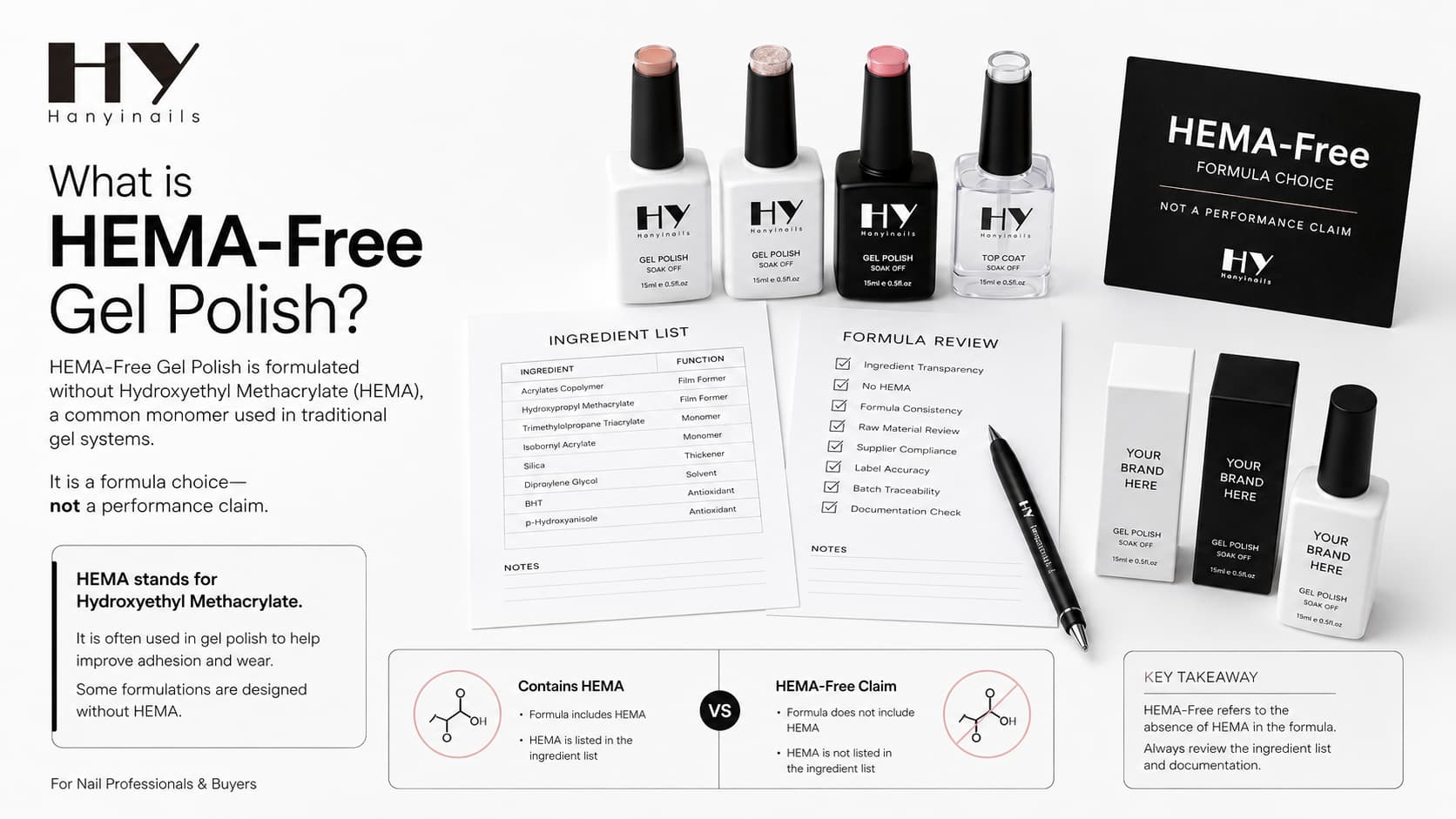
Yes, you can get HEMA-free gel polish, but HEMA-free does not automatically mean allergy-free, hypoallergenic, methacrylate-free, non-irritating, or suitable for every user. HEMA-free means the final formula does not include 2-hydroxyethyl methacrylate, if the claim is correctly supported by the product’s formula and documents.
HEMA-free should be read as a HEMA absence claim, not as an all-allergen, all-irritant, or all-methacrylate absence claim.
A HEMA-free gel polish may still contain other methacrylates or ingredients that require careful use, complete curing, skin contact precautions, SDS review, ingredient list confirmation, label review, and target market document checks. If someone has contact dermatitis, a known nail product allergy, or repeated irritation after nail products, they should not rely only on a HEMA-free label. The specific allergen, full formula, and product use should be reviewed with a qualified professional.
Key Takeaways
HEMA-free gel polish means the final formula should not contain HEMA, which stands for 2-hydroxyethyl methacrylate.
HEMA-free is not the same as methacrylate-free. A HEMA-free gel polish may still contain other methacrylates.
HEMA-free does not automatically mean allergy-free, hypoallergenic, non-irritating, or suitable for users with contact dermatitis.
Nail professionals should check ingredient information, SDS, curing instructions, lamp requirements, layer thickness, skin contact precautions, and product system compatibility.
Private label buyers should confirm the formula claim, SDS, ingredient list, label wording, product specification, approved sample, and target market requirements before production.
Claims such as HEMA-free, methacrylate-free, low-odor, vegan, cruelty-free, or professional use should be supported by suitable product documents before printing labels or publishing product pages.
What Does HEMA-Free Gel Polish Mean?
HEMA-free gel polish usually means that the formula does not contain HEMA, also known as 2-hydroxyethyl methacrylate. HEMA is a methacrylate ingredient that has been used in some nail gel systems and is often discussed in relation to adhesion, gel performance, professional use, skin contact, and contact dermatitis concerns.
However, HEMA-free should be understood as a formula-specific claim. It should not be treated as a broad safety promise.
HEMA-free gel polish means the final formula should not contain HEMA, but the claim should still be confirmed with formula and document review.
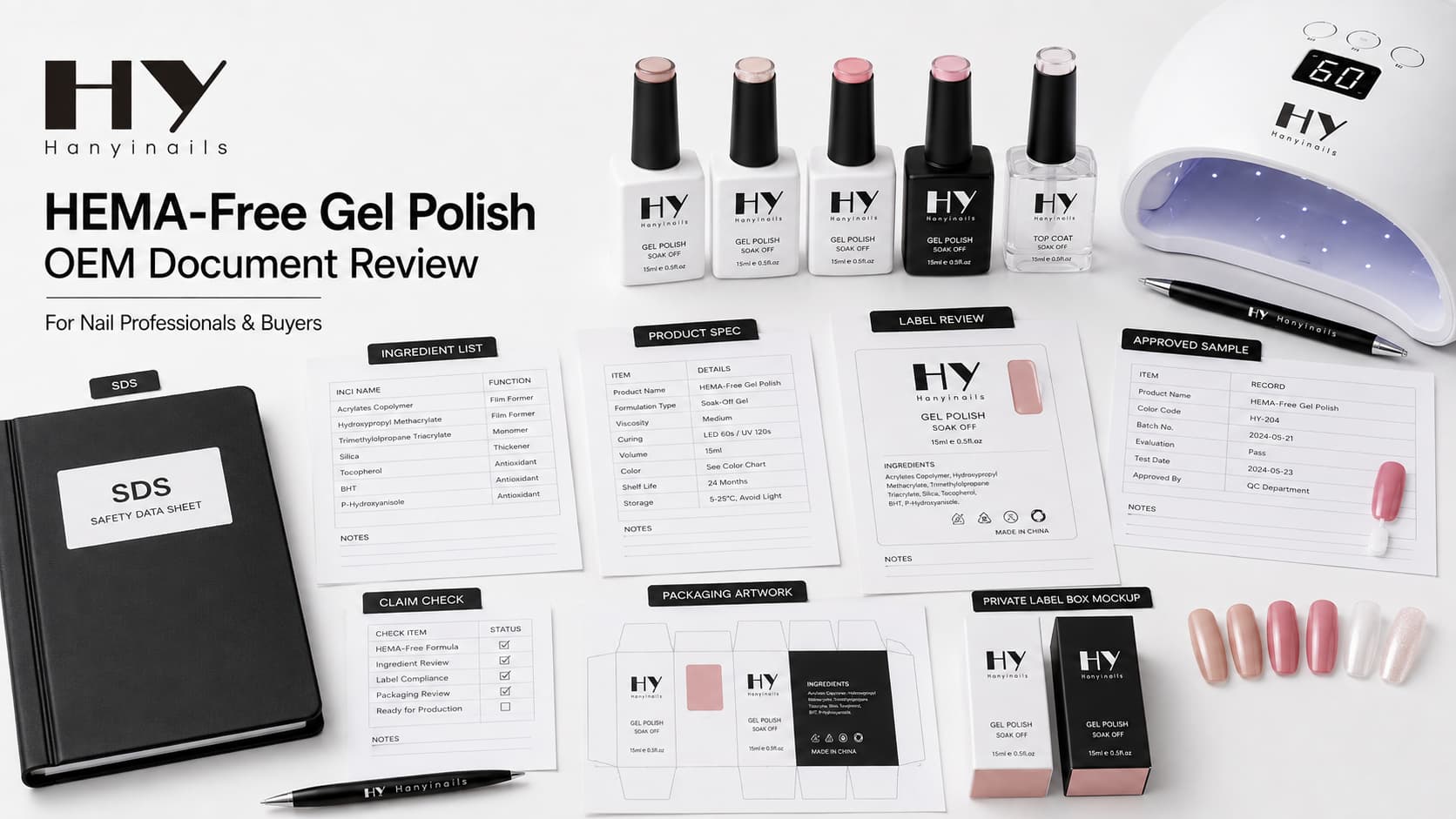
A product described as HEMA-free should be checked against:
The final approved formula
Ingredient information
SDS
Product specification sheet
Label wording
Packaging artwork
Approved sample record
Target market requirements
Any claim support provided by the supplier or brand owner
For nail professionals, HEMA-free may be one ingredient-related point to review before use. For private label buyers, it is a claim that should be confirmed before sampling, label printing, packaging production, bulk production, and product page publication.
Can You Get HEMA-Free Gel Polish?
Yes. HEMA-free gel polish is available in the nail product market, and many salons, distributors, private label buyers, and nail brands ask manufacturers about HEMA-free formula options.
Buyers may request HEMA-free gel polish for different reasons:
Ingredient positioning
Professional salon product planning
Private label product development
Retail product line expansion
Market-specific label review
Consumer question management
Product claim differentiation
OEM or ODM formula discussion
However, the phrase “HEMA-free” should be used carefully. A HEMA-free product is not automatically suitable for every user, and it may still contain other methacrylate ingredients. The correct approach is to confirm the final formula and supporting documents instead of relying only on product names or marketing text.
If a buyer wants to develop a HEMA-free gel polish line, the RFQ should clearly state:
Product type
Target market
Professional use or retail use positioning
HEMA-free claim requirement
Whether other methacrylate restrictions are requested
Desired product performance
Curing requirements
Packaging and label requirements
Document requirements
Sample testing plan
Does HEMA-Free Gel Polish Prevent Contact Dermatitis?
HEMA-free gel polish should not be described as preventing contact dermatitis.
Contact dermatitis can be linked to different ingredients, exposure conditions, skin contact, incomplete curing, repeated contact, individual sensitivity, or other product-use factors. If a person has contact dermatitis or a known allergy, the key question is not only whether the product is HEMA-free. The key question is which ingredient or group of ingredients is causing the reaction.
A HEMA-free product may reduce exposure to HEMA if the claim is accurate, but it does not automatically remove exposure to all methacrylates or all possible irritants or allergens.
Nail professionals and buyers should avoid claims such as:
Prevents contact dermatitis
Safe for contact dermatitis
Allergy-free
Hypoallergenic
Non-irritating
Suitable for sensitive skin
No allergy risk
Safer for everyone
Dermatologist-safe, unless properly supported
Medical-grade, unless properly supported
A more accurate statement is this: HEMA-free gel polish may be relevant for buyers who want to avoid HEMA in a formula, but product suitability still depends on the full ingredient list, curing performance, skin contact precautions, professional use, individual sensitivity, and claim support documents.
Can HEMA-Free Gel Polish Still Cause Contact Dermatitis?
Yes, it is possible for a HEMA-free gel polish to still be associated with contact dermatitis concerns.
HEMA is not the only ingredient that can be involved in nail product sensitivity discussions. Other methacrylates, acrylates, photoinitiators, pigments, solvents, fragrance components, or other formula ingredients may also require review. In addition, uncured or under-cured gel, product contact with the surrounding skin, incorrect lamp use, thick application layers, or unsuitable product systems may increase product performance and sensitivity concerns.
Nail professionals should review ingredient information, curing instructions, lamp type, layer thickness, product system, and skin contact precautions before use.
For this reason, HEMA-free should not be used as a shortcut for allergy-free.
If a client has a history of nail product reactions, a more cautious professional approach is not to guess based only on the label. The user should stop using the suspected product and consult a qualified healthcare or dermatology professional for appropriate evaluation. Nail professionals should follow salon policy, local requirements, and product instructions.
Private label buyers should also be careful. A product page, label, or catalog should not imply that HEMA-free gel polish is suitable for users with contact dermatitis unless suitable evidence and regulatory review support that exact claim.
HEMA-Free vs Methacrylate-Free Gel Polish
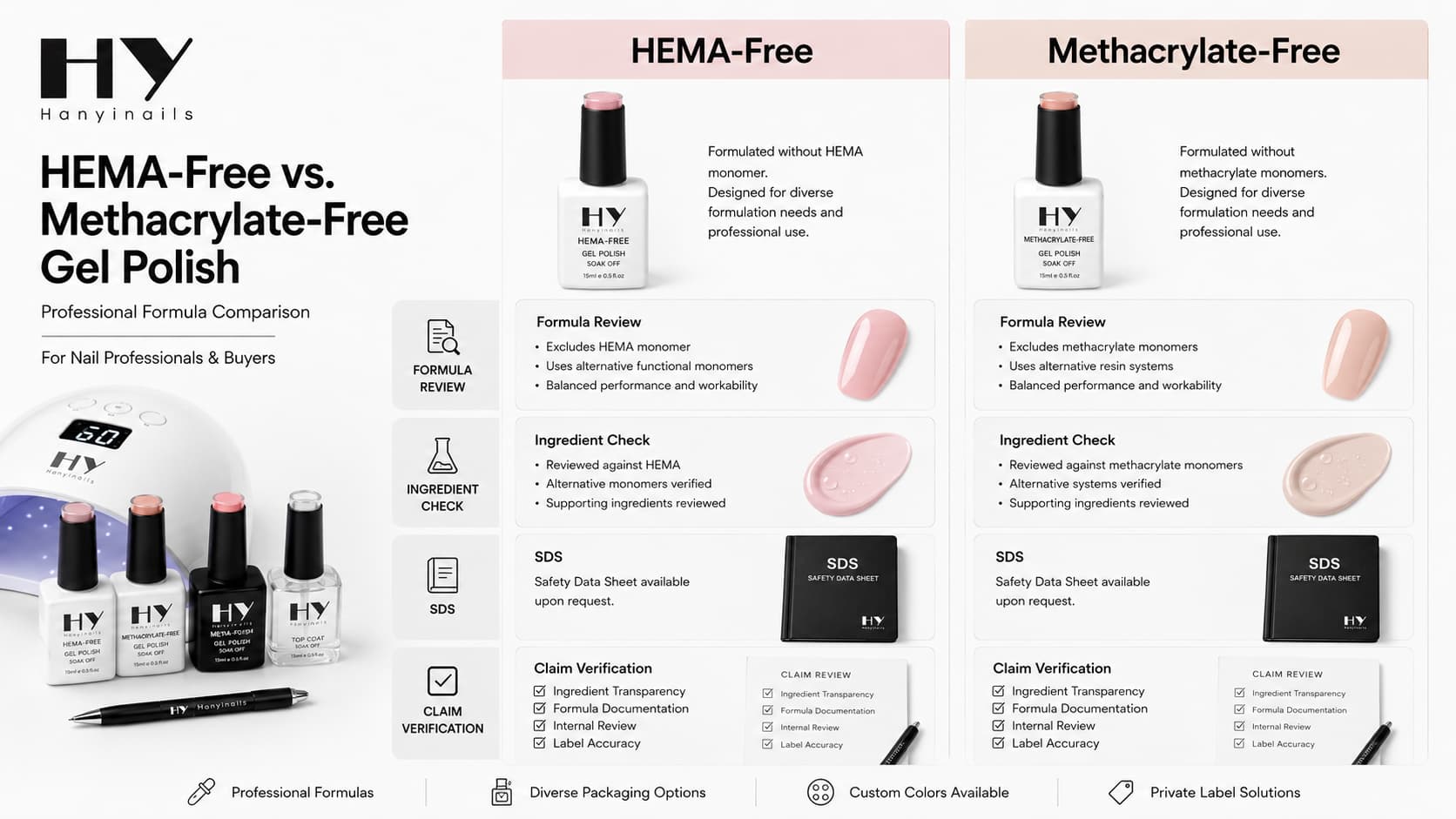
HEMA-free and methacrylate-free are not the same claim.
HEMA is one specific methacrylate ingredient. Methacrylate-free is a much broader claim and should only be used when the full formula and documents support it. Many gel polish systems rely on methacrylate chemistry, so buyers should be very careful before using “methacrylate-free” in product names, labels, or advertising.
HEMA-free and methacrylate-free are different claims and should be confirmed separately through the full formula and supporting documents.
Claim
What It Usually Means
What Buyers Should Confirm
HEMA-Free
The formula does not contain 2-hydroxyethyl methacrylate.
Confirm HEMA is not present in the final formula, SDS, ingredient information, and label claim documents.
HPMA-Free
The formula does not contain HPMA, usually 2-hydroxypropyl methacrylate.
Confirm the full ingredient name because abbreviations can vary by supplier or document.
Methacrylate-Free
The formula does not contain methacrylate ingredients.
Confirm the full formula carefully because this is a broad claim and may not apply to many gel systems.
Low-Odor
The product has a lower odor profile compared with a reference product or formula.
Confirm how the claim is defined and whether it is supported by testing or supplier documentation.
Hypoallergenic
A high-risk claim that should not be used casually.
Confirm whether the claim is legally allowed and supported by suitable evidence in the target market.
Suitable for Sensitive Skin
A high-risk claim because it relates to individual sensitivity.
Avoid unless supported by strong product, testing, and regulatory review.
For most B2B gel polish projects, it is more practical to request a specific claim such as HEMA-free and then review the full formula for other ingredients that may matter to the target market.
Common Alternative Ingredients Buyers May See
When buyers request HEMA-free gel polish, they may see other ingredient names in the formula, SDS, or product documents. These ingredients should not be automatically treated as safer. They should be reviewed as part of the full formula.
Common review points may include:
Other methacrylate monomers
Acrylate or methacrylate oligomers
Photoinitiators
Pigments
Solvents
Stabilizers
Plasticizers
Film-forming components
Additives affecting texture or leveling
Ingredients related to adhesion or flexibility
Ingredients linked to color effects or glitter effects
Buyers should avoid simple substitutions in marketing language. For example, a product should not be described as allergy-free just because HEMA has been removed. A HEMA-free formula may still need careful curing, correct application, skin contact precautions, and document review.
For a deeper comparison between HEMA and HPMA, buyers can review the HEMA vs HPMA ingredient guide.
What Nail Professionals Should Check Before Use
Nail professionals should treat HEMA-free as one part of product review, not a complete safety evaluation. Before using HEMA-free gel polish, they should review product information, application requirements, curing instructions, and client suitability based on salon policy.
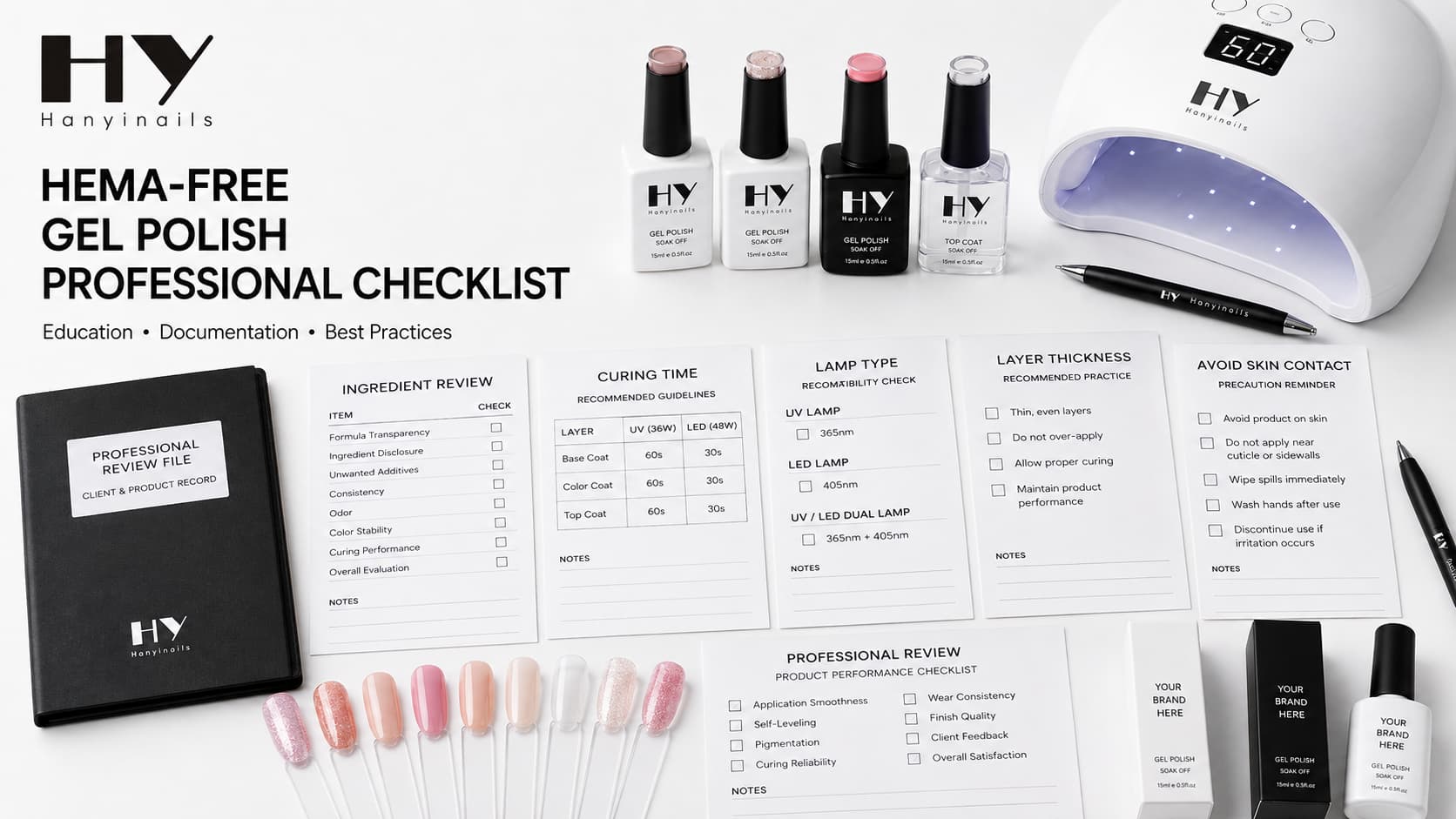
Before use, nail professionals should check:
Product type
Whether the product is HEMA-free
Whether other methacrylates are present
Ingredient list, if available
SDS or safety information, if available
Professional use or retail use labeling
Required UV/LED lamp type
Curing time
Recommended layer thickness
Base coat and top coat compatibility
Whether skin contact should be avoided
Removal instructions
Storage instructions
Whether the client has a known nail product reaction history
Local professional practice requirements
Application technique matters. Nail professionals should avoid flooding the cuticle or surrounding skin, should follow curing instructions, and should use products within the recommended product system.
If irritation, discomfort, redness, itching, swelling, blistering, or repeated sensitivity concerns appear, product use should stop and the affected person should seek suitable professional advice.
What Private Label Buyers Should Confirm Before OEM Production
Private label buyers should not approve a HEMA-free gel polish project based only on the product name. The claim should be confirmed before sample approval, label design, packaging printing, product photography, marketplace listing, and bulk production.
Before OEM production, buyers should confirm:
Product type
Target country or sales market
Professional use or retail use positioning
Whether HEMA is absent from the final formula
Whether HPMA or other methacrylates are present
Whether the buyer needs HEMA-free only or broader methacrylate restrictions
Ingredient information
SDS
Product specification sheet
Formula claim confirmation
Product claim wording
Curing requirements
Lamp compatibility
Sample testing plan
Label warning text
Packaging artwork
Color number list
Approved sample record
Batch consistency requirements
Test reports, if required
CPNP-related documents for EU projects, if applicable
Responsible person or importer requirements, if applicable
The buyer should also define who is responsible for final market compliance. A manufacturer may provide product documents, but the brand owner, importer, distributor, seller, or responsible person may still have target market obligations.
HEMA-Free Claims: What Documents Should Support Them?
A HEMA-free claim should be supported by documents that match the final product. It is not enough to use “HEMA-free” in a product title if the formula, SDS, ingredient information, and label files do not support the same claim.
HEMA-free claims should match the ingredient list, SDS, product specification, label wording, packaging artwork, and approved sample records.
For HEMA-free gel polish, buyers should request and review:
Document or File
Why It Matters
Ingredient Information
Confirms which ingredients are present in the formula.
SDS
Helps buyers review safety and handling information.
Product Specification Sheet
Records product type, appearance, viscosity, curing, packaging, and other specifications.
Formula Claim Confirmation
Supports claims such as HEMA-free, HPMA-free, or other ingredient-related statements.
Label File
Confirms whether the label text matches the product claim and target market requirements.
Packaging Artwork
Helps prevent unsupported claims from being printed on boxes or kits.
Approved Sample Record
Connects the claim to the tested and approved sample.
Color Number List
Helps manage SKU-level consistency across a product line.
Test Reports, If Required
May be needed depending on market, product type, claim, or buyer policy.
CPNP-Related Documents, If Applicable
May be relevant for EU cosmetic product projects.
Claims should be reviewed before labels, outer boxes, product pages, color charts, catalogs, marketplace listings, or advertising materials are finalized.
For broader OEM claim planning, buyers can also review the TPO-Free and HEMA-Free Gel Polish OEM Guide.
Sample Testing and Curing Checks for HEMA-Free Gel Polish
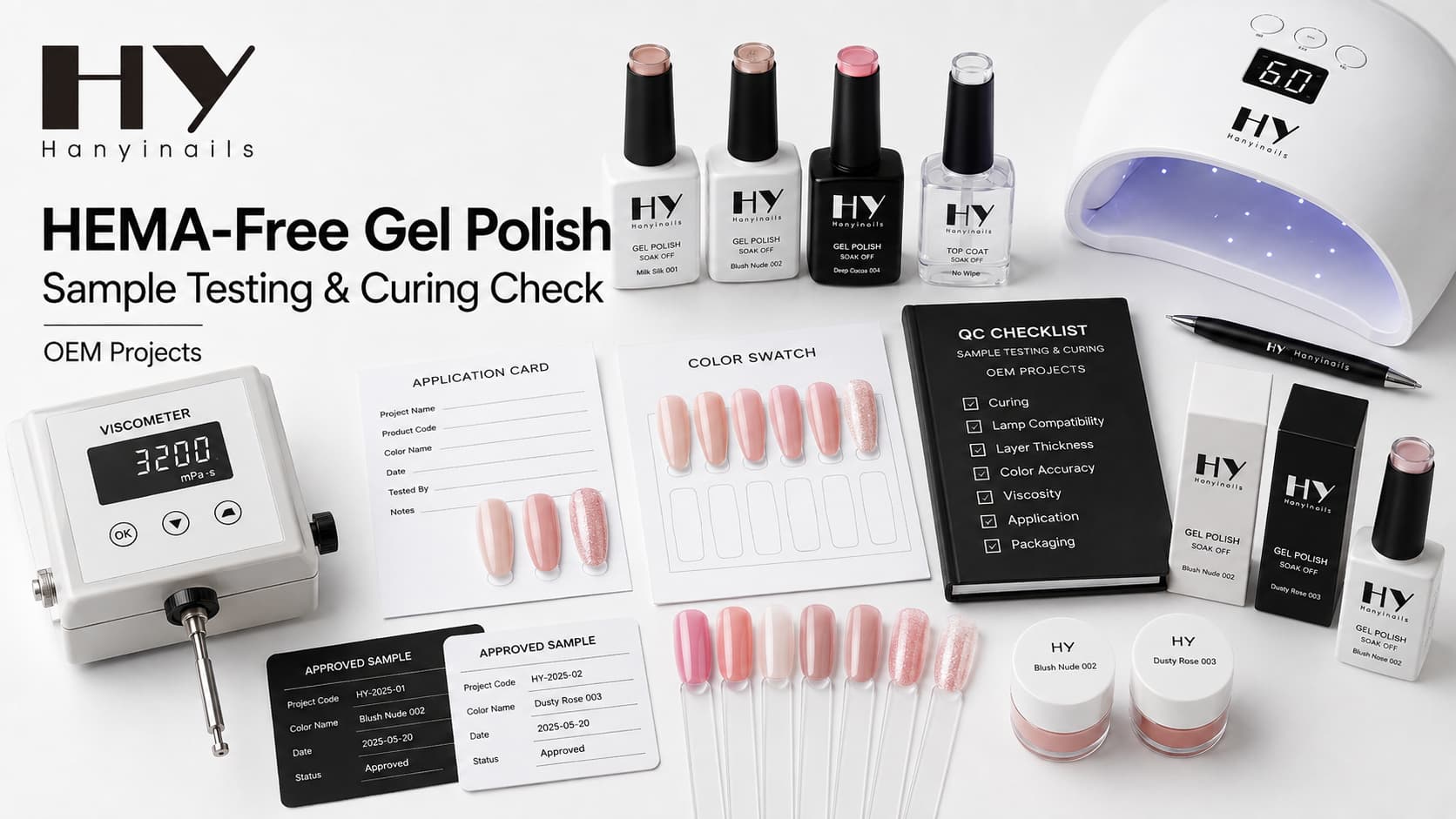
A HEMA-free claim does not replace sample testing. Gel polish still needs to be checked for curing performance, color accuracy, viscosity, application, finish, adhesion, removal, packaging, and batch consistency.
HEMA-free gel polish samples should still be checked for curing performance, lamp compatibility, layer thickness, color accuracy, viscosity, application, and packaging consistency.
Testing Area
What to Check
Curing Performance
Whether the gel cures properly under the intended UV/LED lamp conditions.
Layer Thickness
Whether the product cures as expected when applied at the recommended thickness.
Lamp Compatibility
Whether the product is tested with the recommended lamp type and curing time.
Color Accuracy
Whether the sample matches the approved color, color chart, or reference shade.
Viscosity
Whether the texture fits the intended use and product positioning.
Application
Whether the product applies smoothly and evenly.
Finish
Whether the final appearance matches the expected glossy, matte, jelly, shimmer, glitter, or cat eye effect.
Adhesion
Whether the product works with the recommended base and top coat system.
Soak-Off or Removal
Whether removal performance fits the intended use case, if applicable.
Odor Expectations
Whether odor expectations are discussed, if relevant to the project.
Packaging Accuracy
Whether bottles, caps, labels, boxes, and color numbers match the approved plan.
Batch Consistency
Whether production can be checked against approved samples and color standards.
Buyers should not use one sample result to make broad claims across every formula, shade, effect, or future batch. Testing should be product-specific.
How Hanyinails Supports HEMA-Free Gel Polish OEM Discussions
Hanyinails is a professional nail products manufacturer focused on professional nail gel items. The company supports OEM customization and one-stop customization for nail brands, salons, distributors, wholesalers, retailers, and beauty businesses.
For HEMA-free gel polish OEM discussions, buyers can share product type, target market, formula expectations, claim requirements, packaging plans, sample testing needs, and documentation needs during RFQ communication.
Verified Hanyinails manufacturing and customization capabilities include:
12 years of OEM customization experience
10 production lines
60 production machines
8 QA/QC inspectors
8000㎡ workshop
2000 new colors per year
More than 50 styles of stock bottles and caps
More than 600 styles of customized bottles and caps
More than 100 different styles of kit boxes
More than 200 styles of color chart design
Participation in exhibitions in more than 10 countries every year
Buyers planning private label packaging can review the Create Your Brand page.
Buyers reviewing documentation can review the Certifications page.
For larger or ongoing production needs, buyers can review the Contract Manufacturing page.
Discuss a HEMA-Free Gel Polish or Private Label Nail Gel Project
Share your product type, target market, HEMA-free claim requirements, formula expectations, packaging needs, sample testing plan, document needs, and launch schedule with Hanyinails for project-specific discussion.
Common Mistakes When Discussing HEMA-Free Gel Polish
Mistake 1: Treating HEMA-Free as Allergy-Free
HEMA-free does not automatically mean allergy-free, hypoallergenic, non-irritating, or suitable for every user. A HEMA-free formula may still contain other ingredients that require review.
Mistake 2: Confusing HEMA-Free With Methacrylate-Free
HEMA is one specific methacrylate. HEMA-free does not automatically mean the product is free from all methacrylates.
HEMA-free gel polish should not be marketed as preventing contact dermatitis. Contact dermatitis concerns require ingredient-specific and user-specific review.
Mistake 4: Ignoring Other Ingredients
Other methacrylates, acrylates, photoinitiators, pigments, solvents, or additives may also matter. Buyers should review the full formula instead of focusing only on HEMA.
Mistake 5: Printing Claims Before Document Review
Labels, boxes, color charts, product pages, and marketplace listings should not use HEMA-free, methacrylate-free, hypoallergenic, low-odor, vegan, cruelty-free, or professional-use claims before documents are reviewed.
Mistake 6: Ignoring Curing and Skin Contact
Correct curing, recommended layer thickness, proper lamp use, and avoiding skin contact are important for professional nail gel use.
Mistake 7: Assuming One Product Fits Every Market
Different markets may have different cosmetic product requirements, label rules, professional-use warnings, importer responsibilities, and claim expectations. Buyers should confirm the target market before launch.
FAQ: HEMA-Free Gel Polish
Can you get HEMA-free gel polish?
Yes, HEMA-free gel polish is available. However, HEMA-free means the formula does not contain HEMA if the claim is correctly supported. It does not automatically mean allergy-free, hypoallergenic, methacrylate-free, or suitable for every user.
What does HEMA-free gel polish mean?
HEMA-free gel polish means the formula should not contain HEMA, also known as 2-hydroxyethyl methacrylate. Buyers should confirm the claim with ingredient information, SDS, product specifications, label files, and formula claim documents.
Does HEMA-free gel prevent contact dermatitis?
HEMA-free gel polish should not be described as preventing contact dermatitis. It may reduce exposure to HEMA if the claim is accurate, but contact dermatitis can involve other ingredients, skin contact, incomplete curing, or individual sensitivity.
Can you use HEMA-free gel with contact dermatitis?
A person with contact dermatitis or a known nail product allergy should not rely only on a HEMA-free label. They should stop using suspected products and consult a qualified healthcare or dermatology professional for appropriate evaluation.
Can you get contact dermatitis from HEMA-free gel polish?
Yes, it is possible. A HEMA-free gel polish may still contain other methacrylates or ingredients that require review. Skin contact, curing issues, and individual sensitivity may also matter.
Is HEMA-free gel polish safe for contact dermatitis?
This should not be answered with a simple yes. HEMA-free does not automatically mean suitable for contact dermatitis. The specific allergen, full formula, SDS, curing process, and professional advice should be considered.
Is HEMA-free gel polish the same as methacrylate-free gel polish?
No. HEMA-free means HEMA is not present in the formula. Methacrylate-free is a broader claim and should only be used if the full formula supports it.
Is HEMA-free gel polish hypoallergenic?
HEMA-free gel polish should not automatically be called hypoallergenic. Hypoallergenic is a high-risk claim and should only be used when suitable evidence and target market review support it.
What documents should buyers check for HEMA-free gel polish?
Buyers should check ingredient information, SDS, product specifications, formula claim confirmation, label files, packaging artwork, approved sample records, test reports if required, and target market documents.
What should nail professionals check before using HEMA-free gel polish?
Nail professionals should check ingredient information, SDS if available, curing instructions, lamp type, layer thickness, base and top coat compatibility, skin contact precautions, removal instructions, and client reaction history according to salon policy.
Cre8tion Roses Are Red Gel Polish Collection - 36 Classic Shades | HEMA/TPO-Free & Long-Lasting
🔑 Key Features:
🌹 36 Romantic Red Shades – From soft rose to deep crimson for timeless nail art ⏱️ 60-90s UV/LED Cure – Fast-setting formula for efficient application ✨ 28+ Days Long-Lasting – Resists chipping, peeling, and color fading 🌿 HEMA/TPO-Free & Low Odor – Breathable formula safe for sensitive nails 🎨 High Gloss & Even Coverage – Professional salon-quality finish in every shade 🏭 OEM/ODM Ready – Custom colors, packaging, and private branding available
Looking for a creative, premium, and reliable nail product manufacturer?
Whether you're an Amazon seller, Shopify store owner, chain store buyer, brand owner, distributor, wholesaler, or nail supply retailer — Hanyinails is your trusted partner for custom and wholesale nail solutions.
Address: 303 West Gate, Block A, South China International Innovation Industrial Park, Foluo Road, Luocun, Nanhai District, Foshan, Guangdong Province, China.
We specialize in OEM & ODM services, offering tailored formulations, vibrant colors, and premium packaging. Contact us today to discuss your brand’s needs and get a personalized quote!
We specialize in OEM & ODM services, offering tailored formulations, vibrant colors, and premium packaging. Contact us today to discuss your brand’s needs and get a personalized quote!
We specialize in OEM & ODM services, offering tailored formulations, vibrant colors, and premium packaging. Contact us today to discuss your brand’s needs and get a personalized quote!





Hanyinails
Hanyinails
Hanyinails
Hanyinails