Wholesale Gel Nail Polish: How to Choose the Best Supplier for Your Business
Thursday, 06/26/2025
The demand for gel nail polish continues to grow across salons, nail boutiques, and online retailers. If you’re looking to expand your nail product offerings or launch a private label brand, sourcing high-quality wholesale gel nail polish is key to your success. In this guide, we’ll explore the benefits of buying gel polish in bulk, what to look for in a reliable supplier, and how to differentiate your brand with custom options.
Wholesale gel polish purchasing is not only about finding a lower bottle price. Buyers must decide which product categories to stock, how many colors to launch, how quantities should be divided across SKUs, how samples will be approved, and how reorders will be managed without creating slow-moving inventory.
Quick Answer
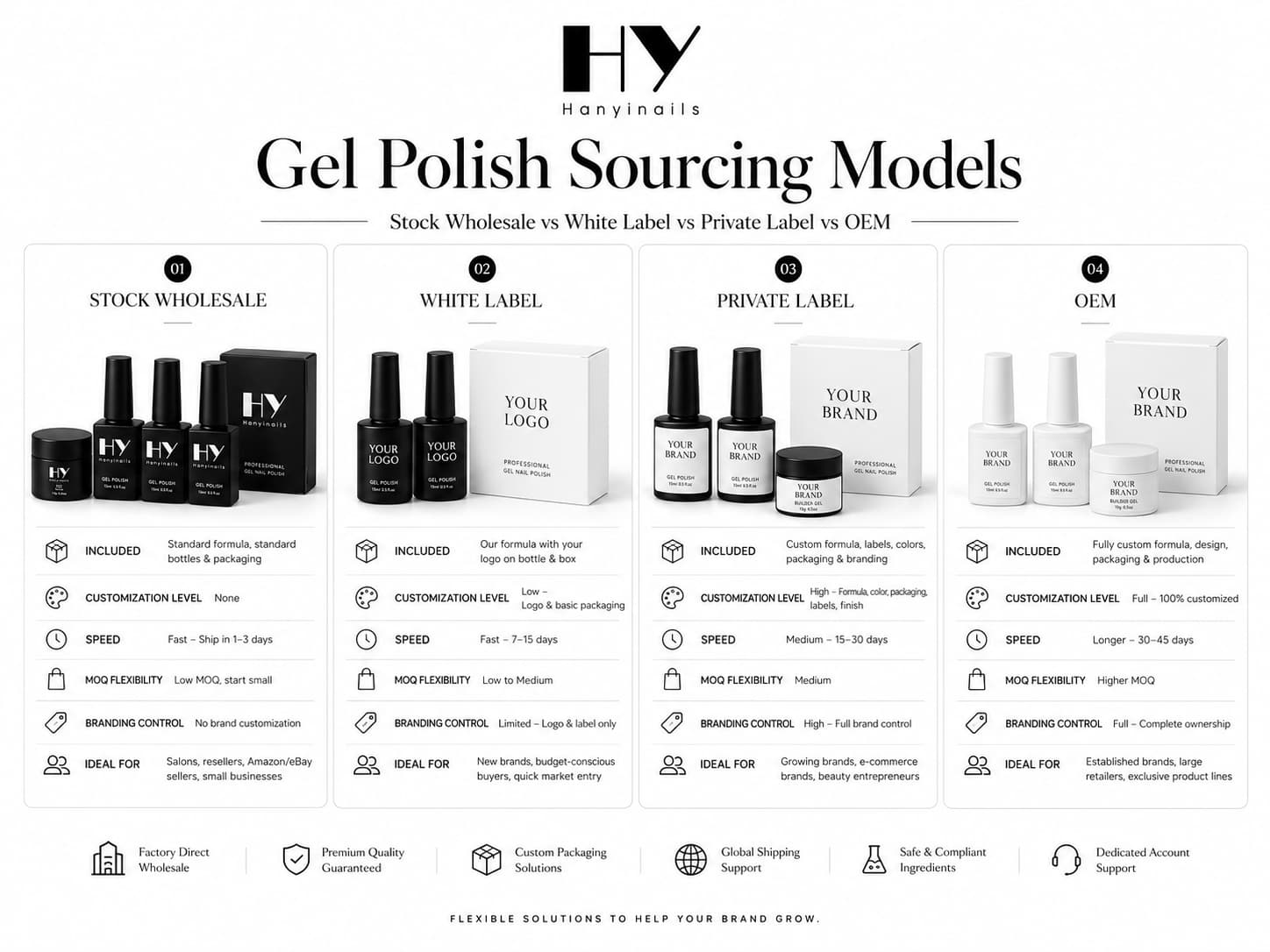
Stock wholesale, white label, private label and OEM development are different sourcing models with different customization, MOQ, approval and lead-time implications. The right route depends on the buyer type, sales channel, available inventory budget and the level of brand differentiation required.
A strong wholesale purchasing plan should cover product mix, color planning, component-level MOQ, sample approval, total landed cost, trial-order design, inventory turnover, safety stock and reorder timing.
Key Takeaways
Wholesale purchasing involves a trade-off between unit cost and inventory risk.
Too many launch SKUs can create slow-moving stock, especially before real sales data is available.
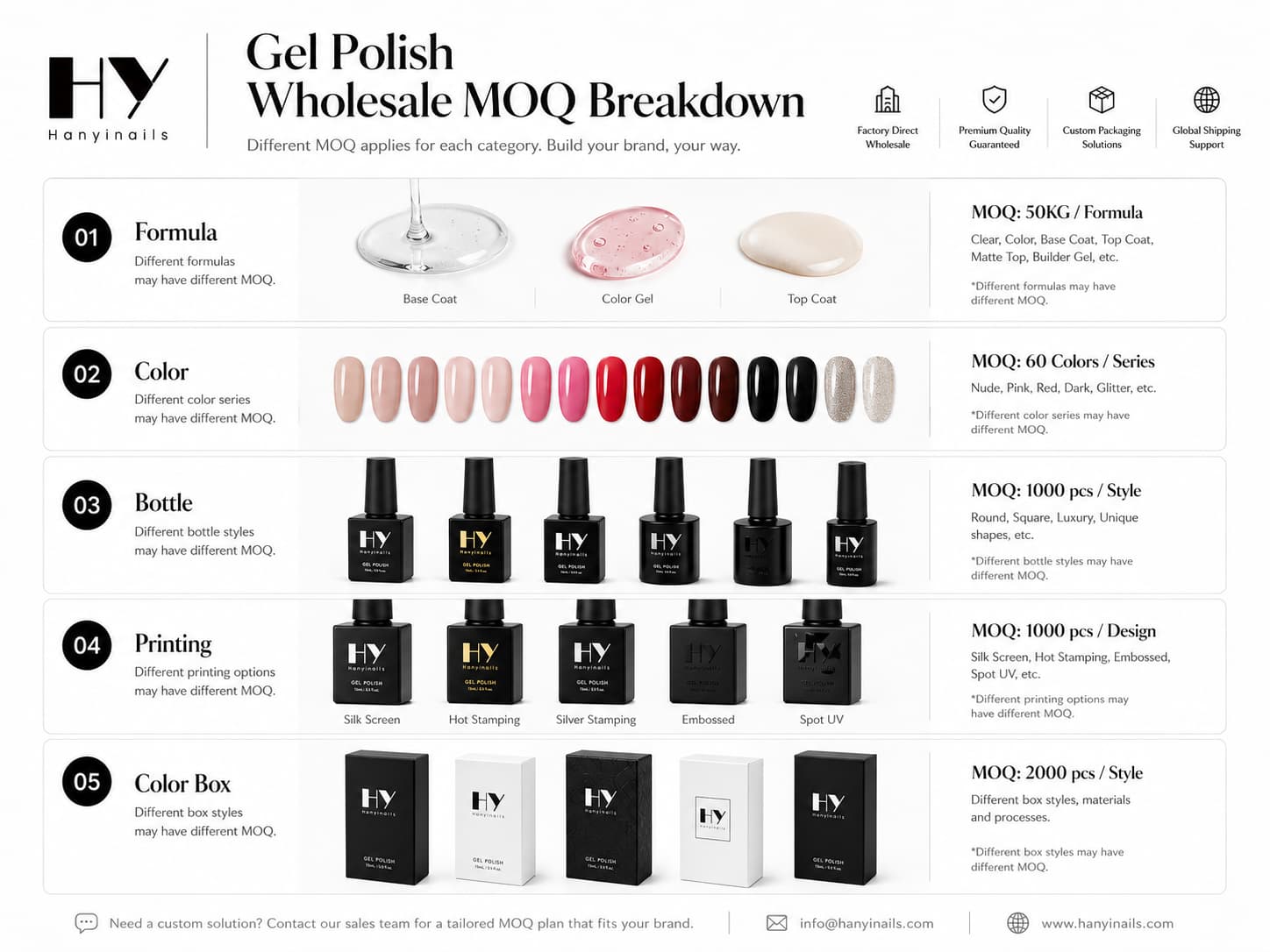
MOQ may involve several separate minimums when formula, color, bottle, printing or box customization is included.
Samples should be tested within the intended base, color, top and lamp system.
Total landed and commercial cost matters more than bottle price alone.
Reorder timing should include production, packaging, shipping, customs and an appropriate safety-stock allowance.
Choose the Right Wholesale Model
The terms wholesale, white label, private label and OEM are not used consistently by every supplier. Confirm the permitted product changes, formula ownership, artwork ownership, exclusivity, validation responsibilities and production scope in the quotation or agreement.
Sourcing Model
Best For
Advantages
Main Limitations
Stock wholesale
Salons, retailers and distributors
Faster route to market and generally lower customization requirements
Limited branding, packaging and formula changes
White label
New brands and controlled market tests
Often uses an existing product with limited branding changes
Limited product differentiation and possible shared base products
Private label
Brands, chains and established retailers
May include broader branding, packaging and product-selection customization
More approvals, packaging minimums and longer preparation time
OEM development
Brands with a detailed product brief
May involve manufacturing to a more detailed buyer specification
More development, testing, validation, time and MOQ commitments
For factory vetting, documentation, defect handling and supplier scoring, see the Private Label Gel Polish Manufacturer Buyer Checklist. This page focuses on what to buy, how much to order and how to manage inventory after delivery.
Define Your Buyer Type and Sales Channel
Salons and Salon Chains
Prioritize product-system compatibility, dependable core colors, reorder speed, technician usability and consistent supply across one or multiple locations.
A wholesale order is usually easier to manage when the assortment is built in layers rather than selected only from current trends.
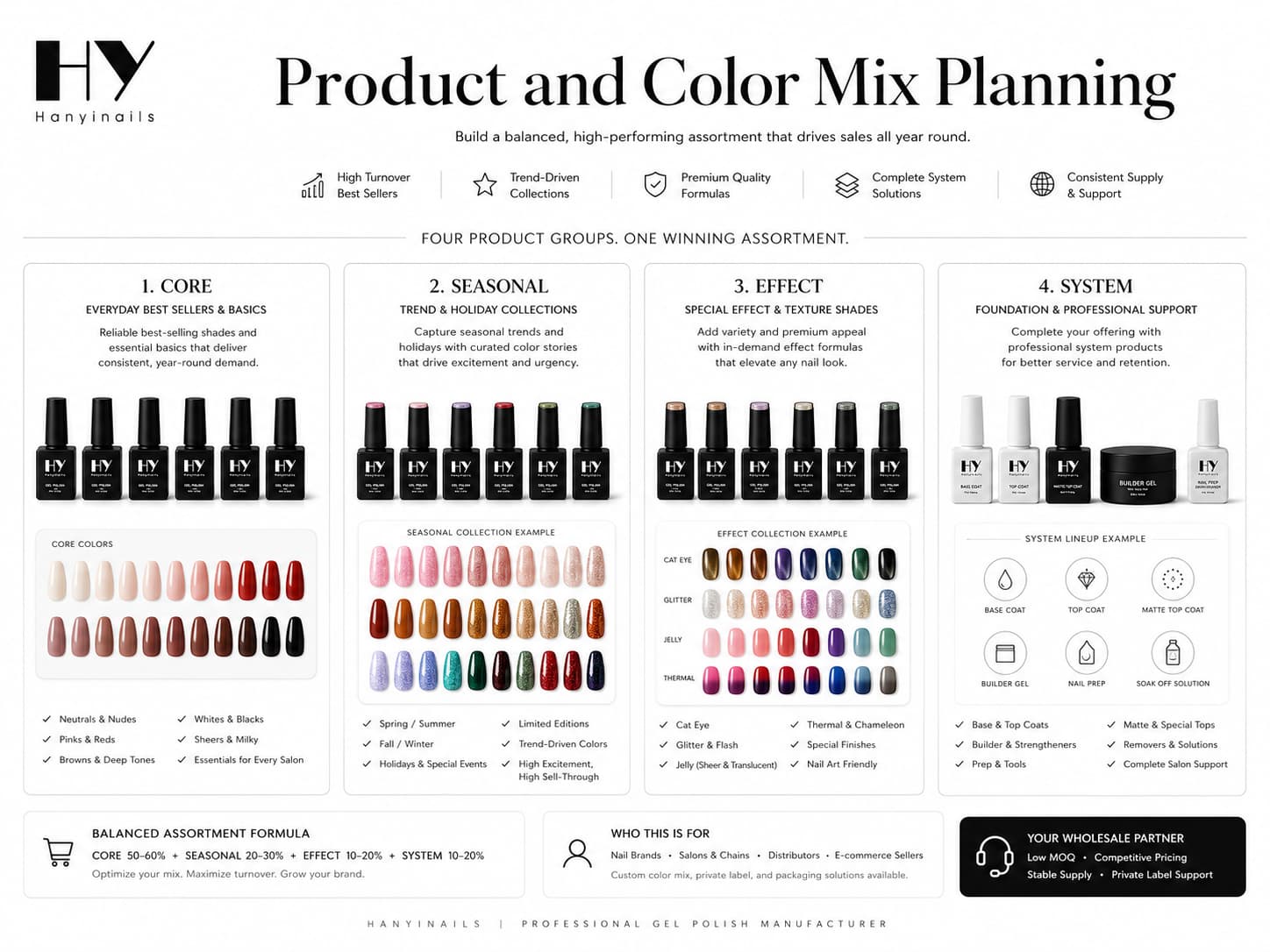
Core colors: Reds, nudes, pinks, whites, blacks and French shades that can support steady, repeatable sales.
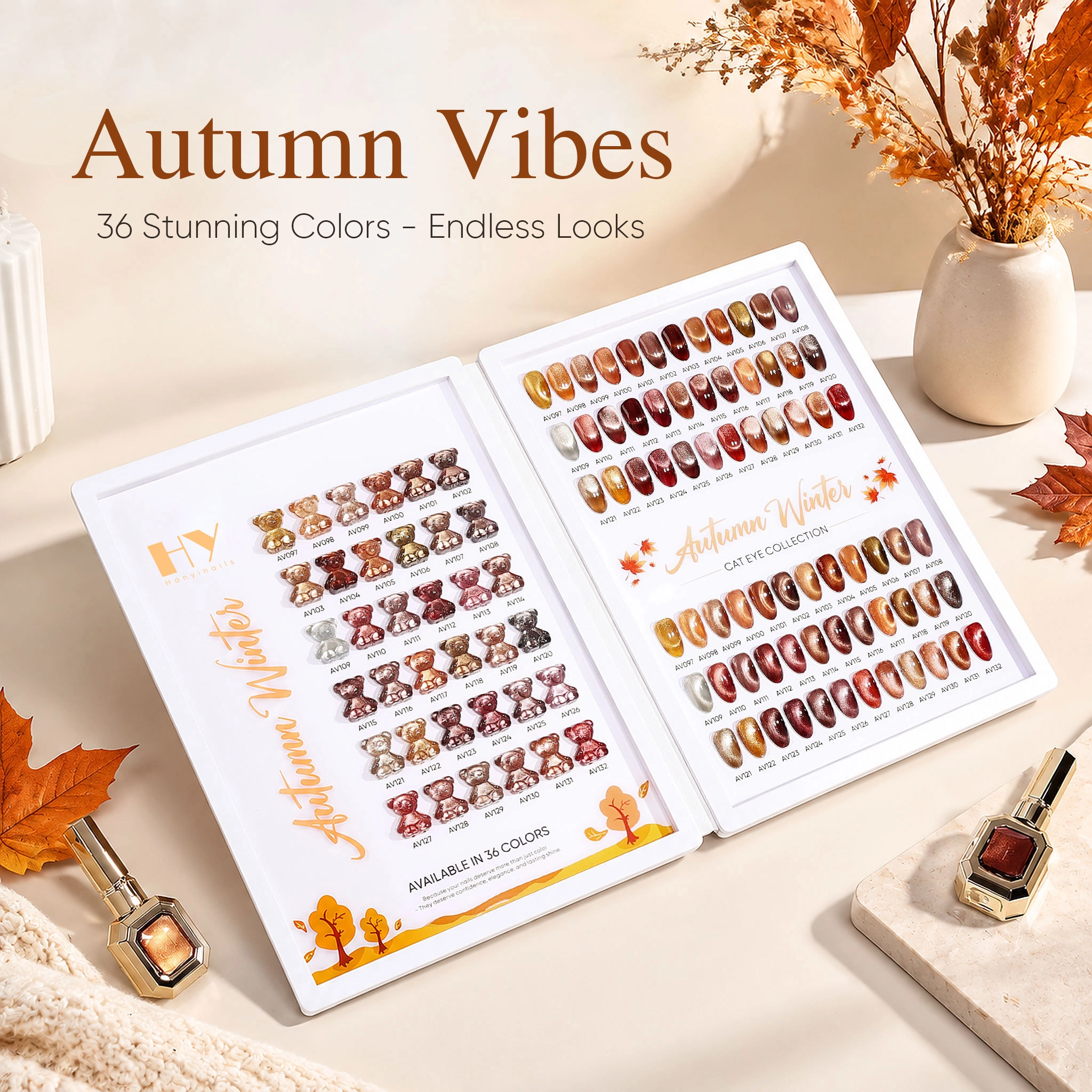
Seasonal colors: Spring pastels, summer brights, autumn earth tones and winter metallics used to refresh the range.
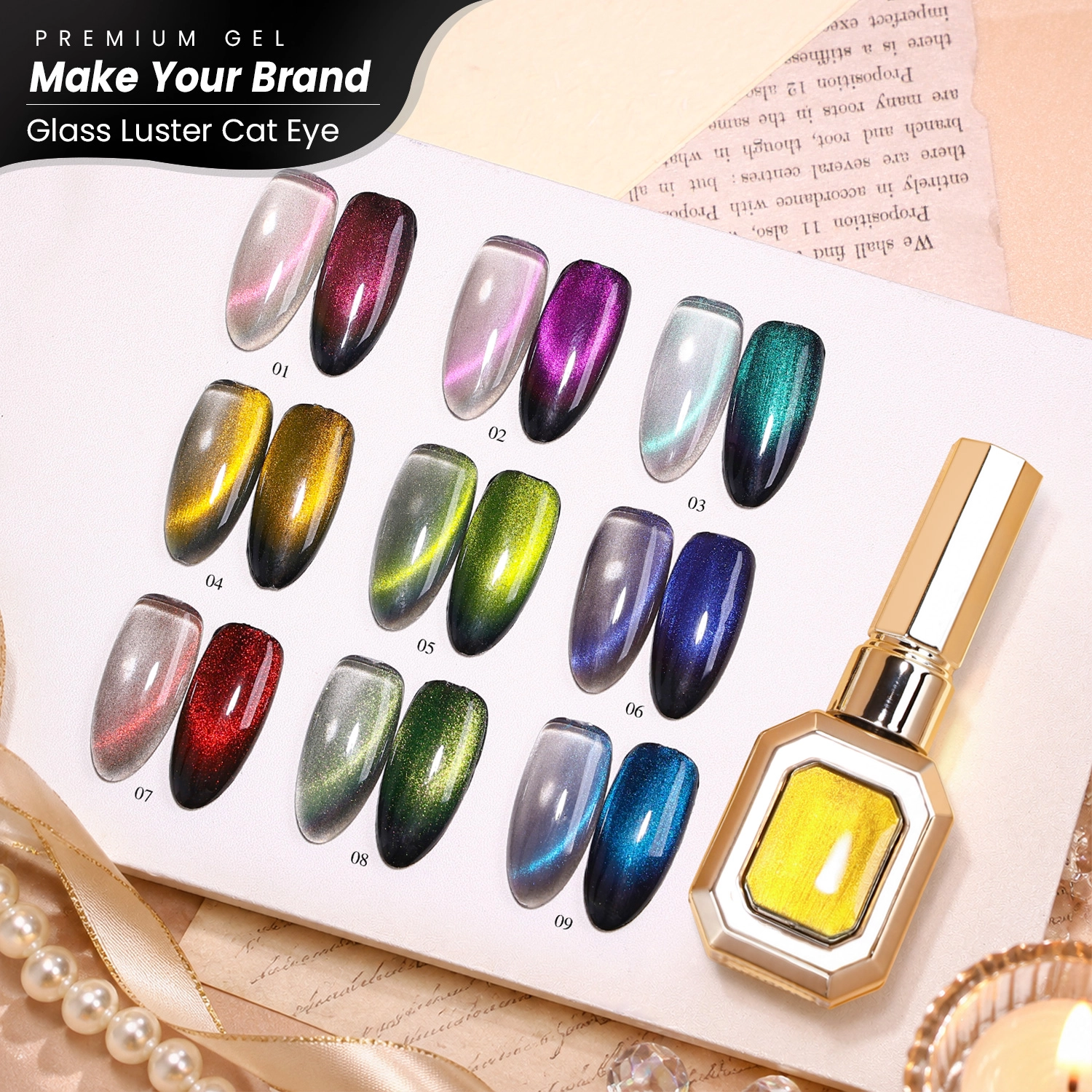
Effect products: Cat eye, glitter, jelly, pearl, chrome-compatible gels and specialty art products used for differentiation.
System products: Base coat, top coat, matte top, rubber base and builder base used to complete the product system and encourage repeat purchasing.
Kits and sets: Products grouped by season, effect, color story or complete application system.
Test SKUs: New formulas, effects or colors introduced in controlled quantities before a wider rollout.
Plan SKU Quantity and Inventory
Product Tier
Role
First-Order Logic
Core colors
Steady, long-term sales
Allocate a larger share of the first-order budget after reviewing channel data, preorders, salon usage or trial results
Trend colors
Capture seasonal demand
Use smaller quantities to validate actual sell-through
Effect gels
Product differentiation
Match the quantity and effect type to the intended sales channel
Base and top systems
Support complete applications and repeat purchases
Plan quantities alongside expected color-product usage
Kits and sets
Increase order value and simplify selection
Bundle products by season, effect or application system
Test SKUs
Validate new formulas, colors or effects
Keep quantities limited until demand and product performance are confirmed
Rather than following one fixed quantity per SKU, use available sales history, channel count, salon locations, expected monthly turnover, reorder cycle, inventory budget and the percentage of the assortment reserved for new-product testing.
Understand MOQ
MOQ may be set by total order value, total units, formula, individual color, bottle, printing, box or another project component. More customized projects commonly involve several separate minimums.
MOQ Item
What to Confirm
Total-order MOQ
Whether the minimum is based on total units, cartons or order value
Formula MOQ
Minimum total volume required for one formula
Color MOQ
Minimum quantity for each individual color
Bottle MOQ
Difference between stock-bottle and custom-bottle requirements
Printing MOQ
Minimum quantities for labels, silkscreen, hot stamping or other print methods
Box MOQ
Minimum quantity for individual cartons, collection boxes or kits
Reorder MOQ
Whether future reorder minimums differ from the first order
Mixed-color MOQ
Whether multiple colors can be combined to meet a total minimum
Packaging stock
How unused bottles, labels or boxes are stored, charged or handled
Calculate Total Landed Cost
Bulk pricing may look attractive on a per-bottle basis, but the total commercial cost can include:
Formula and finished-product costs
Bottles, caps and brushes
Labels, printing and artwork setup
Individual boxes, inserts and kit packaging
Samples and pre-production proofs
Tooling, plates or setup charges
Inspection costs
Freight, duties and taxes
Warehousing and inventory carrying cost
Payment-processing fees and exchange-rate movement
Defect, replacement, reorder and delay risk
Slow-moving or obsolete inventory
The lowest unit price may not produce the lowest total commercial cost once packaging minimums, shipping, defects, slow-moving inventory and reorder delays are included.
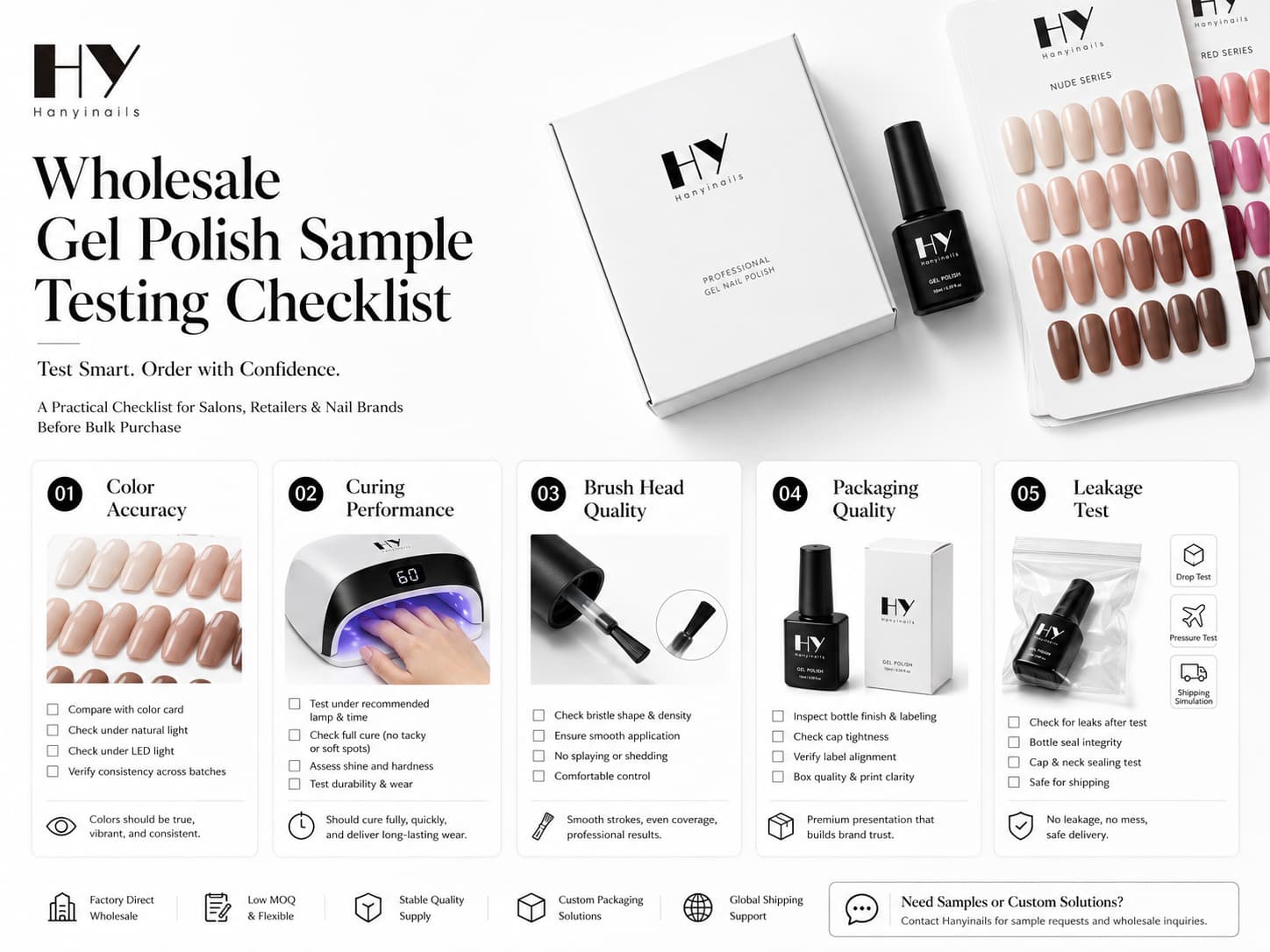
Test Samples Before Bulk Ordering
Samples should be tested under documented and repeatable conditions using the intended preparation, base coat, color layer, top coat and lamp system.
Shade accuracy
Opacity and coverage
Viscosity and self-leveling
Brush, stem, wiper and bottle performance
Cure performance under the intended lamp model or compatible wavelength range and application thickness
Center and edge curing for dark and highly pigmented shades
Compatibility across the intended base, color and top system
Gloss and surface appearance
Adhesion and wear under documented preparation and system conditions
Removal behavior
Bottle, cap and formula-contact compatibility
Leakage and shipping stability
Label resistance
Fill quantity
Batch identification and traceability
Curing caution: A dry or hard surface alone does not prove complete curing. Confirm the application thickness, lamp conditions and full product system using the supplier's validated testing method.
A trial order should be designed to validate the product, packaging, commercial demand and supplier response before a larger commitment.
Actual sell-through of core colors
Channel response to seasonal and effect products
Product and packaging defect rates
Shipping damage and leakage
Actual delivery time
Batch identification and traceability
Inventory turnover
Customer complaints and return reasons
Reorder speed
Supplier communication and after-sales support
Avoid committing to a large custom-bottle run, launching too many colors, producing high volumes of custom boxes before formula approval, ordering only from a color chart, or ignoring base, top and lamp-system compatibility.
Compare Wholesale Suppliers
Use mandatory pass-or-fail requirements before assigning a commercial score.
Mandatory Pass-or-Fail Checks
The product cures under the agreed formula, lamp and application system.
A written product specification is available.
Batch coding and traceability are available.
The filled packaging passes the agreed leakage and compatibility review.
Required product-specific supporting information is available for the target project.
A written defect and claim-handling process is available.
Only score suppliers that pass every non-negotiable product, packaging, documentation and traceability requirement.
Evaluation Area
Suggested Weight
Product and color mix
15%
Sample performance
15%
MOQ flexibility
15%
Total landed cost
15%
Reorder lead time
15%
Packaging options
10%
Documentation organization and response
5%
Inventory and scaling support
5%
Communication and claims handling
5%
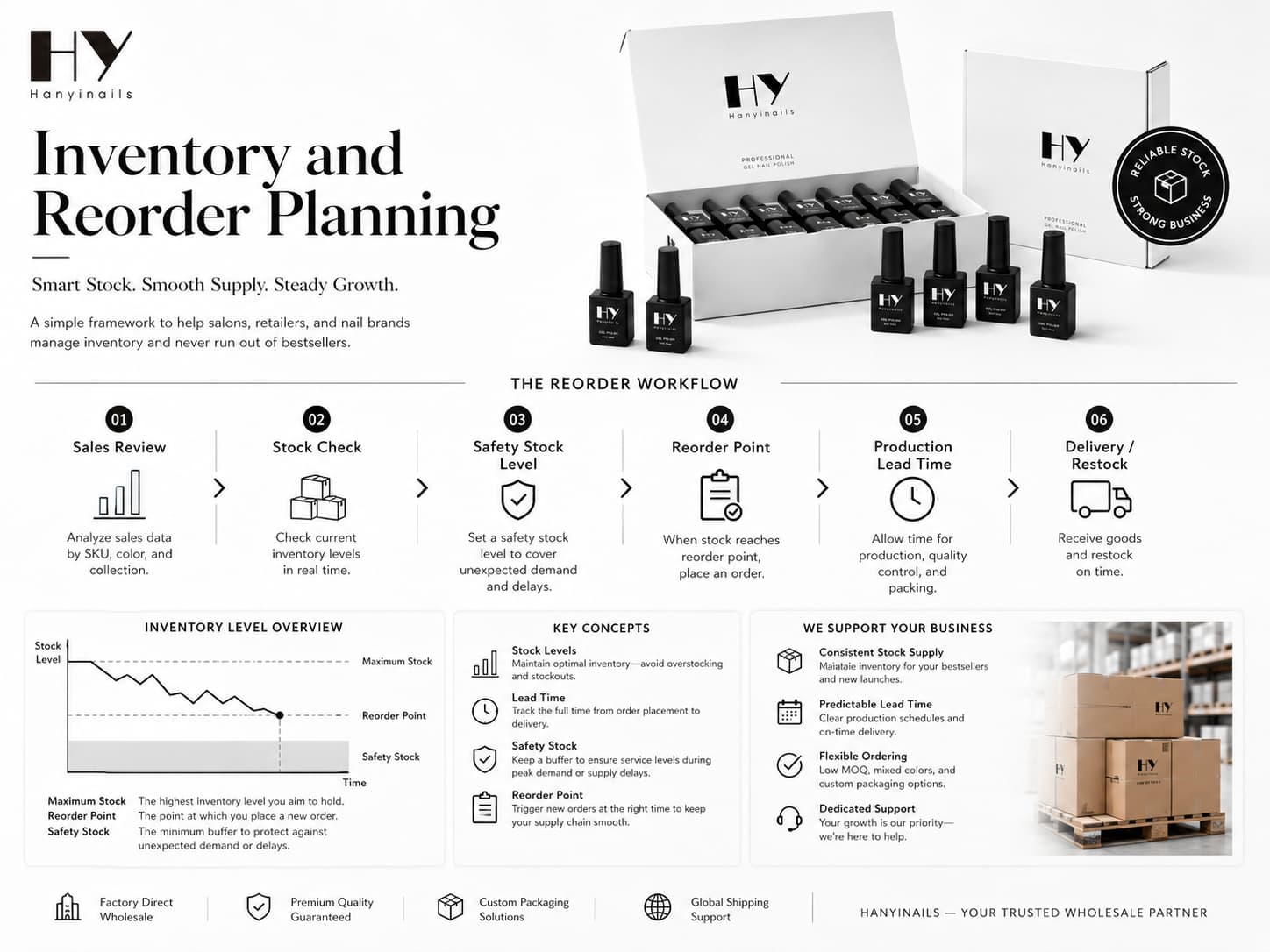
Inventory and Reorder Planning
Wholesale purchasing is an ongoing inventory process rather than a one-time buying decision. Plan around:
Production lead time
Packaging procurement and printing lead time
Shipping time
Customs and delivery buffer
Demand variation
Safety stock
Reorder point
Slow-moving colors
Seasonal end dates
Unused packaging stock
Formula, bottle or component discontinuation risk
Set the reorder point according to expected demand during production, packaging, shipping and customs lead time, plus an appropriate safety-stock allowance for demand changes and possible delays.
Fast-moving core colors may require a higher safety-stock level. Seasonal colors should be reviewed against the remaining selling window rather than reordered according to full-year demand. New colors should begin with controlled quantities, and highly customized packaging should be planned earlier because it can add procurement and approval time.
How Hanyinails Supports Wholesale Orders
Depending on the selected project, Hanyinails can support wholesale and private label buyers through a structured purchasing process:
Review the buyer type, target market, sales channel and expected order size.
Discuss stock wholesale, private label or OEM sourcing routes.
Help organize product categories, color groups and system products.
Prepare available formula, color and packaging samples.
Confirm applicable MOQ by product and packaging component.
Provide available product-specific supporting information.
Confirm approved products, packaging and artwork.
Plan production, packing, shipment and future reorder requirements.
Prepare a Wholesale RFQ
Include These Details in Your Request
Buyer type: salon, distributor, retailer or brand
Target market and delivery country
Sales channel
Product categories
Number of colors
Estimated quantity per SKU
Stock wholesale, white label, private label or OEM route
Bottle, label and box preferences
Intended base, top and lamp system
Sample requirements
Documentation requirements
Budget or target price range, where available
Existing sales data or confirmation that this is a first order
Target order and launch dates
FAQ
What is the difference between wholesale, private label and OEM gel polish?
Stock wholesale generally involves existing products with limited changes. Private label may include broader branding, packaging or product-selection customization. OEM may involve production to a more detailed buyer specification. Confirm the exact scope, ownership and responsibilities in writing because definitions vary by supplier.
What is a typical wholesale gel polish MOQ?
MOQ may be set by total order, total units, formula, individual color, bottle, printing or box, depending on the sourcing model and customization level.
Can different gel polish colors be mixed in one wholesale order?
Sometimes. It depends on whether the supplier allows a mixed-color MOQ and whether separate formula, color or packaging minimums still apply.
How many colors should a new retailer order?
Begin with a focused core range and controlled quantities of seasonal or effect colors. Increase the range after reviewing actual sell-through, returns and channel demand.
What samples should be tested before a bulk order?
Test shade, opacity, viscosity, brush performance, curing, gloss, adhesion, wear, removal and packaging integrity using the intended preparation, base, top and lamp system.
How is wholesale gel polish pricing calculated?
Total cost can include the product, bottle, printing, box, samples, inspection, freight, duties, warehousing, payment fees, defects, delays and slow-moving inventory.
What documents should a supplier provide?
Ask which product-specific documents and market-supporting information are available, and confirm which party is responsible for safety assessment, notification, registration, labeling and claims in the target market.
How should a trial order be planned?
Use it to validate sell-through, defect rates, shipping performance, batch traceability, customer feedback and reorder responsiveness before increasing the number of SKUs or the level of packaging customization.
How far in advance should a reorder be placed?
Reorder before remaining stock falls below expected demand during production, packaging, shipping and customs lead time, plus a suitable safety-stock allowance.
What information is needed for a wholesale quotation?
Provide the buyer type, target market, sales channel, product categories, color count, quantity per SKU, packaging preferences, sourcing model, sample and document requirements, delivery country and target dates.
Send Hanyinails your target market, product categories, color plan, quantity, packaging preferences and delivery requirements to discuss samples and wholesale or private label options.
Looking for a creative, premium, and reliable nail product manufacturer?
Whether you're an Amazon seller, Shopify store owner, chain store buyer, brand owner, distributor, wholesaler, or nail supply retailer — Hanyinails is your trusted partner for custom and wholesale nail solutions.
Address: 303 West Gate, Block A, South China International Innovation Industrial Park, Foluo Road, Luocun, Nanhai District, Foshan, Guangdong Province, China.
We specialize in OEM & ODM services, offering tailored formulations, vibrant colors, and premium packaging. Contact us today to discuss your brand’s needs and get a personalized quote!
We specialize in OEM & ODM services, offering tailored formulations, vibrant colors, and premium packaging. Contact us today to discuss your brand’s needs and get a personalized quote!
We specialize in OEM & ODM services, offering tailored formulations, vibrant colors, and premium packaging. Contact us today to discuss your brand’s needs and get a personalized quote!





Hanyinails
Hanyinails
Hanyinails
Hanyinails