

What Are HEMA and TPO in Gel Polish? HEMA-Free vs TPO-Free Explained
HEMA free gel polish and TPO free gel polish address different ingredient concerns. Learn what HEMA and TPO do in gel polish, how the formulas differ, and what to check when choosing between them.
- What Are HEMA and TPO?
- HEMA and TPO at a Glance
- 1. What Is HEMA in Gel Polish?
- 2. What Is TPO in Gel Polish?
- 3. HEMA vs TPO: What Is the Difference?
- 4. What Does HEMA-Free Gel Polish Mean?
- 5. What Does TPO-Free Gel Polish Mean?
- 6. What Does HEMA-Free & TPO-Free Gel Polish Mean?
- 7. Does HEMA-Free & TPO-Free Mean Allergy-Free?
- 8. HEMA vs TPO: EU Rules in 2026
- 9. HEMA-Free vs TPO-Free vs HEMA-Free & TPO-Free
- 10. What Should Salons Verify?
- 11. What Should Private Label Buyers Verify?
- HEMA & TPO Buyer Checklist
- Common HEMA & TPO Claim Mistakes
- Frequently Asked Questions
- Related HEMA & TPO Guides
- Final Thoughts
- Move From Ingredient Claims to Product Verification
HEMA and TPO are different ingredients that can play different roles in nail gel systems.
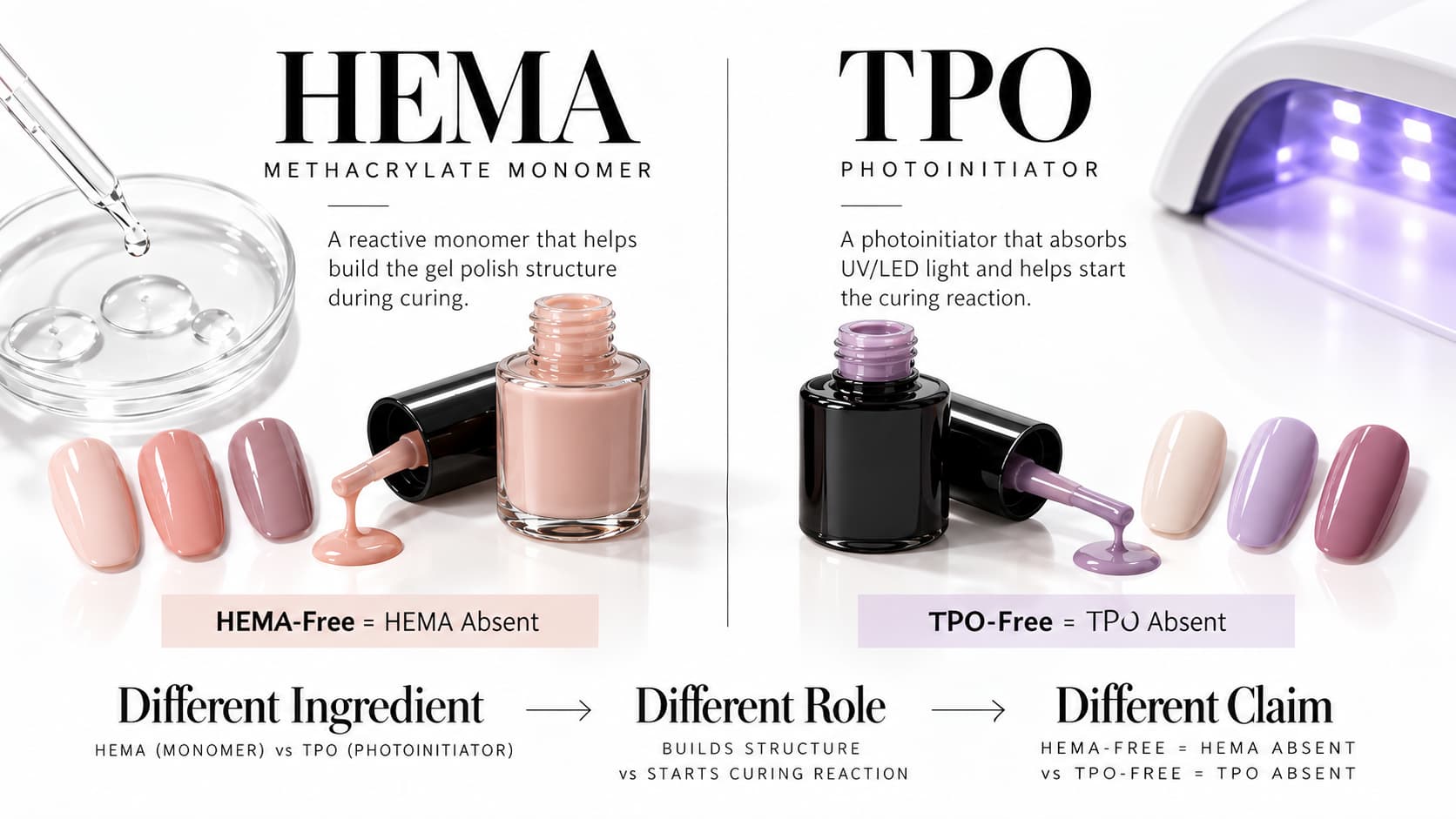
HEMA is a methacrylate monomer used in some nail product formulas. TPO is a photoinitiator that has been used in some UV/LED-curable cosmetic nail products to help initiate polymerization during curing.
HEMA-free and TPO-free are separate ingredient-absence claims. They do not mean the same thing.
They also have different regulatory positions in the European Union.
- HEMA in EU nail products is subject to professional-use restrictions and allergy-warning requirements.
- TPO has been prohibited in EU cosmetic products since 1 September 2025.
Neither “HEMA-free” nor “TPO-free” should automatically be interpreted as:
- allergy-free;
- hypoallergenic;
- non-irritating;
- suitable for every sensitive user;
- or proof that the complete formula is safer than every alternative.
For salons, nail professionals and private label buyers, the useful question is not simply whether a gel is HEMA-free or TPO-free. The better question is: which claim applies to the exact formula, what rules apply in the target market, and what product information supports that claim?
What Are HEMA and TPO?
HEMA and TPO are not the same type of ingredient.
HEMA is a methacrylate monomer used in some nail product systems. TPO is a photoinitiator used in some UV/LED-curable formulas.
A product can therefore be:
- HEMA-free but use a different photoinitiator system;
- TPO-free but still contain HEMA;
- free from both HEMA and TPO;
- or formulated using another combination of ingredients.
Ingredient claims should be checked against the exact SKU and formula rather than assumed from the product category.
HEMA and TPO at a Glance
| Question | HEMA | TPO |
|---|---|---|
| What type of ingredient is it? | Methacrylate monomer | Photoinitiator |
| Does it have the same role? | No | No |
| What does “free” mean? | HEMA is not present in the claimed formula | TPO is not present in the claimed formula |
| EU status | Professional-use restriction in nail products with required warning language | Prohibited in EU cosmetic products since 1 September 2025 |
| Does “free” mean allergy-free? | No | No |
| Should the claim be SKU-specific? | Yes | Yes |
1. What Is HEMA in Gel Polish?
HEMA stands for 2-Hydroxyethyl Methacrylate.
It is a methacrylate monomer that may be used as part of the polymer-forming system in certain nail products.
Its exact function and concentration depend on the formula, so it should not be treated as a universal ingredient in every gel polish.
Why Is HEMA Discussed So Often in Nail Products?
HEMA receives attention because methacrylate exposure can be relevant to allergic contact reactions.
That does not mean every person using a HEMA-containing professional nail product will develop an allergy.
It does mean that:
- product placement matters;
- unnecessary skin contact should be avoided;
- curing instructions matter;
- the product should be used according to its intended instructions;
- and unexpected reactions should not be dismissed simply because the manicure initially appears normal.
What Is the EU Status of HEMA?
HEMA is not subject to the same EU prohibition as TPO.
Under the EU Cosmetics Regulation framework, HEMA in nail products is restricted to professional use and carries specified warning language.
EU requirement for nail products containing HEMA:
“For professional use only” and “Can cause an allergic reaction.”
Therefore, a general statement such as “HEMA is banned in European gel polish” would be inaccurate.
For a deeper explanation of HEMA and related methacrylate terminology, see the HEMA vs HPMA Gel Polish Ingredient Guide .
2. What Is TPO in Gel Polish?
TPO stands for Trimethylbenzoyl Diphenylphosphine Oxide.
It is a photoinitiator that has been used in some UV/LED-curable nail formulas.
A photoinitiator helps start the polymerization process when exposed to an appropriate light source. That makes its role different from HEMA.
Is TPO Banned in the EU?
Yes, for cosmetic products in the European Union.
TPO has been prohibited in EU cosmetic products since 1 September 2025.
For a 2026 article, the EU status of TPO should therefore not be described merely as “under scrutiny” or “potentially restricted.”
TPO is prohibited in EU cosmetic products from 1 September 2025.
The European Commission also explains that professional nail technicians cannot continue using TPO-containing cosmetic nail products on clients in the EU after that date.
Why Does This Matter for Nail Brands?
A brand selling into multiple markets should not assume that an ingredient status in one jurisdiction automatically applies everywhere.
For EU-focused projects, TPO status should be considered at the formula-selection stage rather than after packaging and product development are already complete.
For a deeper TPO-specific discussion, see the TPO-Free Gel Polish Ingredient Guide .
3. HEMA vs TPO: What Is the Difference?
HEMA and TPO are often discussed together because both appear in conversations about nail gel ingredients.
But they should not be treated as equivalent.
| Factor | HEMA | TPO |
|---|---|---|
| Ingredient Category | Methacrylate monomer | Photoinitiator |
| General Role | Part of the polymer-forming system in some formulas | Helps initiate curing in some light-curable formulas |
| HEMA-Free Claim | Addresses the absence of HEMA | Does not describe TPO status |
| TPO-Free Claim | Does not describe HEMA status | Addresses the absence of TPO |
| EU Status in Nail Cosmetics | Restricted to professional use with warning requirements | Prohibited in EU cosmetic products from 1 September 2025 |
| Allergy-Free Claim? | HEMA-free does not establish allergy-free status | TPO-free does not establish allergy-free status |
| Buyer Check | Exact formula and ingredient information | Exact formula, target market and ingredient information |
Different Ingredient → Different Role → Different Claim → Different Regulatory Status
4. What Does HEMA-Free Gel Polish Mean?
When accurately supported, a HEMA-free claim means that the claimed formula does not contain HEMA.
It does not necessarily mean the product is free from:
- all acrylates;
- all methacrylates;
- all sensitizing ingredients;
- all photoinitiators;
- or every ingredient that could cause a reaction in an individual user.
HEMA-Free Does Not Mean Acrylate-Free
HEMA is one specific methacrylate.
Removing HEMA does not automatically remove every other acrylate or methacrylate from a UV/LED nail formula.
Therefore, the following terms should not be treated as interchangeable unless the exact formulation supports each claim:
- HEMA-free;
- acrylate-free;
- methacrylate-free.
Does HEMA-Free Mean Hypoallergenic?
Not automatically.
A formula without HEMA can still contain other ingredients to which a person may react.
HEMA-free should be treated as an ingredient-absence claim, not as a universal allergy or medical suitability claim.
5. What Does TPO-Free Gel Polish Mean?
A TPO-free claim means the claimed formula does not contain TPO.
It does not tell the buyer which alternative photoinitiator approach is used, how the product should be cured or whether the overall formula meets requirements in every target market.
Those questions need separate verification.
TPO-Free and EU Market Planning
For brands developing cosmetic nail products for the EU market in 2026, the TPO issue is no longer simply a marketing preference.
TPO is prohibited in EU cosmetic products.
Buyers should therefore verify the actual formula rather than relying only on:
- a product name;
- a sales description;
- a bottle sticker;
- or a generic “TPO-free” marketing image.
Does TPO-Free Mean Hypoallergenic?
No.
Removing TPO addresses that specific ingredient. It does not establish that the rest of the formulation cannot cause irritation or allergic reactions.
6. What Does HEMA-Free & TPO-Free Gel Polish Mean?
When properly substantiated, HEMA-free and TPO-free describes a formula that contains neither HEMA nor TPO.
It combines two separate ingredient-absence claims.
It should not automatically be rewritten as:
- “allergy-free gel polish”;
- “hypoallergenic gel polish”;
- or “completely safe gel polish.”
A HEMA-free and TPO-free claim describes the absence of those two ingredients. The rest of the formula still needs to be evaluated on its own composition, curing instructions, intended use and target-market requirements.
Why Do Buyers Request Both Claims?
A buyer may request both because:
- HEMA and TPO are different ingredients;
- the target market may have ingredient-specific requirements;
- the brand may have an internal formulation policy;
- the product portfolio may need consistent claim architecture;
- or the brand wants to distinguish a specific formula strategy.
The reason should be defined before formula selection begins.
7. Does HEMA-Free & TPO-Free Mean Allergy-Free?
No.
This is one of the most important distinctions in this topic.
A gel formula contains more than HEMA and TPO. Depending on the product, other components can include:
- other acrylates or methacrylates;
- other photoinitiators;
- pigments;
- additives;
- stabilizers;
- and other formulation components.
Removing two ingredients does not prove that no user can react to anything else in the formula.
Better Claim Language
| Avoid Assuming | Use a More Precise Statement |
|---|---|
| Safe for sensitive users | HEMA-free and TPO-free formulation, when verified |
| Hypoallergenic gel polish | State the specific ingredient absence unless broader evidence supports the claim |
| No allergy risk | The formula does not contain HEMA or TPO, if verified for the exact SKU |
8. HEMA vs TPO: EU Rules in 2026
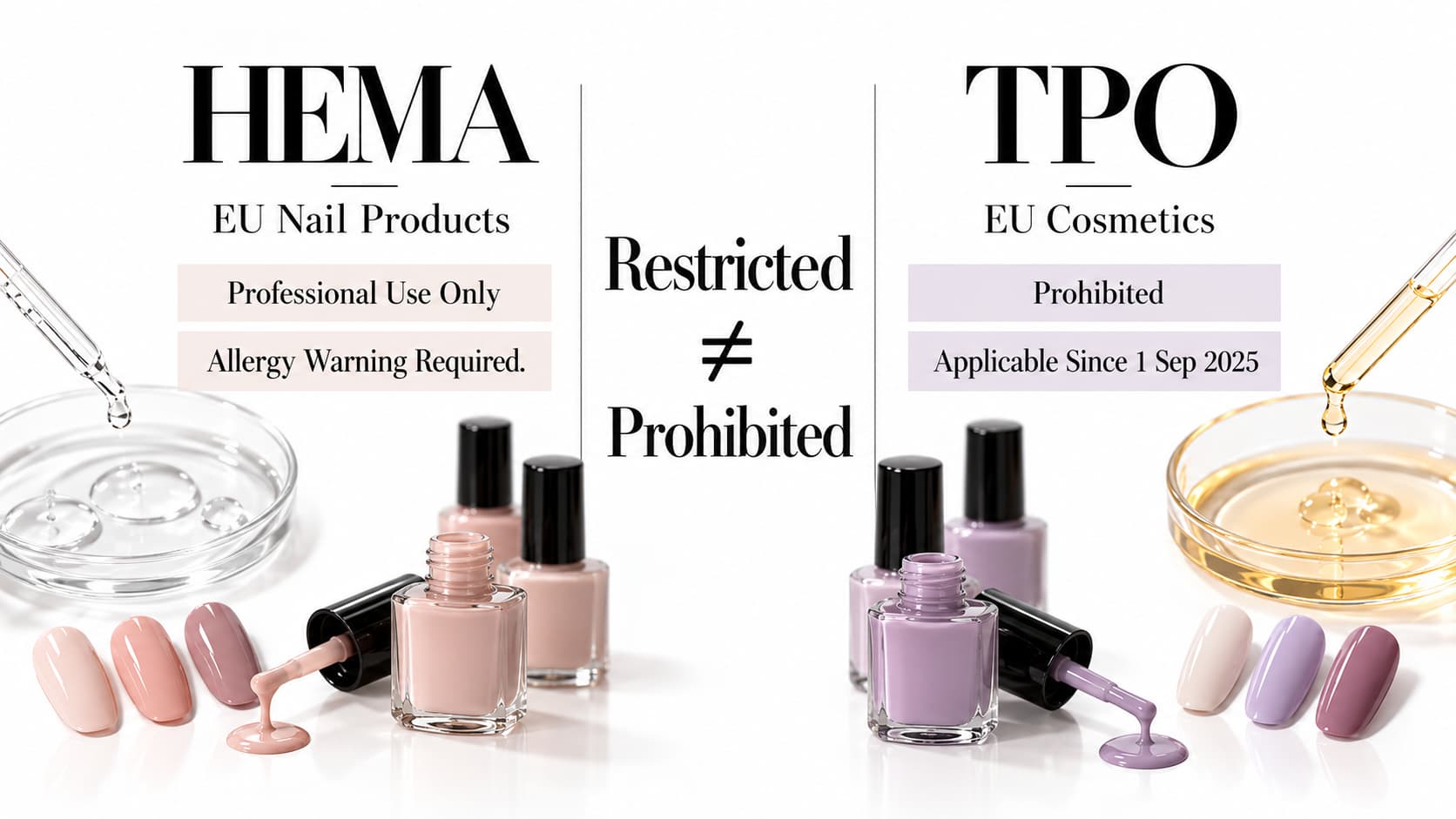
HEMA and TPO now have clearly different EU regulatory positions.
Restricted in Nail Products
Professional use only.
Specified allergy-warning language applies.
Prohibited in EU Cosmetics
Applicable since 1 September 2025.
Different regulatory category from HEMA.
HEMA
For nail products containing HEMA, EU rules require professional-use-only restrictions and specified warning wording.
HEMA has not simply been placed under the same prohibition as TPO.
TPO
TPO has been prohibited in EU cosmetic products since 1 September 2025.
For EU market planning, buyers should therefore distinguish a restricted ingredient from a prohibited ingredient.
If an article says “HEMA and TPO are both banned,” it oversimplifies the current EU rules. If it says both are only “under scrutiny,” it is also outdated for TPO.
9. HEMA-Free vs TPO-Free vs HEMA-Free & TPO-Free
These claims answer different questions.
| Claim | What It Tells You | What It Does Not Tell You |
|---|---|---|
| HEMA-Free | HEMA is absent from the claimed formula | Whether TPO or other methacrylates are present |
| TPO-Free | TPO is absent from the claimed formula | Whether HEMA is present |
| HEMA-Free & TPO-Free | Both HEMA and TPO are absent from the claimed formula | Whether the product is allergy-free or suitable for every user |
| EU-Compliant | Requires broader product and regulatory review | Cannot be established only because a formula is HEMA-free or TPO-free |
This is especially important for B2B purchasing. A single ingredient claim should not be used as a shortcut for evaluating the entire product.
10. What Should Salons Verify?
Ingredient claims matter, but salons also need product-use information.
Exact Product Identity
Confirm the exact product and SKU being used.
Do not assume that every product from one brand has the same HEMA or TPO status.
Ingredient Information
Check the ingredient information supplied for the actual formula.
A claim on one product should not automatically be extended to:
- another color;
- another base;
- another top coat;
- another builder gel;
- or another nail-art product.
Curing Instructions
HEMA-free or TPO-free does not tell you how a product should be cured.
Follow the verified instructions for the exact formula and compatible lamp system.
Skin Contact
Ingredient claims do not replace careful application.
Avoid unnecessary contact between uncured gel and surrounding skin.
Client Reactions
If a client experiences an unexpected reaction, do not assume a HEMA-free or TPO-free label rules out a product-related issue.
Professional or medical assessment may be appropriate depending on the circumstances.
Removal
HEMA-free and TPO-free claims do not determine whether a product is soak-off, file-off or removed using another system.
Follow the product-specific removal instructions.
11. What Should Private Label Buyers Verify?
For private label and OEM projects, ingredient claims should be built into product development rather than added at the end as marketing copy.
1. Target Market
Start with:
Where will the final product be sold?
An EU-focused project may have different formulation and regulatory requirements from another target market.
2. Exact Ingredient Claim
Define whether the requirement is:
- HEMA-free;
- TPO-free;
- both HEMA-free and TPO-free;
- or another specific formulation request.
Do not use “clean formula” as a substitute for an exact ingredient requirement.
3. Exact SKU
Claims should be checked at the product level.
A brand should not assume that because one gel is HEMA-free, every color, base, builder, top or nail-art gel is also HEMA-free.
4. Formula Information
Ingredient-absence claims should be supported by appropriate information for the exact formula.
5. Curing System
Changing a formula or photoinitiator approach can affect how a light-cured product needs to be evaluated.
Buyers should review:
- curing instructions;
- compatible lamp requirements;
- layer guidance;
- and the finished product workflow.
6. Product Claims
Avoid converting a precise formulation claim into a broader unsupported statement.
| Claim Type | Example |
|---|---|
| Specific ingredient claim | HEMA-free and TPO-free |
| Requires separate substantiation | Hypoallergenic, allergy-free, safer for sensitive nails, non-irritating |
7. Label and Market Requirements
The final label and supporting product information should be reviewed for the intended market rather than copied from a product designed for another jurisdiction.
8. Product Portfolio Consistency
If a collection includes base coat, color gel, top coat, builder products or nail-art gel, check each product independently before applying one formulation claim across the collection.
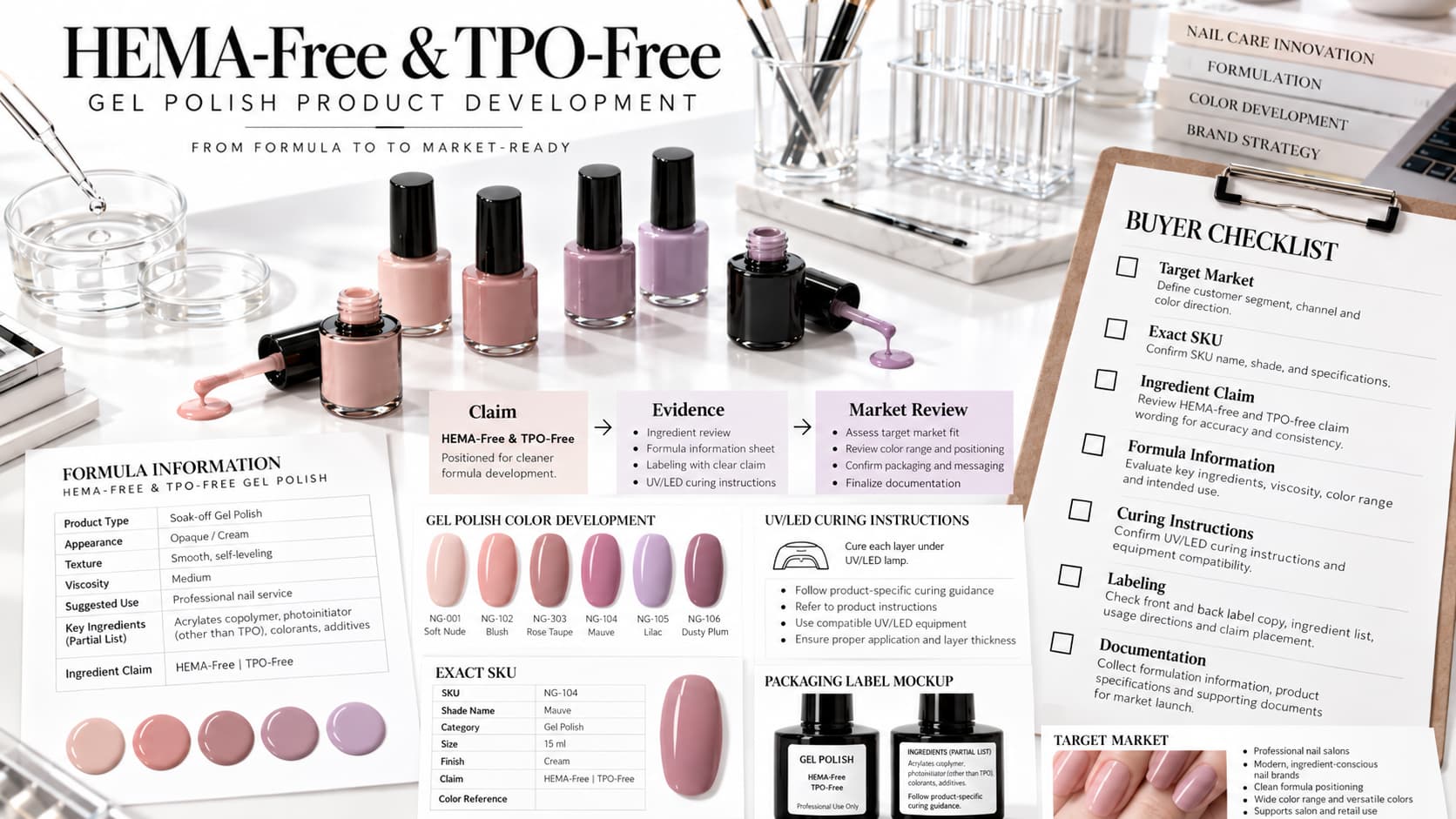
For a commercial development workflow focused on formula claims, samples, labels and OEM preparation, see the TPO-Free & HEMA-Free Gel Polish OEM Guide .
HEMA & TPO Buyer Checklist
| Area | What to Verify |
|---|---|
| Ingredient Claim | Is the requirement HEMA-free, TPO-free or both? Is the claim tied to the exact formula? |
| Target Market | Which country or region will receive the product? What market-specific requirements apply? |
| Formula | What formulation approach is used when the excluded ingredient is not present? Has the exact SKU been checked? |
| Curing | What curing instructions and compatible lamp requirements apply to the exact formula? |
| Documentation | Is ingredient information available? Are formulation claims supported? Are relevant market documents handled as applicable? |
| Labeling | Are claims precise? Are required warnings included where applicable? Does the label avoid unsupported broad safety claims? |
| Commercial Fit | Professional salon, retail, distributor, private label or multiple international markets? |
Common HEMA & TPO Claim Mistakes
“HEMA-Free Means Allergy-Free”
No. HEMA-free addresses one ingredient. Other ingredients may still be relevant to individual reactions.
“TPO-Free Means HEMA-Free”
No. HEMA and TPO are different ingredients. A TPO-free formula can still contain HEMA unless the formula is also verified as HEMA-free.
“HEMA and TPO Are Both Banned in the EU”
No. HEMA is restricted in nail products to professional use with warning requirements. TPO is prohibited in EU cosmetic products from 1 September 2025.
“TPO Is Only Under Regulatory Review”
That wording is outdated for EU cosmetic products. The prohibition is already applicable.
“HEMA-Free Is the Same as Acrylate-Free”
No. HEMA is one methacrylate ingredient. Its absence does not establish that all acrylates or methacrylates are absent.
“TPO-Free Automatically Means EU-Compliant”
No. EU cosmetic compliance involves more than the absence of one ingredient.
“An SDS Proves a Product Is Safe”
An SDS is a technical safety document used for hazard and handling information where applicable. It should not be presented as a universal product safety certification.
“CPNP Means Certified”
No. EU cosmetic notification and compliance processes should not be represented as a product quality or safety award.
Frequently Asked Questions
What are HEMA and TPO?
HEMA is a methacrylate monomer used in some nail product formulas. TPO is a photoinitiator that has been used in some UV/LED-curable nail formulas. They are different ingredients with different functions.
What does HEMA-free mean?
HEMA-free means the claimed formula does not contain HEMA. It does not automatically mean that the formula is free from all acrylates, methacrylates or potential allergens.
What does TPO-free mean?
TPO-free means the claimed formula does not contain TPO. It does not automatically indicate which alternative photoinitiator approach is used or establish overall product safety.
What is HEMA and TPO-free gel polish?
It is gel polish presented as containing neither HEMA nor TPO. The claim should be verified for the exact formula or SKU.
Is TPO banned in EU gel polish?
TPO has been prohibited in EU cosmetic products since 1 September 2025. This applies to cosmetic nail products within the scope of the EU Cosmetics Regulation.
Is HEMA banned in the EU?
HEMA is not subject to the same prohibition as TPO. In EU nail products, HEMA is restricted to professional use and products containing it require specified allergy-warning language.
Is HEMA-free gel polish allergy-free?
No. Removing HEMA removes that specific ingredient, but reactions to other ingredients can still be possible.
Is TPO-free gel polish hypoallergenic?
TPO-free alone does not establish that a product is hypoallergenic. It is an ingredient-absence claim.
Is HEMA-free the same as TPO-free?
No. HEMA and TPO are different ingredients with different functions. A formula can be free from one while still containing the other.
Does HEMA-free gel polish still need to be cured correctly?
Yes. Ingredient claims do not replace product-specific curing instructions.
Is TPO-free gel polish automatically compliant in the EU?
No. TPO-free status addresses one ingredient requirement. The complete cosmetic product still needs to meet the regulatory requirements that apply to the final product and its market.
What should private label buyers verify before using HEMA-free or TPO-free claims?
Verify the exact formula, ingredient claim, target market, curing instructions, product information, labeling and whether the claim applies to every SKU being sold under the same collection.
Related HEMA & TPO Guides
TPO-Free Gel Polish Ingredient Guide
Use the dedicated TPO guide for a deeper explanation of TPO-free formulas, the EU TPO prohibition and buyer claim verification.
HEMA vs HPMA Gel Polish Ingredient Guide
Use the HEMA-focused guide when you need a deeper explanation of HEMA, HPMA and related methacrylate terminology.
TPO-Free & HEMA-Free Gel Polish OEM Guide
Use the OEM guide when the main task is commercial product development, formula-claim planning, samples, labels and private label project preparation.
Final Thoughts
HEMA and TPO should not be grouped together as if they are the same ingredient or subject to the same regulatory rule.
A clearer evaluation framework is:
Identify the Ingredient → Understand Its Role → Define the Exact “Free From” Claim → Check the Target Market → Verify the Exact Formula → Confirm Curing & Product Instructions → Review Labeling and Documentation → Approve the Claim for the Exact SKU
For salons, this prevents ingredient claims from replacing proper product-use instructions.
For consumers, it provides a more accurate explanation of what HEMA-free and TPO-free actually mean.
For private label buyers, it creates a stronger basis for formulation discussions, claim review and market-specific product planning.
HEMA-free and TPO-free are specific ingredient claims. They should not automatically be expanded into allergy-free, hypoallergenic or universally safe claims.
Move From Ingredient Claims to Product Verification
If your main question is about TPO and the EU prohibition, continue to the dedicated TPO ingredient guide. If your main question is HEMA and related methacrylate terminology, use the HEMA vs HPMA guide. For a private label project, define the target market, exact ingredient claims, product type, curing requirements, packaging and required product information before formula approval.
Read the TPO-Free Guide Explore HEMA vs HPMAThis article provides general ingredient, product-development and regulatory information and is not legal or medical advice. Regulatory requirements can change; brands and professionals should verify current requirements for the exact product and target market.

Velvet Chrome vs. Magnetic 3D: The Two Texture Trends Defining 2026
Baccarat Nails 2026: Where Crystal Glassware Meets Nail Art – The Complete Trend Guide

Soft Chrome vs. Mirror Chrome: Which Nail Finish Is Right for 2026? – The Complete Guide

Jelly Candy Aesthetic 2026: Pinterest‘s 100% Search Surge & the Rubberised Nail Art Trend
Polygel vs. Acrylic vs. Builder Gel: A 2026 Professional’s Comparison Guide
Beaded Nails 2026: The Sculptural Manicure Taking Over Red Carpets – Your Complete Guide
Recommended for You

-
-
🔑 Key Features:
-
🍊 24 Fruit-Inspired Shades – From citrus orange to berry red, tropical mango to kiwi green, a complete fruit color palette
🧲 Strong Magnetic Effect – Sharp, luminous cat eye lines with every application
💅 HEMA-Free & Long-Lasting – 60s cure, 28 days wear, soak-off removal
🖌️ Easy Application – Smooth self-leveling texture, salon & home use
🌿 Gentle Formula – Low odor, non-irritating, cruelty-free
🌸 Perfect for Summer – Vibrant, juicy colors ideal for tropical and playful nail art
🛠️ OEM/ODM Supported – Custom colors, bottles & branding
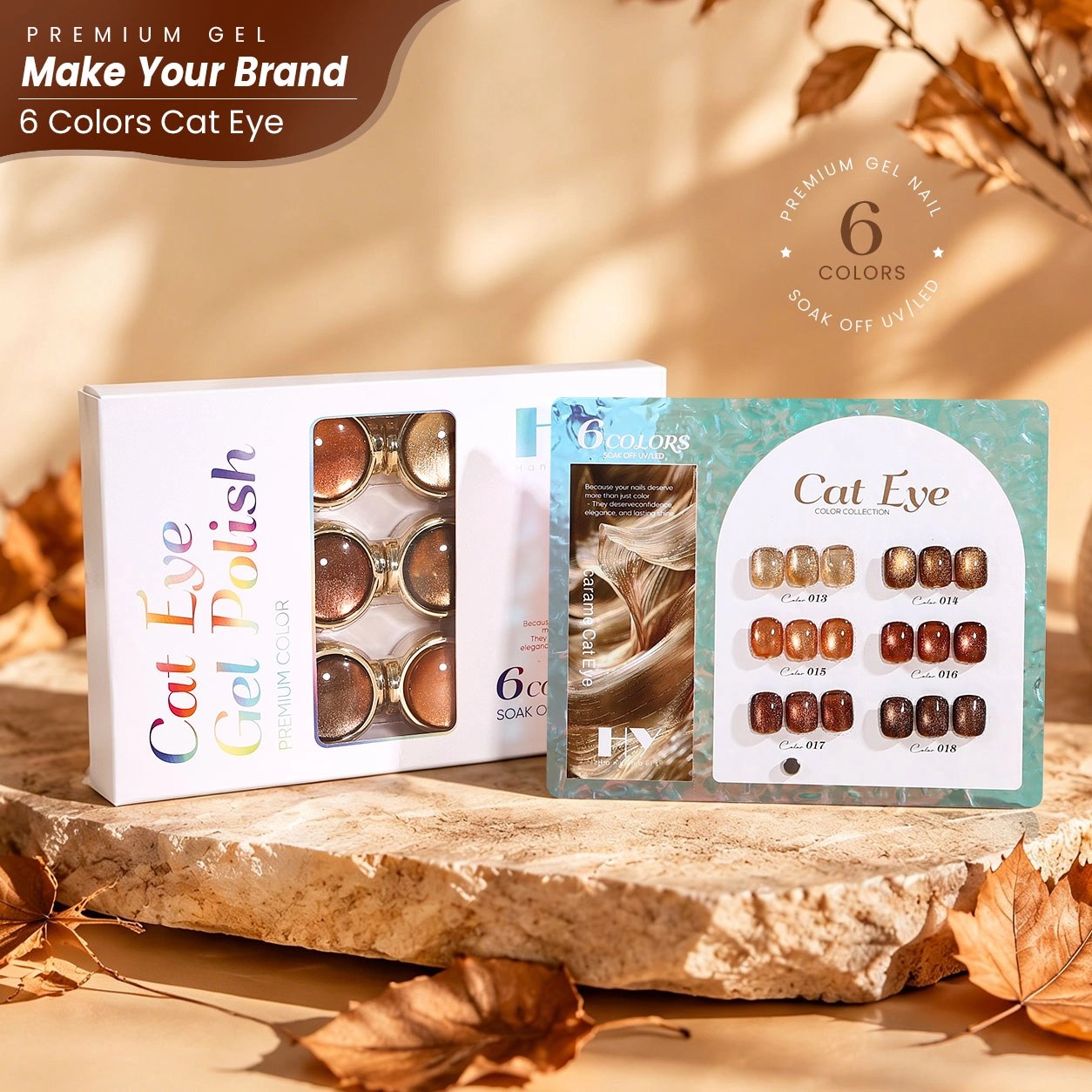
Key Features:
🍂 6 Caramel Autumn Shades – Warm caramel, toffee, copper, amber – complete warm collection.
✨ Caramel Glow Shimmer – Warm-toned magnetic particles – 3D cat eye glow.
💎 High Pigment Formula – One coat – salon-quality results.
⚡ Smooth Self-Leveling – No streaks, no bubbles – beginner-friendly.
🌟 Long-Lasting & Chip-Resistant – 3 weeks wear – glossy and fresh.
💡 HEMA & TPO Free – Safer for natural nails.
🌱 Vegan & Cruelty-Free – Eco-conscious – never tested on animals.
💧 Soak Off Formula – Easy removal – no damage to natural nails.
🕯️ UV/LED Curable – Quick cure – efficient for professional use.
🎨 15ml Professional Size – Salon & retail ready.
🧴 OEM/ODM Support – Custom formula, packaging, branding.
Key Features:
-
-
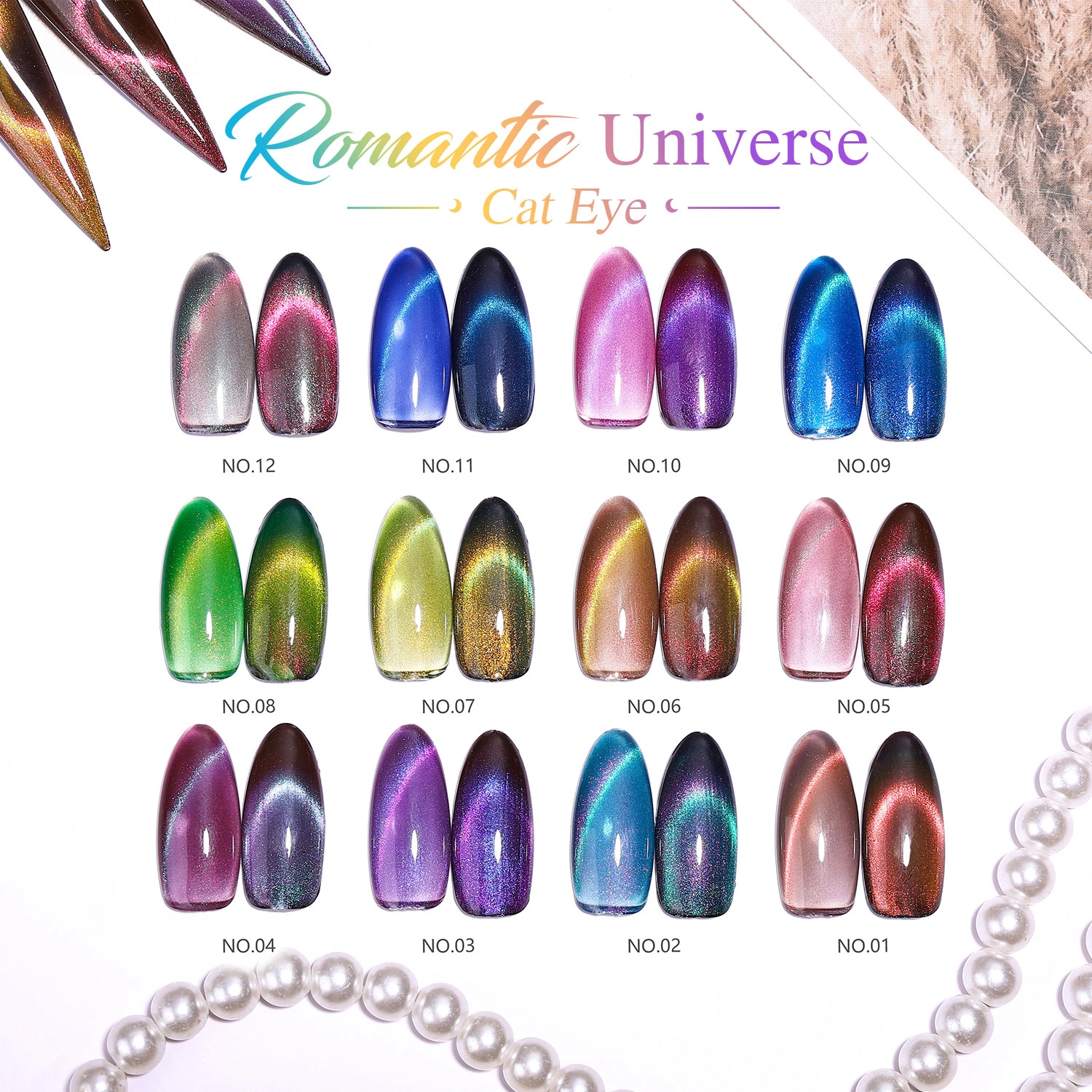
✨ 12 Romantic Universe Shades – Cosmic blue, galaxy purple, aurora green, nebula pink & deep space black with holographic shimmer
🌌 Galaxy Cat Eye Effect – Ultra-fine magnetic particles create a multidimensional glow that shifts like starlight across the universe
💅 HEMA/TPO-Free & Safe – Non-toxic, low odor, gentle on natural nails
⚡ UV/LED Curable – 60s LED / 90s UV for quick, hassle-free curing
🖌️ Easy Application – Self-leveling formula for smooth, streak-free coverage
🌿 Long-Lasting Wear – Chip-resistant & glossy for 28+ days
💫 Perfect for Every Occasion – Parties, festivals, weddings & everyday cosmic elegance
📦 15ml Professional Bottles – Salon-quality & retail-ready packaging
🛠️ OEM/ODM Supported – Custom colors, branded packaging & private label welcome
-
Key Features:
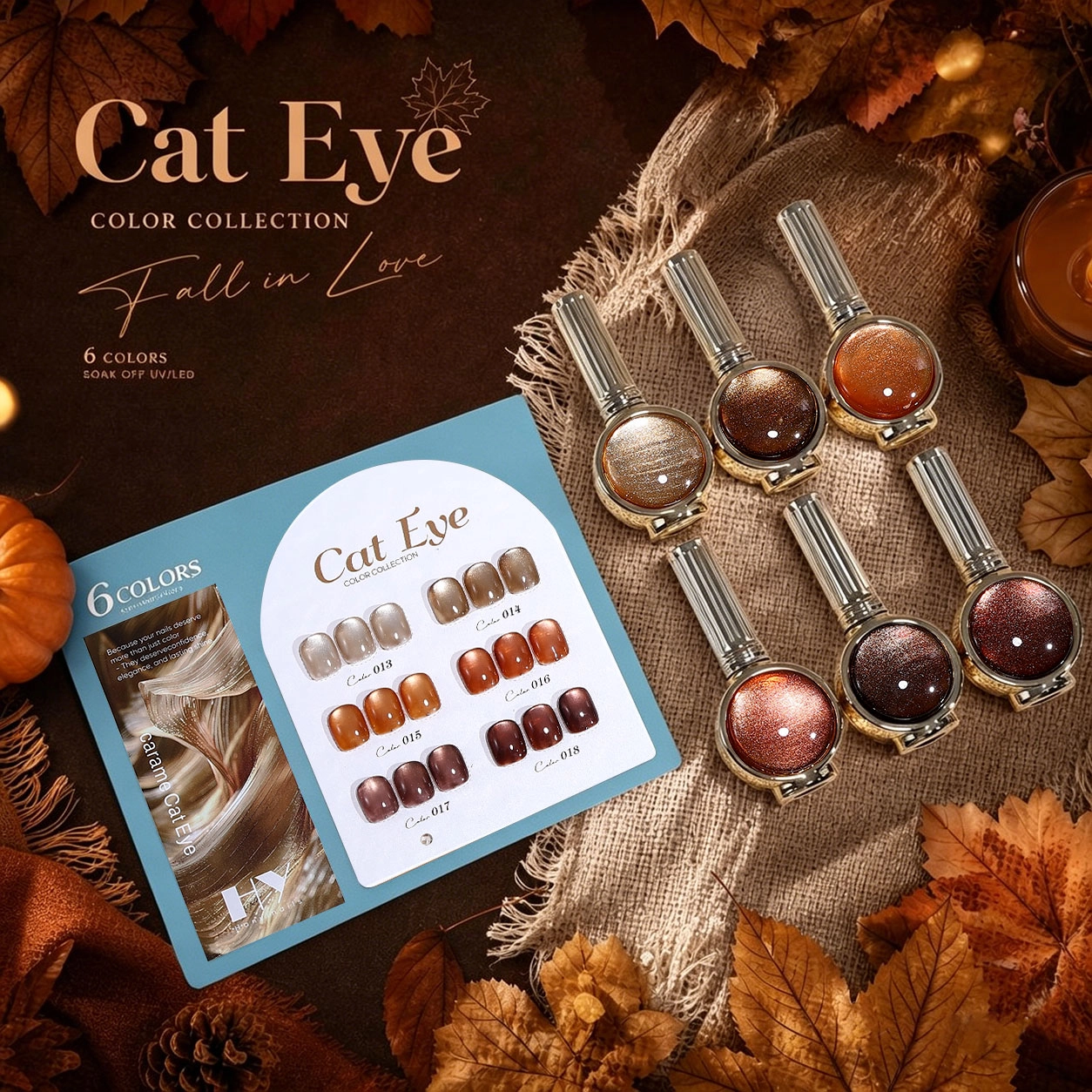
🍂 6 Caramel Moonlight Shades – Warm caramel, toffee, copper, amber – complete autumn collection.
🌙 Caramel Moonlight Shimmer – Warm-toned magnetic particles – 3D cat eye glow.
💎 High Pigment Formula – One coat – salon-quality results.
⚡ Smooth Self-Leveling – No streaks, no bubbles – beginner-friendly.
🌟 Long-Lasting & Chip-Resistant – 3 weeks wear – glossy and fresh.
💡 HEMA & TPO Free – Safer for natural nails.
🌱 Vegan & Cruelty-Free – Eco-conscious – never tested on animals.
💧 Soak Off Formula – Easy removal – no damage to natural nails.
🕯️ UV/LED Curable – Quick cure – efficient for professional use.
🎨 15ml Professional Size – Salon & retail ready.
🧴 OEM/ODM Support – Custom formula, packaging, branding.
Looking for a creative, premium, and reliable nail product manufacturer?
Whether you're an Amazon seller, Shopify store owner, chain store buyer, brand owner, distributor, wholesaler, or nail supply retailer — Hanyinails is your trusted partner for custom and wholesale nail solutions.
Hanyinails
Hanyinails
Hanyinails
Hanyinails