Nail Polish Manufacturers OEM/ODM Selection Guide for Global Buyers
- Quick Answer: How Should Global Buyers Evaluate Nail Polish Manufacturers?
- Key Takeaways
- What Should Global Buyers Look for in Nail Polish Manufacturers?
- Manufacturer Types: Brand Owners, Contract Manufacturers, OEM/ODM Suppliers, and Private Label Partners
- Brand Owners
- Contract Manufacturers
- OEM/ODM Suppliers
- Private Label Partners
- OEM vs ODM vs Private Label Nail Polish Manufacturing
- Product Range and Formula Direction Buyers Should Confirm
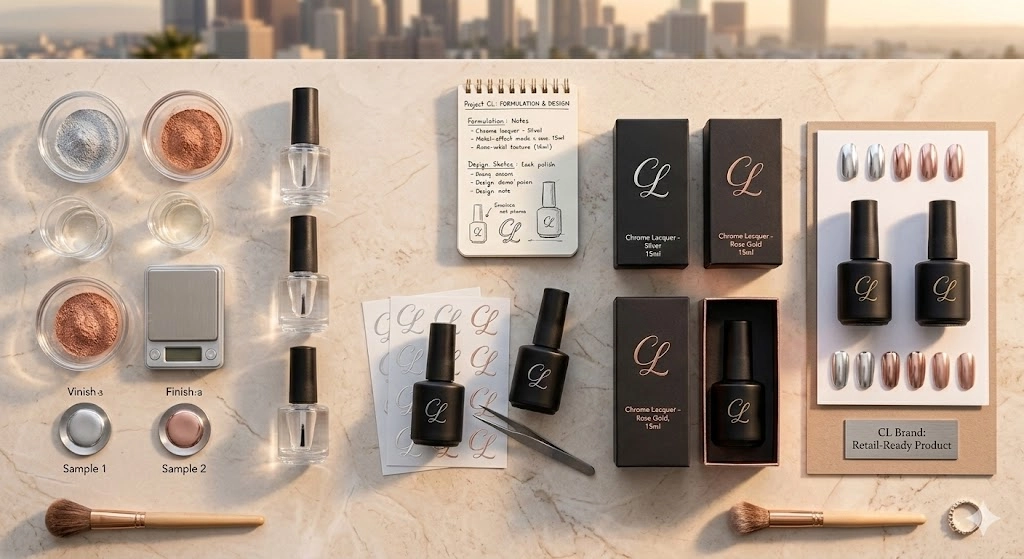
- Customization Options: Colors, Bottles, Caps, Labels, Boxes, and Color Charts
- Color Customization
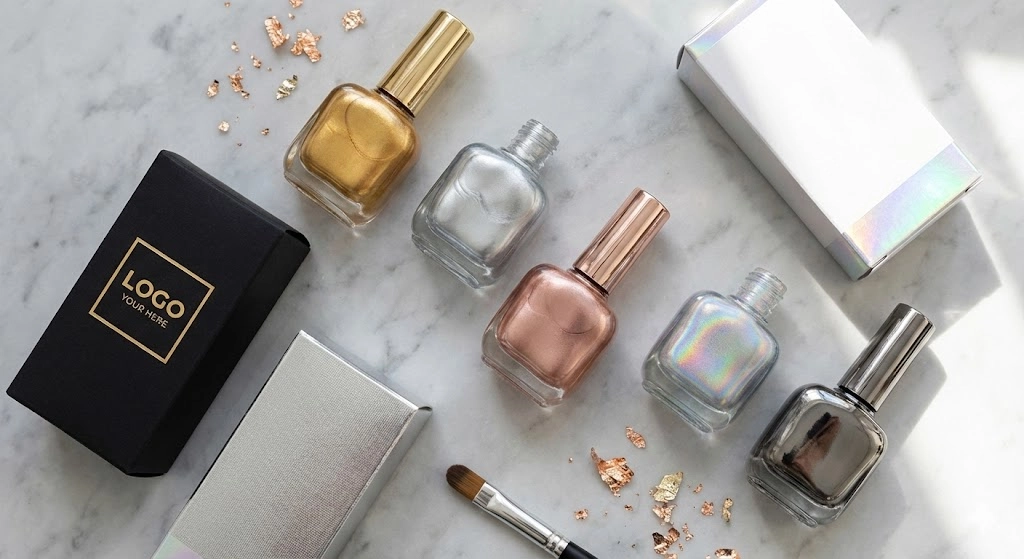
- Bottle and Cap Customization
- Labels, Boxes, Kits, and Color Charts
- Quality Control and Sample Testing Before Bulk Production
- Documents and Market Requirements Buyers Should Confirm
- How to Compare Nail Polish Manufacturers Without Relying on Rankings
- Product Capability
- Customization Support
- Sample Process
- QC Process
- Document Availability
- Communication
- Reorder Planning
- RFQ Checklist for OEM/ODM Nail Polish Supplier Projects
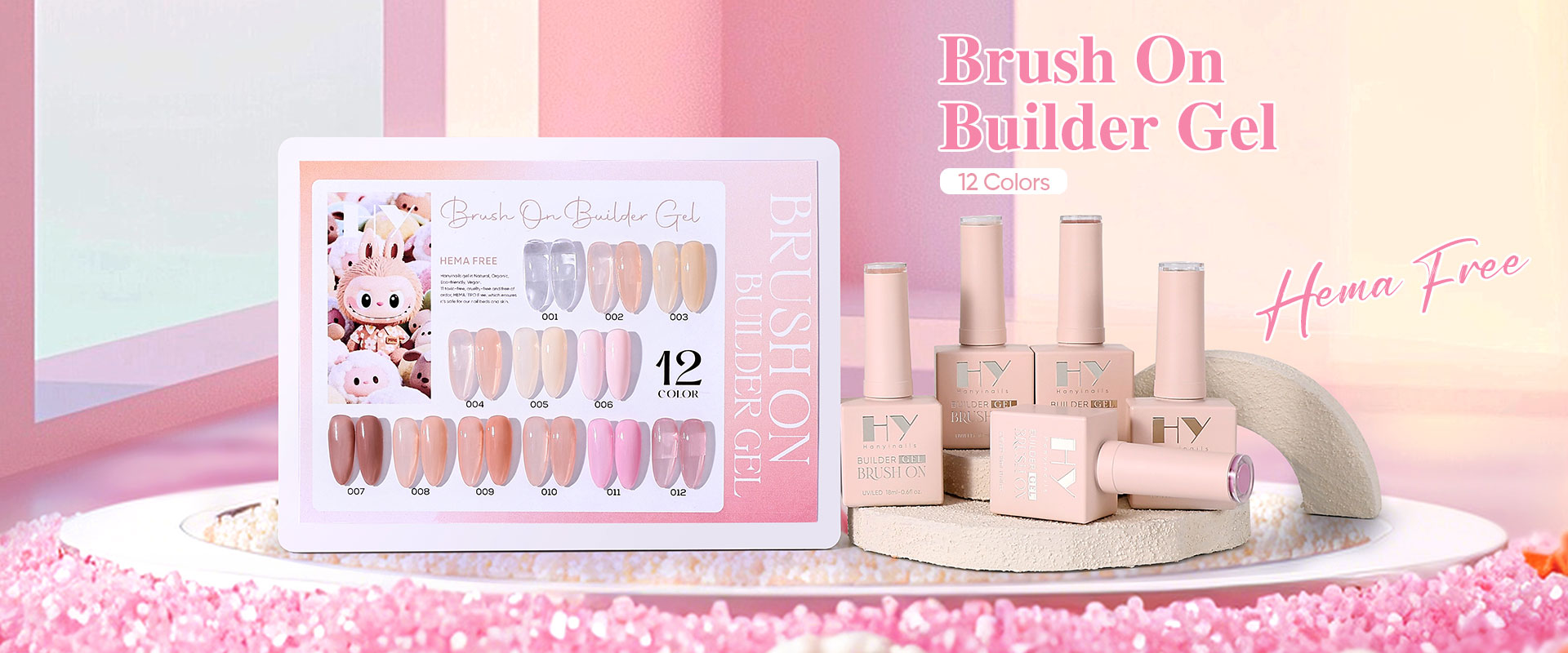
- How Hanyinails Supports Private Label and OEM Nail Gel Projects
- Ready to Discuss an OEM/ODM Nail Polish or Gel Polish Project?
- Common Mistakes When Choosing Nail Polish Manufacturers
- Mistake 1: Relying Only on Manufacturer Lists
- Mistake 2: Choosing Only by Price
- Mistake 3: Not Defining the Product Type Clearly
- Mistake 4: Making Claims Without Verification
- Mistake 5: Printing Packaging Too Early
- Mistake 6: Ignoring Sample Testing
- Mistake 7: Assuming One Supplier Fits Every Market
- Mistake 8: Sending an Incomplete RFQ
- FAQ: Nail Polish Manufacturers OEM/ODM Selection
Nail Polish Manufacturers OEM/ODM Selection Guide
Quick Answer: How Should Global Buyers Evaluate Nail Polish Manufacturers?
Global buyers should evaluate nail polish manufacturers by reviewing product range, OEM and ODM support, private label customization options, color development capability, bottle and packaging choices, sample testing process, quality control checks, document availability, target market requirements, communication process, and RFQ readiness.
Buyers should avoid relying only on rankings, broad marketing claims, or low prices. A stronger approach is to compare manufacturers through practical project details: product type, colors, formula expectations, packaging, samples, QC standards, documents, order quantity, and launch schedule.
This guide is not a ranking of nail polish manufacturers. It is a practical OEM/ODM evaluation checklist for buyers comparing suppliers for private label or contract manufacturing projects. In this guide, “nail polish manufacturers” refers to suppliers involved in custom nail polish, gel polish, and related nail gel product projects. The exact product type, formula, and market requirements should always be confirmed during RFQ and sample review.
Key Takeaways
- Global buyers should evaluate nail polish manufacturers through OEM/ODM capability, product range, customization options, samples, QC checks, documents, and communication.
- Manufacturer rankings can be difficult to verify, so buyers should focus on practical selection criteria instead of unsupported lists.
- OEM, ODM, private label, and contract manufacturing models may fit different buyer needs depending on product development stage, packaging requirements, and brand strategy.
- Product range, formula direction, color development, bottle choices, labels, kit boxes, and color charts should be confirmed before sampling or production.
- Claims such as long-lasting, vegan, cruelty-free, HEMA-free, TPO-free, low-odor, or professional use should be supported by suitable product information and documents.
- A complete RFQ helps manufacturers respond more accurately to product, packaging, sample, document, order quantity, and launch planning requirements.
What Should Global Buyers Look for in Nail Polish Manufacturers?
Global buyers often search for nail polish manufacturers when planning a private label line, OEM project, ODM product range, salon collection, distributor catalog, or retail beauty launch. However, choosing a manufacturer is not only about finding a name on a supplier list.
A good manufacturer evaluation should answer practical questions:
- What product types can the manufacturer support?
- Does the manufacturer provide OEM, ODM, or private label cooperation?
- Can the manufacturer support custom colors and seasonal collections?
- What packaging options are available?
- How are samples tested and approved?
- What quality control checks are used before bulk production?
- What documents can be provided for the specific product?
- Can the manufacturer support the buyer’s target market requirements?
- How clear is the communication process?
- Can the manufacturer respond to a detailed RFQ?
For international buyers, the most reliable selection process is not based on unsupported rankings. It is based on project-specific review, sample testing, document confirmation, and clear production requirements.
Manufacturer Types: Brand Owners, Contract Manufacturers, OEM/ODM Suppliers, and Private Label Partners
The nail product industry includes different types of companies. Understanding these differences helps buyers choose the right partner for their project.
Brand Owners
Brand owners sell products under their own brand name. Some brand owners may operate their own production facilities, while others work with contract manufacturers or OEM partners. A brand owner is not always the right contact for private label manufacturing unless it clearly offers OEM or contract manufacturing services.
Contract Manufacturers
Contract manufacturers produce products for other companies based on agreed specifications. They may support long-term production, repeat orders, packaging systems, and project-specific manufacturing requirements.
- Stable production cooperation
- Repeated orders
- Multi-SKU product lines
- Custom packaging
- Quality control coordination
- Document confirmation
- Long-term supply planning
OEM/ODM Suppliers
OEM and ODM suppliers help buyers develop or produce products under different cooperation models. Some buyers have exact requirements, while others need existing product options, color ideas, or development support.
- Existing color selection
- Custom color development
- Formula direction discussion
- Bottle and cap selection
- Private label packaging
- Sample testing
- Production planning
- Product documentation
Private Label Partners
Private label partners help buyers launch branded products using the buyer’s own logo, label, packaging, and product presentation. This model is common for salons, distributors, retailers, e-commerce beauty brands, and independent nail brands.
- Logo labels
- Bottle selection
- Outer boxes
- Kit packaging
- Color charts
- Product names
- Color numbers
- Sample approval
- Reorder consistency
OEM vs ODM vs Private Label Nail Polish Manufacturing
Before contacting nail polish manufacturers, buyers should decide which cooperation model fits their project.
| Model | What It Usually Means | Best For |
|---|---|---|
| OEM | The buyer provides specific product, formula, color, packaging, or production requirements, and the manufacturer produces according to the agreed details. | Buyers with clear product specifications, brand requirements, and packaging plans. |
| ODM | The manufacturer provides existing product options or development support that the buyer can adapt for its own brand. | Buyers who need product ideas, existing colors, or development guidance. |
| Private Label | The manufacturer produces products under the buyer’s brand name, usually with custom labels, packaging, and brand presentation. | Salons, distributors, retailers, and beauty brands launching branded nail products. |
| Contract Manufacturing | The manufacturer supports production for another company, often for longer-term or repeated product needs. | Buyers planning stable supply, repeat orders, or broader product ranges. |
Many real projects combine these models. A buyer may choose existing colors, request private label bottles, customize labels, develop a kit box, and later request new formulas or seasonal collections.
Before selecting a manufacturer, buyers should define:
- Product type
- Target country or sales market
- Buyer type
- Brand positioning
- OEM, ODM, or private label model
- Number of colors or SKUs
- Formula expectations
- Special-effect needs
- Bottle size and style
- Packaging requirements
- Sample testing plan
- Document requirements
- Estimated order quantity
- Launch schedule
Product Range and Formula Direction Buyers Should Confirm
Product range is one of the first areas buyers should review when comparing nail polish manufacturers. Some buyers may need traditional nail polish, while others need gel polish, color gel, builder gel, base coat, top coat, cat eye gel, glitter gel, jelly gel, or other nail gel products.
Because product categories can differ by formula, curing method, application process, packaging, and target market requirements, buyers should confirm the exact product type early.
Key questions include:
- Does the manufacturer support the product type required?
- Is the project for nail polish, gel polish, or another nail gel product?
- Is the product for professional use, retail use, or both?
- Does the buyer need existing colors or custom color development?
- Are special effects required, such as glitter, cat eye, shimmer, jelly, or chrome?
- Are there formula claim requirements?
- What sample testing steps are needed?
- What documents are available for the specific formula?
- Are there target market requirements that affect labels or ingredients?
Formula-related discussions may include:
- Texture
- Viscosity
- Curing or drying requirements
- Finish
- Color coverage expectations
- Application experience
- Soak-off or removal needs
- Odor expectations, if relevant
- Ingredient claim requirements
- Product system compatibility
- Target market requirements
Buyers should treat formula claims carefully. Claims such as long-lasting, vegan, cruelty-free, HEMA-free, TPO-free, low-odor, professional use, salon-grade, or special performance claims should be confirmed with suitable product information and documents for the specific product.
Customization Options: Colors, Bottles, Caps, Labels, Boxes, and Color Charts
Customization is one of the main reasons global buyers work with OEM/ODM nail polish manufacturers. However, customization should be reviewed in detail before sampling or production.
Color Customization
Color development is central to nail product branding. Buyers may choose existing colors, request custom color matching, build seasonal collections, or develop special-effect products.
- Nude collections
- Red and pink collections
- Autumn or holiday collections
- Glitter effects
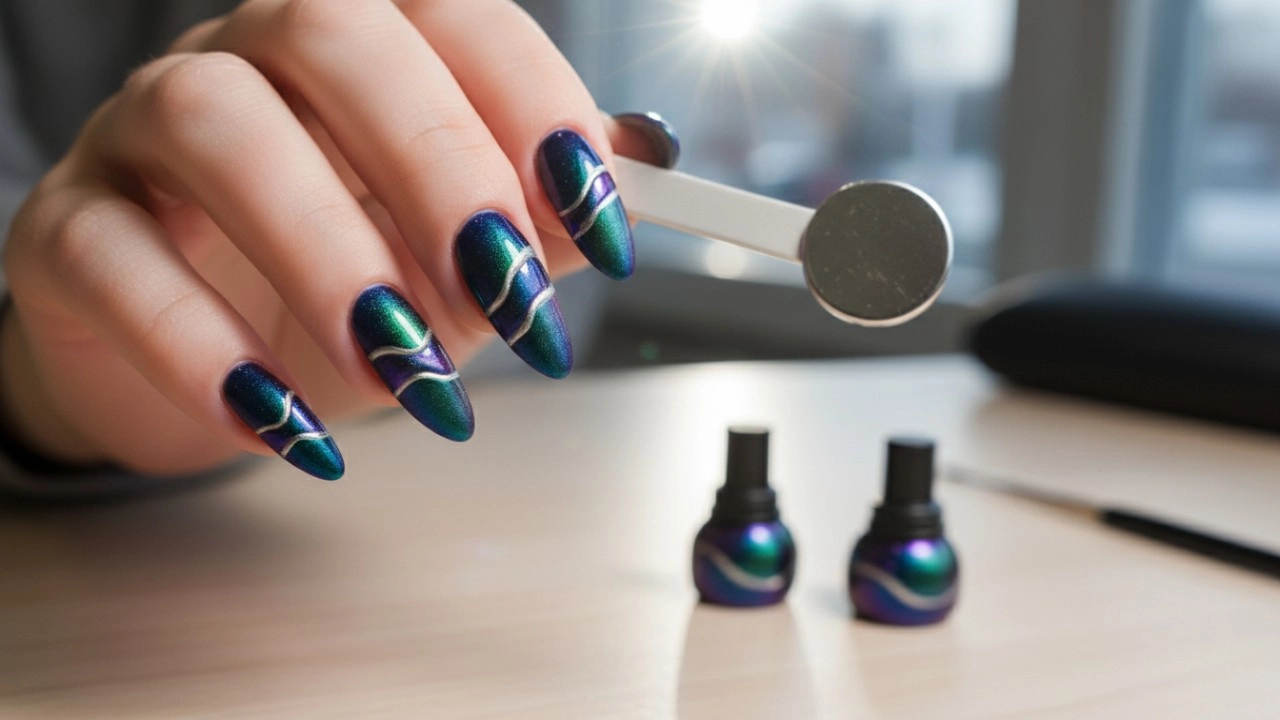
- Cat eye effects
- Jelly colors
- Chrome effects
- Shimmer shades
- Custom color matching
- Color number systems
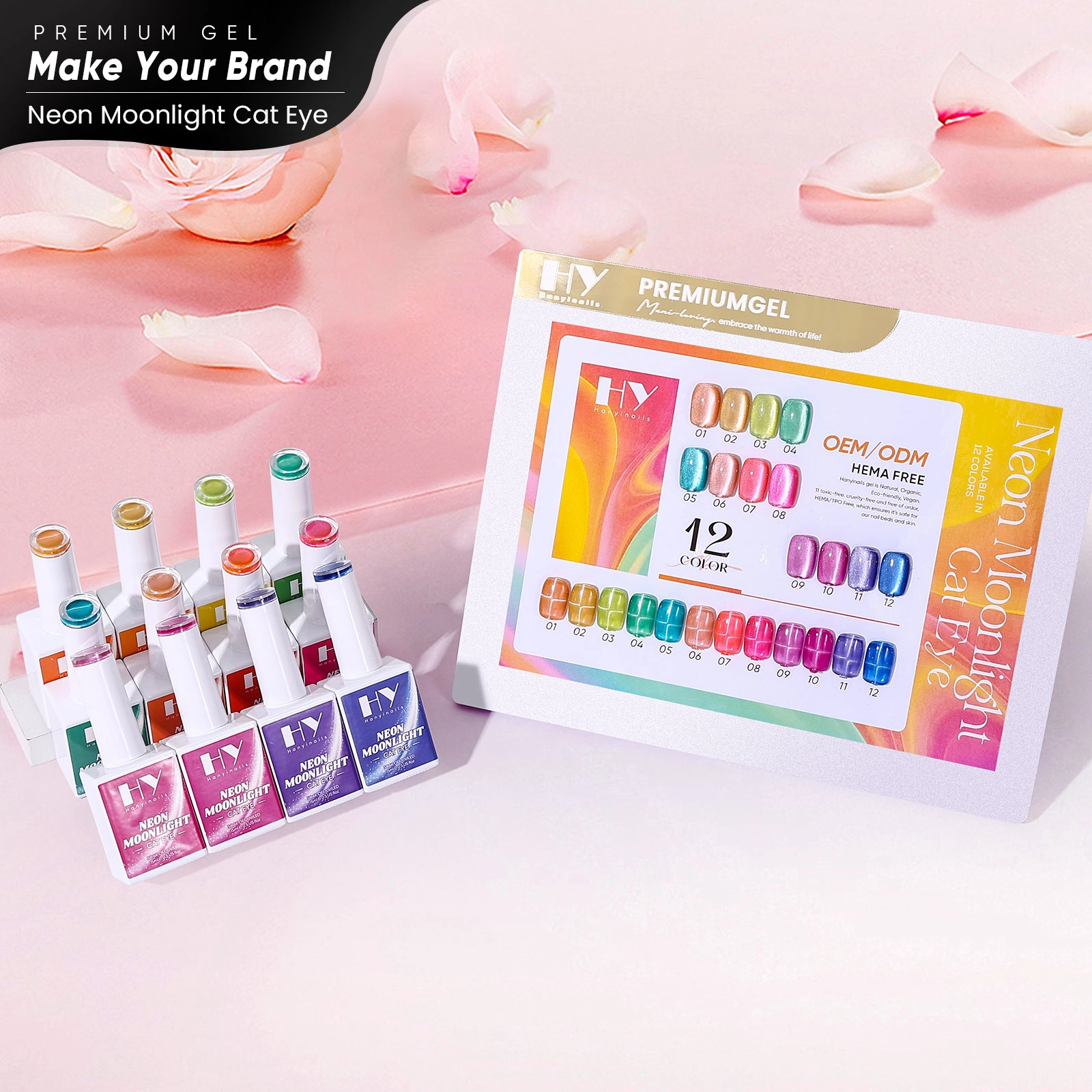
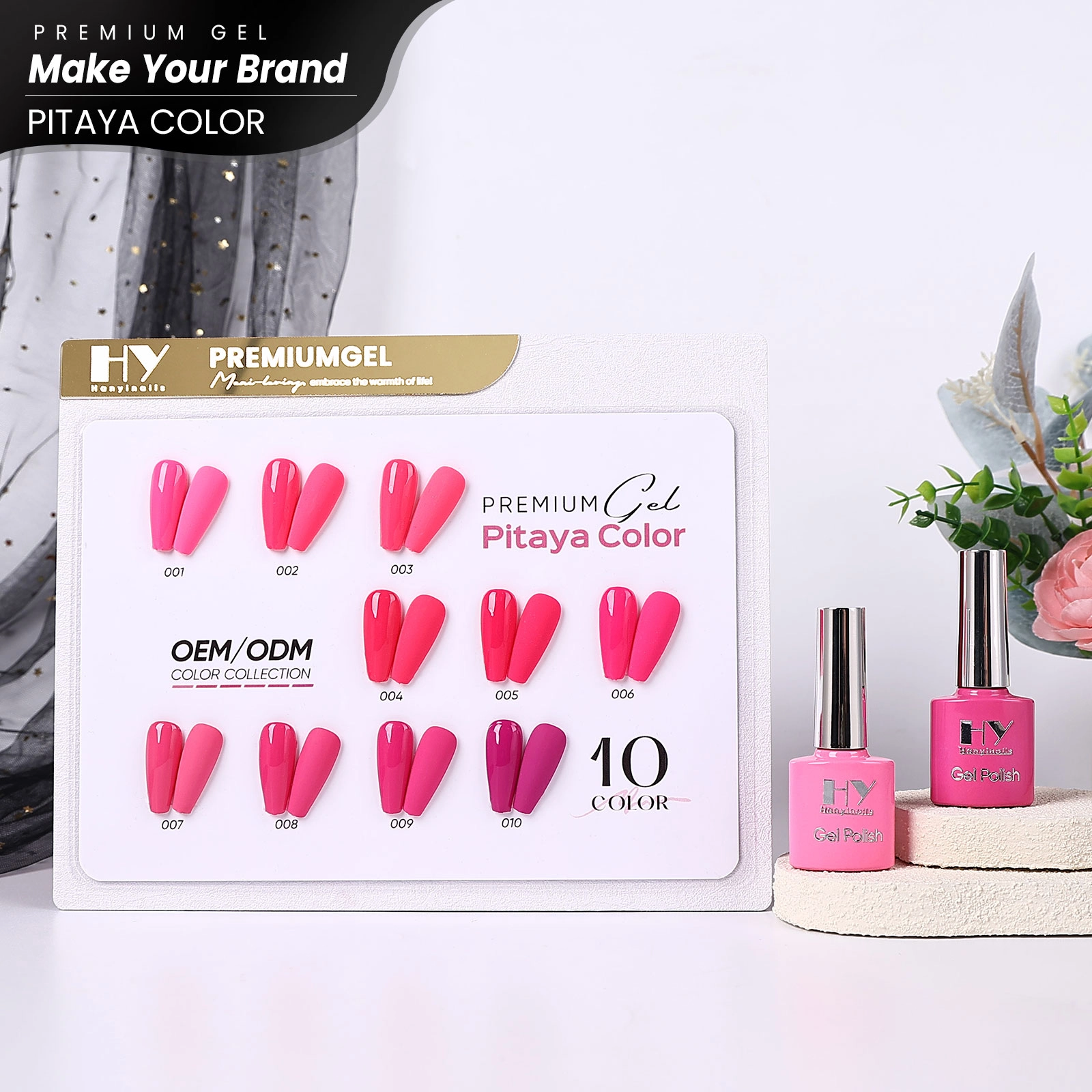
- Color chart planning
- Seasonal product planning
Hanyinails develops 2000 new colors per year, which can support private label nail brands, salons, distributors, and beauty businesses that need seasonal collections, custom color ranges, or private label color systems.
Bottle and Cap Customization
Bottle and cap choices affect product presentation, daily use, label space, and brand image. Buyers should confirm practical details before choosing a bottle style.
- Bottle size
- Bottle shape
- Bottle finish
- Cap style
- Brush type
- Label fit
- Color number placement
- Product name placement
- Outer box compatibility
- Carton packing method
Hanyinails supports more than 50 styles of stock bottles and caps and more than 600 styles of customized bottles and caps.
Labels, Boxes, Kits, and Color Charts
Private label packaging should be reviewed before printing. A label or box should not be finalized before color numbers, product names, formula requirements, document needs, and sample results are confirmed.
- Logo labels
- Color number labels
- Ingredient labels
- Warning text
- Outer boxes
- Kit boxes
- Color charts
- Display materials
- Barcode placement
- Carton labels
- Shipping marks
- Market-specific label information
Hanyinails supports more than 100 different styles of kit boxes and more than 200 styles of color chart design. Buyers planning private label branding can review the Create Your Brand page.
Quality Control and Sample Testing Before Bulk Production
Quality control is one of the most important parts of manufacturer evaluation. Buyers should ask how samples are reviewed, how approved samples are recorded, and how bulk production is checked against the approved standard.
| Review Area | What Buyers Should Check |
|---|---|
| Product Appearance | Whether the product appearance matches the agreed standard. |
| Color Accuracy | Whether the sample matches the approved shade, color chart, or reference color. |
| Viscosity | Whether the texture fits the target user and product positioning. |
| Application | Whether the product applies smoothly and evenly. |
| Curing or Drying Performance | Whether the product performs properly under the intended use conditions. |
| Finish | Whether the finish matches the expected glossy, matte, glitter, shimmer, jelly, or cat eye effect. |
| Coverage by Shade | Whether coverage is reviewed by color instead of assumed across the whole range. |
| Special Effects | Whether glitter, cat eye, shimmer, or other effects remain clear and consistent. |
| Compatibility | Whether the product works with the intended base coat, top coat, or product system. |
| Soak-Off or Removal | Whether removal performance fits the intended user experience, if applicable. |
| Packaging Accuracy | Whether bottles, caps, labels, boxes, color numbers, and cartons are correct. |
| Batch Consistency | Whether bulk production matches approved samples and agreed specifications. |
Buyers should avoid using broad performance claims before testing. A claim may apply to one formula or color but not automatically apply to every product, effect, shade, or future batch. Hanyinails has 8 QA/QC inspectors to support nail gel production checks. Buyers should still confirm project-specific inspection requirements, especially for custom formulas, color matching, special effects, packaging, color charts, and target market documents.
Documents and Market Requirements Buyers Should Confirm
Document requirements can vary by product type, formula, target country, sales channel, and product claims. Buyers should confirm which documents are available for the specific product and whether additional market review is needed.
Before launch, buyers should ask about:
- Ingredient information
- SDS
- Product specification sheet
- Formula claim confirmation
- Label files
- Packaging artwork
- Approved sample records
- Color number list
- Batch information
- Test reports, if required
- CPNP-related documents for EU projects, if applicable
- Market-specific language or warning requirements
- Responsible person or importer requirements, if applicable
- Carton label and shipping mark requirements
Buyers should be careful with marketing claims. If a brand wants to use claims such as HEMA-free, TPO-free, vegan, cruelty-free, low-odor, long-lasting, professional use, or salon-grade, the buyer should confirm whether suitable product information and documents support those claims for the specific product. Hanyinails provides certification-related information on the Certifications page.
How to Compare Nail Polish Manufacturers Without Relying on Rankings
Many buyers search for lists of nail polish manufacturers, but rankings can be difficult to verify. A ranking may be based on brand awareness, company size, online visibility, export activity, product range, or editorial opinion. These factors do not always show whether a manufacturer is the right partner for a specific OEM or private label project.
Instead of relying only on manufacturer lists, buyers should compare manufacturers with a practical checklist.
Product Capability
Does the manufacturer support the product type, formula direction, color range, and special-effect needs required for the project?
Customization Support
Can the manufacturer support bottle, cap, label, box, kit packaging, color chart, and private label requirements?
Sample Process
Does the manufacturer provide a clear sample process for color approval, packaging review, and product testing?
QC Process
Does the manufacturer explain how samples, production batches, packaging, color numbers, and cartons are checked?
Document Availability
Can the manufacturer provide the product documents needed for the target market and product claims?
Communication
Does the manufacturer respond clearly to RFQ details, technical questions, packaging requests, and timeline discussions?
Reorder Planning
Can the manufacturer support repeat orders, color number consistency, packaging consistency, and longer-term product planning?
RFQ Checklist for OEM/ODM Nail Polish Supplier Projects
A clear RFQ helps the manufacturer understand the project and provide more accurate feedback. Instead of asking only for a general price, buyers should prepare detailed project information.
- Company or brand name
- Buyer type, such as salon, distributor, retailer, wholesaler, or private label brand
- Target country or sales market
- Product type
- OEM, ODM, private label, or contract manufacturing model
- Number of colors or SKUs
- Existing color selection or custom color matching
- Special effects, if needed
- Formula expectations
- Performance requirements
- Bottle size
- Bottle shape and finish
- Cap style
- Brush requirement
- Label and logo files
- Outer box requirement
- Kit box requirement
- Color chart requirement
- Product set or bundle plan
- Claims that need document verification
- Certification or documentation needs
- Sample quantity
- Sample testing plan
- Estimated order quantity
- Reorder plan, if available
- Launch schedule
- Shipping destination
- Carton labeling requirements
- Product photography or display material needs
How Hanyinails Supports Private Label and OEM Nail Gel Projects
Hanyinails is a professional nail products manufacturer focused on professional nail gel items. The company supports OEM customization and one-stop customization for nail brands, salons, distributors, wholesalers, retailers, and beauty businesses.
Verified manufacturing and customization capabilities include:
- 12 years of OEM customization experience
- 10 production lines
- 60 production machines
- 8 QA/QC inspectors
- 8000㎡ workshop
- 2000 new colors per year
- More than 50 styles of stock bottles and caps
- More than 600 styles of customized bottles and caps
- More than 100 different styles of kit boxes
- More than 200 styles of color chart design
- Participation in exhibitions in more than 10 countries every year
These capabilities can support private label nail brands and global buyers that need custom color collections, packaging systems, sample testing, color charts, and longer-term OEM or contract manufacturing discussions.
For larger or ongoing production needs, buyers can review the Contract Manufacturing page.
Ready to Discuss an OEM/ODM Nail Polish or Gel Polish Project?
Share your product type, target market, color quantity, packaging needs, sample requirements, document needs, order quantity, and launch schedule with Hanyinails for project-specific discussion.
Common Mistakes When Choosing Nail Polish Manufacturers
Mistake 1: Relying Only on Manufacturer Lists
A supplier list does not prove that a manufacturer fits a specific project. Buyers should review product type, customization needs, samples, QC, documents, packaging, communication, and target market requirements.
Mistake 2: Choosing Only by Price
Price matters, but it should not be the only decision factor. A low quote may not include packaging details, sample revisions, special effects, document needs, color chart requirements, or inspection expectations.
Mistake 3: Not Defining the Product Type Clearly
A manufacturer cannot provide accurate feedback if the buyer only says “nail polish” without specifying whether the project is for traditional nail polish, gel polish, color gel, builder gel, base coat, top coat, or another nail gel product.
Mistake 4: Making Claims Without Verification
Claims such as long-lasting, HEMA-free, TPO-free, vegan, cruelty-free, low-odor, professional use, or salon-grade should not be used casually. Buyers should confirm whether product information and documents support the claim.
Mistake 5: Printing Packaging Too Early
Labels, boxes, color charts, and kit boxes should not be printed before formula details, color numbers, product names, label information, sample results, and document needs are confirmed.
Mistake 6: Ignoring Sample Testing
Samples should be tested for color accuracy, application, viscosity, finish, curing or drying performance, special effects, packaging accuracy, and batch expectations before bulk production.
Mistake 7: Assuming One Supplier Fits Every Market
Different target markets may have different requirements for ingredients, labels, documents, responsible parties, product claims, and sales channels. Buyers should confirm market requirements before launch.
Mistake 8: Sending an Incomplete RFQ
A vague RFQ can slow down communication and lead to inaccurate project planning. Buyers should prepare product type, color quantity, packaging details, sample needs, document requirements, order quantity, and launch schedule.
FAQ: Nail Polish Manufacturers OEM/ODM Selection
What should buyers look for in nail polish manufacturers?
Buyers should review product range, OEM/ODM support, customization options, packaging choices, color development capability, sample testing process, quality control checks, document availability, communication, and target market fit.
What is the difference between OEM and ODM nail polish manufacturing?
OEM usually means production based on the buyer’s specific requirements. ODM may include manufacturer-supported product development or existing product options that the buyer can adapt for its own brand.
What is private label nail polish manufacturing?
Private label nail polish manufacturing means products are produced under the buyer’s brand name, often with custom labels, bottles, caps, boxes, kit packaging, color charts, and product presentation.
Should buyers rely on rankings of nail polish manufacturers?
Rankings can be difficult to verify and may not reflect whether a manufacturer fits a specific project. Buyers should compare manufacturers by product capability, customization support, samples, QC checks, documents, and RFQ response quality.
What customization options are common for OEM/ODM nail polish projects?
Common options include custom colors, existing color selection, bottle size, bottle shape, cap style, brush type, logo label, outer box, kit box, color chart, color numbering system, product sets, and packaging artwork.
What should buyers test before bulk production?
Buyers should test color accuracy, viscosity, application, finish, curing or drying performance, special effects, coverage by shade, packaging accuracy, color chart accuracy, and batch consistency before bulk production.
What documents should global buyers ask for?
Document needs depend on product type and target market. Buyers may ask for ingredient information, SDS, product specifications, formula claim confirmation, label files, approved sample records, color number lists, test reports if required, and CPNP-related documents for EU projects if applicable.
How does Hanyinails support OEM/ODM nail polish and nail gel projects?
Hanyinails supports OEM customization with 12 years of experience, 10 production lines, 60 production machines, 8 QA/QC inspectors, an 8000㎡ workshop, 2000 new colors per year, and a wide range of bottle, cap, kit box, and color chart customization options.
Winter Nail Care: Essential Products to Protect Your Nails in Cold Weathe
Builder Gel 101: Application Techniques for Beginners – Your Complete Step-by-Step Guide
Bridal Nails 2026: The Ultimate Guide to the Perfect Wedding Manicure – Trends, Colors & Products
Holiday Gift Guide 2026: The Best Nail Product Sets for Every Nail Lover on Your List
Fall 2026 Nail Trends: What to Wear This Season – From Mocha Cat Eye to Ghost Rose
Iced Coffee Glass Nails: The Luxe Manicure Trend Everyone’s Talking About in 2026
Recommended for You
-
🔑 Key Features:
🌸 72 Colors – Full range for every style
💅 28-Day Wear – Chip-resistant & long-lasting
✨ High Gloss Finish – Salon-quality shine
🌿 HEMA/TPO Free – Safe & gentle formula
🛠️ OEM/ODM Support – Custom colors & branding -
✅ Private Label & Customizable – From formula to packaging, tailor your cat eye nail polish brand with flexible OEM/ODM services.
✅ Best Cat Eye Nail Polish Formula – Ultra-fine magnetic pigments ensure sharp, shifting lines and a 3D luminous finish with just one swipe.
✅ Long-Lasting & Chip-Resistant – Up to 3+ weeks of wear, designed for durability and brilliance.
✅ HEMA-Free & TPO-Free Options – Gentle, safer formulas available to meet global compliance and sensitive skin needs.
✅ Low MOQ & Fast Delivery – Scalable solutions for both startup brands and global distributors.
✨ Key Features:
-
-
🌸 24 Sakura Shades – Soft pinks, cherry blossoms, and pearl whites – a full spring cat eye collection.
✨ Twinkle Sparkle Effect – Fine holographic shimmer creates a delicate, glittering cat eye.
💎 Multidimensional Shine – Ultra-fine glitter delivers a dreamy, twinkling finish.
💅 HEMA & TPO Free – Non-toxic, low-odor, gentle on natural nails.
⚡ UV/LED Curable – 60s under LED, 90s under UV – lasts up to 4 weeks.
🧲 Easy Application – Apply, magnet swipe, cure – professional results at home.
🎨 24 Colors Collection – Endless creativity for salons and DIY enthusiasts.
🛠️ OEM/ODM Supported – Custom colors, packaging, and branding available.
-
-
✨ Key Features:
🧲 Plated Effect—Creates a stunning magnetic aurora finish with brilliant color shifts.
⚡ Fast Curing—Cures completely under LED/UV lamp in 60 seconds.
🎨 High Pigmentation—Full coverage in just one coat for rich, vibrant color.
💎 High Gloss—Shines intensely without top coat for a mirror-like finish.
🌿 Healthy Formula—Vegan, cruelty-free, and HEMA-free options available.
📦 OEM/ODM Supported—Custom colors, bottles, and packaging available.
Looking for a creative, premium, and reliable nail product manufacturer?
Whether you're an Amazon seller, Shopify store owner, chain store buyer, brand owner, distributor, wholesaler, or nail supply retailer — Hanyinails is your trusted partner for custom and wholesale nail solutions.
Hanyinails
Hanyinails
Hanyinails
Hanyinails