How to Choose Salon-Quality Gel Polish for Professional Salon Use
Friday, 11/21/2025
Best Gel Nails Polish Brand for Salon selection hinges on durability, finish, and ease of application. Hanyinails breaks down key factors to identify Salon-Quality Gel Polish and choose Gel Polish for Professional Salon use that ensures client satisfaction and efficient workflow.
Choosing gel polish for a professional salon is not simply a matter of finding the most fashionable shade, the strongest pigment, or the product with the boldest performance claims.
For a salon, gel polish is part of a complete service workflow.
That means the product should be evaluated by how it:
applies;
levels;
covers;
cures;
wears;
removes;
repeats across shades;
and affects the cost and consistency of the finished service.
For salon owners, nail technicians, distributors, and professional buyers, the most useful question is not:
“Which gel polish brand is the best?”
It is:
Can this gel polish system perform consistently enough under the real conditions in which we plan to use it?
This guide focuses on how to test and evaluate salon-quality gel polish before adding a new product line to a professional service menu or making a larger purchasing decision.
Evaluate salon-quality gel polish by testing the complete professional workflow—not just the color swatch.
A useful evaluation should include application control, coverage across different shade types, viscosity and leveling, product-specific curing compatibility, real-service wear, removal, shade and batch consistency, technician time, product waste, and overall cost per service.
A gel polish that looks good in the bottle may still be a poor salon fit if it creates flooding, streaking, inconsistent curing, excessive rework, difficult removal, or unreliable repeat orders.
What Does “Salon-Quality Gel Polish” Mean in This Guide?
“Salon-quality” is not treated here as a universal certification or legal grade.
For this guide, it means a gel polish system that can be evaluated against the practical requirements of professional salon use.
Those requirements may include:
controlled application;
predictable coverage;
manageable viscosity;
clear curing instructions;
stable surface finish;
acceptable wear under real service conditions;
practical removal;
repeatable color behavior;
and sufficient product information for professional use.
The words “professional,” “salon grade,” “high pigment,” “long lasting,” or “premium” do not prove those qualities on their own.
The product should be tested.
8 Performance Areas to Evaluate Before Buying Gel Polish
1. Application Control
Application control directly affects technician efficiency.
Test how the product behaves around:
the cuticle area;
sidewalls;
the free edge;
curved nail surfaces;
and smaller nail plates.
Observe:
Does the gel flood after placement?
Does it drag under the brush?
Does the brush leave visible streaks?
Can a technician create a thin, controlled layer?
Does the product pull away from the edge before curing?
Does its working behavior remain predictable during the service?
The goal is not to find the thickest or thinnest gel. The goal is to find a working consistency that technicians can control reliably.
2. Coverage Across Different Shade Types
A gel polish line should not be judged from one easy shade.
Representative testing should include categories such as:
nude;
sheer pink;
white;
red;
black;
dark blue;
glitter;
and highly saturated shades.
Evaluate:
streaking;
patchiness;
brush marks;
color depth;
consistency between layers;
and whether the intended finish can be created using controlled coats.
“High pigment” or “one-coat coverage” should not be used as the only definition of professional quality.
Can the shade achieve its intended appearance while remaining compatible with the product's curing instructions and salon workflow?
A product that moves too quickly may flood the cuticle or sidewalls. A product that moves too slowly may require extra manipulation.
Test:
how the product leaves the brush;
how quickly it moves after application;
whether it levels without spreading excessively;
how it behaves on curved surfaces;
and whether different technicians can use it consistently.
Predictable behavior is more useful than simply labeling a gel “thick” or “self-leveling.”
4. Curing Compatibility
Gel polish should be evaluated together with its specified curing system.
Do not assume that:
all gel polishes use the same curing time;
every lamp is interchangeable;
or lamp wattage alone determines whether a product is adequately cured.
Before testing a line, confirm:
the product-specific curing instructions;
the supported curing device or lamp type;
the recommended application thickness;
and whether the intended base, color, and top system is designed to work together.
Testing should use the same curing setup that the salon plans to use in practice.
5. Wear Under Real Service Conditions
Wear claims should be tested rather than treated as universal guarantees.
Performance may be influenced by:
nail preparation;
natural nail condition;
application technique;
layer thickness;
base and top compatibility;
curing;
service type;
client activity;
and aftercare.
Useful observations include:
edge wear;
chipping;
lifting;
cracking;
gloss retention;
color stability;
and differences between shade categories.
The goal is not to prove one universal wear period. The goal is to understand whether the system performs consistently enough for the salon's actual service conditions.
6. Removal Workflow
Removal should be included in product testing from the beginning.
Confirm whether the product is intended for:
soak-off removal;
file-off removal;
partial filing;
or another specified process.
Evaluate:
technician time;
how easily the specified process can be followed;
how much material remains;
whether unnecessary scraping or aggressive filing can be avoided;
and whether the method fits the salon's appointment structure.
A product should not be judged only by how quickly it applies. Removal also consumes salon time.
7. Color and Repeatability
Professional salons often reorder the same shades repeatedly. That makes repeatability important.
When possible, compare repeated samples for:
shade;
opacity;
viscosity;
effect distribution;
surface finish;
product identification;
and application behavior.
For distributors and private-label buyers, repeatability becomes even more important because customers expect the same shade to perform similarly when reordered.
One successful bottle is not enough to evaluate an entire line.
8. Product Information
Professional testing should also include the information supplied with the product.
Depending on the product and target market, relevant information may include:
ingredient information;
usage instructions;
curing guidance;
warning information;
storage guidance;
product specifications;
SDS where applicable;
labeling information;
and relevant market-specific documentation.
An SDS is not a universal “safety certification.”
Likewise, one certificate, document, or ingredient-free claim does not prove that a product is suitable for every market or every user.
How Should Salons Test Gel Polish Before Buying?
A color chart shows appearance. It does not show professional performance.
A stronger evaluation uses representative shades and repeats the same controlled tests.
Test 1: Nude or Sheer Shade
Use a nude, milky, or sheer shade to examine streaking, transparency, brush marks, layering, and surface evenness.
These colors often reveal application issues that are less visible in dense shades.
Test 2: White
White can reveal problems with opacity, streaking, layer control, surface uniformity, and product-specific curing behavior.
Avoid compensating for weak application by creating unnecessarily thick layers.
Test 3: Black or Dark Shade
Test a dark color according to its specific product instructions.
Observe layer thickness, brush control, color consistency, surface result, and compatibility with the salon's actual curing setup.
Test 4: Red or Saturated Shade
Use red or another saturated color to evaluate pigment distribution, brush consistency, color repeatability, and whether repeated applications produce a similar appearance.
Test 5: Base + Color + Top
Do not test the color product only in isolation.
Base → Color → Top
Evaluate layer compatibility, curing, shrinkage, wrinkling, gloss, and the finished surface.
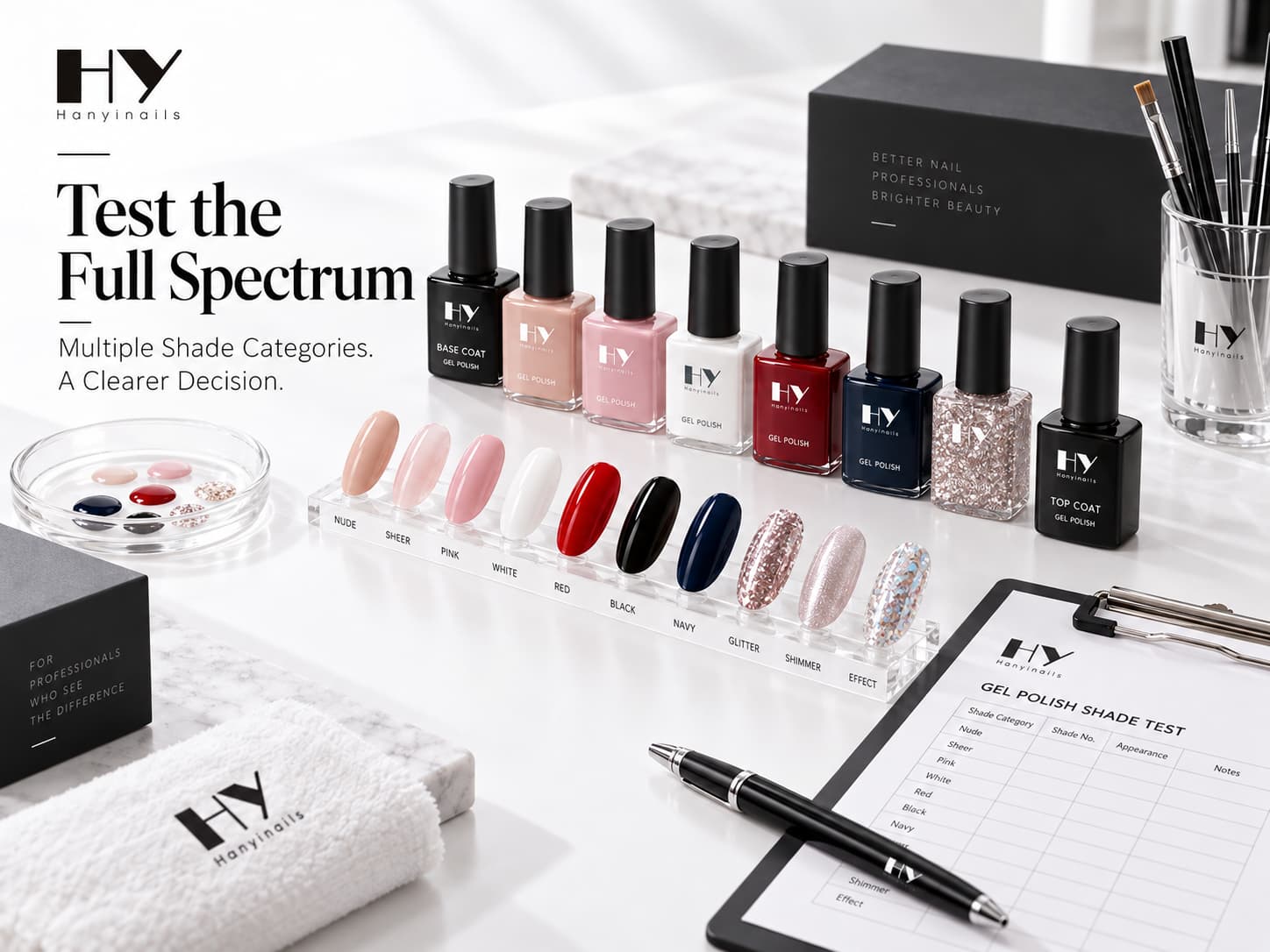
Representative shade testing helps salons evaluate streaking, coverage, layer control, curing compatibility and finish across different gel polish color categories instead of judging an entire line from one easy shade.
Test 6: Real-Service Wear
Use the same preparation, application, lamp, layer thickness, and service process that will be used in the salon.
Monitor the result over time.
Do not treat one client or one nail type as proof for every customer. Look for repeatable patterns.
Test 7: Removal
Use the product's specified removal method.
Track technician time, remaining material, difficulty, and whether the process integrates efficiently into the salon workflow.
Test 8: Repeatability
Repeat the evaluation across more than one shade, more than one technician when practical, and more than one sample or batch when relevant.
Professional buying decisions should be based on repeatable behavior rather than a single successful demonstration.
Build a Simple Gel Polish Test Scorecard
Instead of relying on memory, salons can record the same evaluation points for every product sample.
Test Area
What to Record
Application Control
Flooding, dragging, brush control, edge precision
Coverage
Streaking, patchiness, layer consistency
Viscosity
Flow, leveling, technician control
Curing
Compatibility with specified system and intended layer thickness
Finish
Gloss, surface smoothness, color result
Wear
Chipping, lifting, edge wear, gloss retention
Removal
Method, technician time, remaining material
Repeatability
Shade, viscosity and behavior across repeated samples
The purpose is not to create an artificial “perfect score.”
It is to compare products using the same criteria.
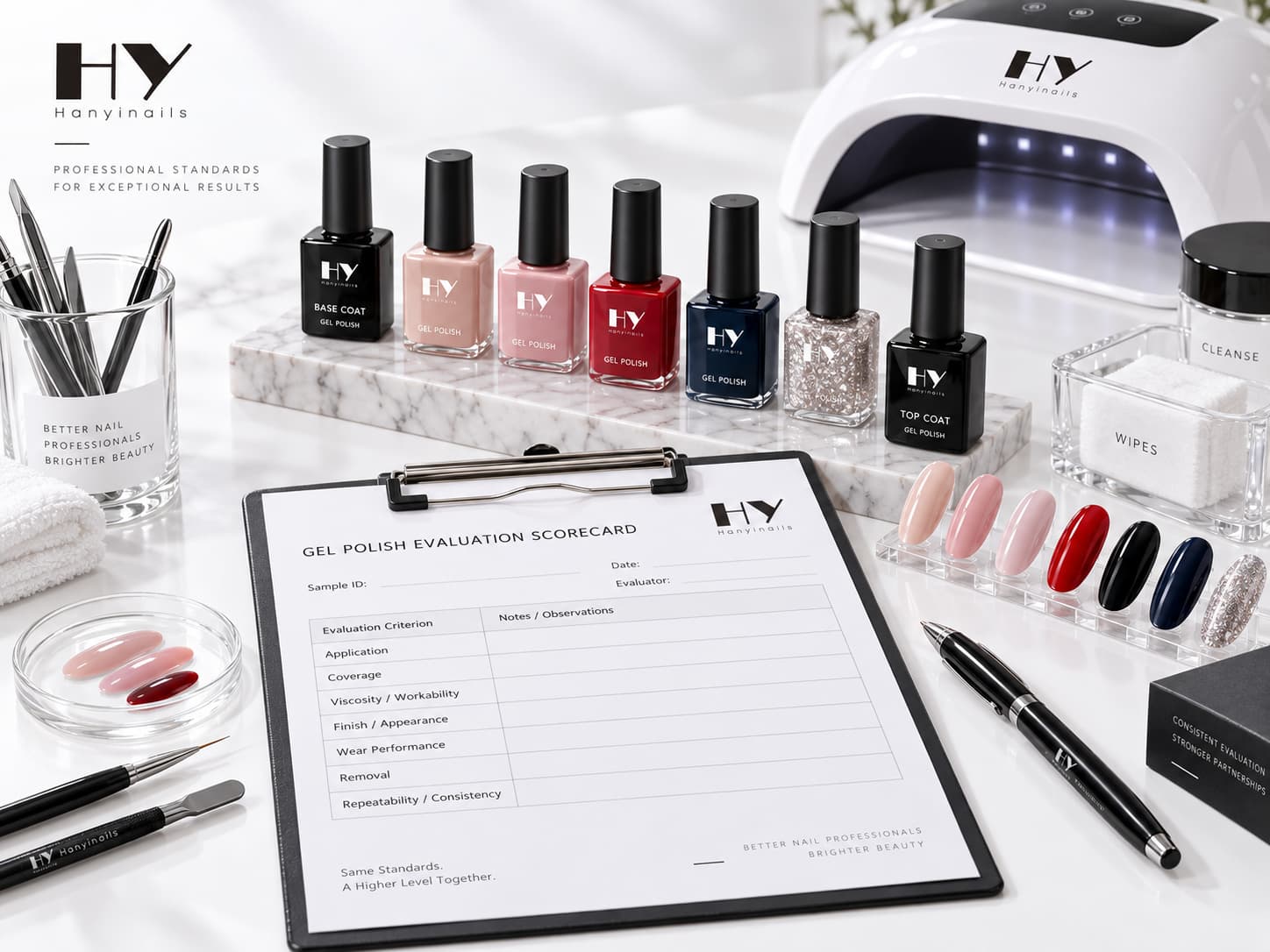
Using the same evaluation criteria for every sample makes it easier to compare application control, coverage, viscosity, curing compatibility, finish, wear, removal and repeatability.
How Gel Polish Performance Affects Salon Workflow
A technically usable product can still be inefficient for a particular salon.
Professional evaluation should therefore consider the complete service process.
Application Time
Time can be affected by:
flooding;
streaking;
brush control;
cleanup;
leveling;
and the number of controlled layers needed for the intended result.
A formula that appears fast may not save time if technicians need repeated correction.
Curing Workflow
Evaluate whether the system's curing requirements fit the salon's equipment, technician process, service sequence, and shade range.
Consistency is more valuable than assuming every color will behave identically.
Finishing Workflow
Test top coat behavior, surface gloss, tacky-layer handling where applicable, and whether the intended finish remains predictable.
Removal Workflow
Removal time affects appointment length, technician workload, service pricing, and client experience.
That makes removal a business variable as well as a technical one.
Price per Bottle Is Not the Same as Cost per Service
Bottle price alone does not tell a salon how expensive a gel polish is to use.
Product Cost + Technician Time + Cleanup / Rework + Removal Time + Product Waste + Reorder Reliability
A lower-priced bottle may create a higher-cost service if it requires extra cleanup, produces inconsistent shades, creates more rework, wastes technician time, or cannot be reordered reliably.
A higher-priced bottle does not automatically provide better economics either.
What is the total cost of delivering a consistent service with this product?
How to Evaluate Cost per Service
Product Usage
Estimate how much product is typically consumed in a service. Do not assume that bottle size alone determines value.
Technician Time
Track whether the product creates smooth application, repeated cleanup, correction work, or extra steps.
Rework
Record avoidable issues such as streaking, lifting, uneven finish, unexpected shrinkage, or service corrections.
Removal Time
Include the labor required to remove the previous service using the specified method.
Waste
Consider unused shades, duplicate colors, packaging loss, product that becomes difficult to use, and slow-moving inventory.
Reorder Reliability
A popular salon shade loses commercial value if replacement stock cannot be identified or reordered consistently.
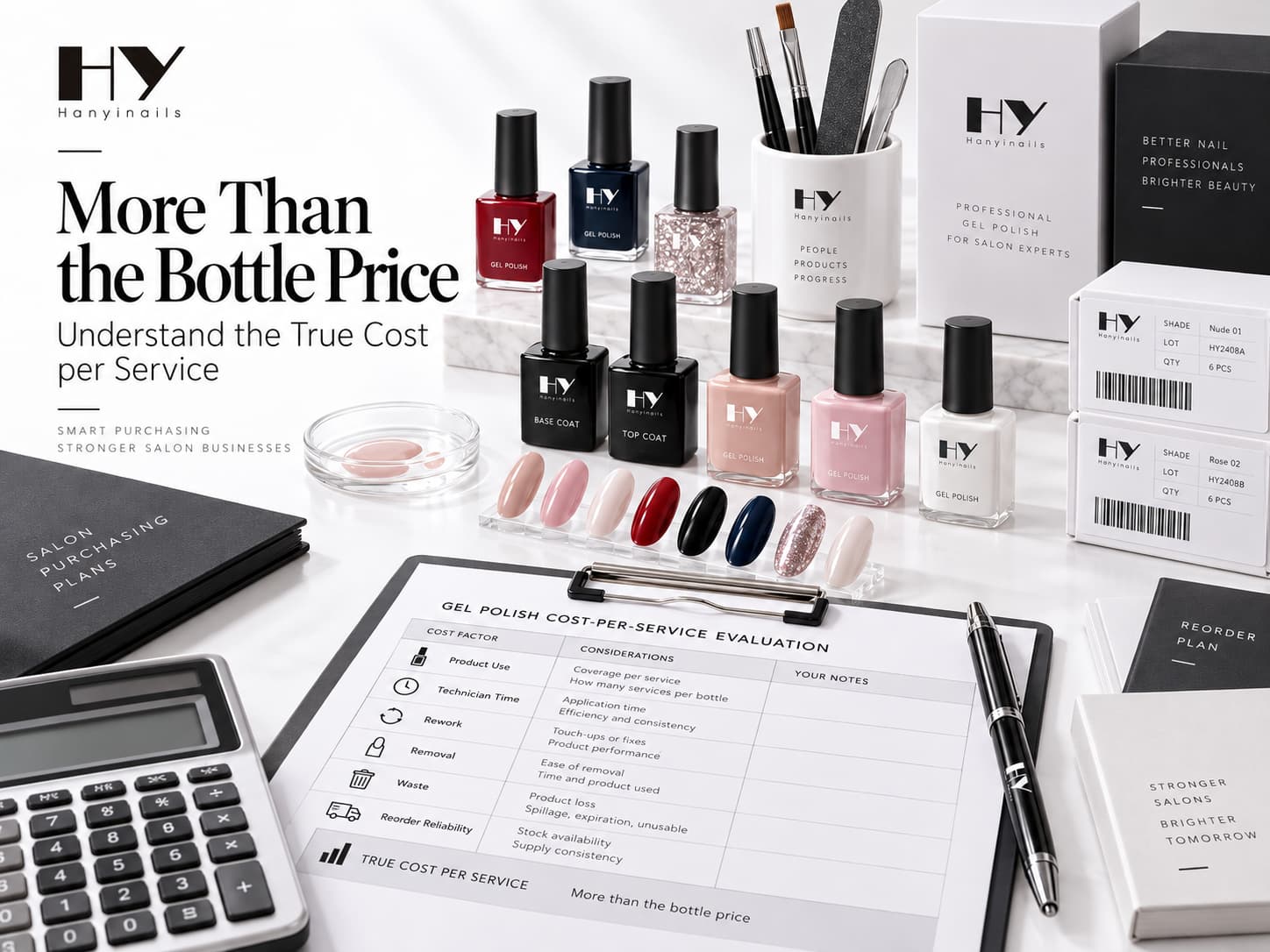
Professional buyers should evaluate total service cost, including product use, technician time, cleanup or rework, removal, waste and reorder reliability—not bottle price alone.
Common Gel Polish Evaluation Mistakes
Testing Only Easy Colors
One mid-tone shade does not represent the full line. Test challenging shade categories as well.
Using Pigmentation as the Main Quality Measure
More pigment is not automatically better. Coverage should be evaluated together with application, curing, consistency, and intended finish.
Ignoring the Complete System
A color gel may behave differently depending on the base, top, curing system, and preparation process. Test the combination that will actually be used.
Looking Only at Initial Application
A successful first application does not tell you wear, removal, repeatability, or reorder consistency.
Ignoring Technician Time
A product can appear inexpensive while increasing labor cost.
Treating Ingredient-Free Claims as a Complete Safety Assessment
A “HEMA-free” or similar claim does not describe the entire formulation and should not automatically be interpreted as allergy-free.
Treating Documentation as a Marketing Badge
SDS, product specifications, ingredient information, and regulatory documentation serve different purposes. They should be reviewed for what they actually provide.
Buying in Volume Before Representative Testing
A large shade chart or attractive packaging cannot replace controlled sample evaluation.
A Short Supplier Check Before Purchasing
This page focuses on product testing rather than full supplier selection.
Before purchasing, however, buyers should still confirm a few practical points:
Can representative samples be tested before a larger order?
Are product-specific curing and removal instructions available?
Can shades and products be clearly identified for repeat ordering?
Is relevant product and market documentation available for review?
How are formula, shade, packaging, or product changes communicated?
Can technicians apply controlled layers without excessive flooding, dragging, or cleanup?
Shade Testing
Have representative nude, white, dark, red, sheer, and effect colors been evaluated?
Viscosity
Does the product behave predictably enough for the intended technique?
Curing
Are the product-specific curing requirements clear and compatible with the planned salon setup?
System Test
Have the intended base, color, and top products been tested together?
Wear
Has the product been reviewed under real service conditions rather than only on display tips?
Removal
Does the specified removal process fit the salon's appointment workflow?
Repeatability
Do repeated samples maintain acceptable color and working consistency?
Product Information
Are the usage instructions, warnings, ingredient information, and relevant documentation available?
Service Cost
Has the salon considered technician time, rework, removal, waste, and reorder reliability—not only bottle price?
Safety and Product Information
Professional nail products should be used according to their specific instructions.
Technical Context
The U.S. Food and Drug Administration advises users to read nail-product labels carefully and follow directions and warning statements. It also notes that allergic reactions can occur with some nail products.
DermNet's clinical information on acrylate allergy explains that certain acrylate monomers can act as irritants and allergens, and occupational exposure can be relevant for beauty professionals.
For professional gel services:
follow product-specific curing instructions;
minimize unnecessary skin contact with uncured material;
review available ingredient and warning information;
use the specified removal process;
and discontinue exposure if a suspected adverse reaction occurs.
Claims such as “non-toxic,” “skin-friendly,” “HEMA-free,” or similar marketing language should not replace evaluation of the complete product information.
Final Thoughts
Salon-quality gel polish should be tested as a service system, not judged as a bottle on a shelf.
Test → Measure → Calculate → Decide
Test how the product applies and cures.
Measure how it wears, removes, and repeats.
Calculate how it affects technician time and service cost.
Then decide whether it fits the salon's technical and commercial requirements.
For technicians, the priority is controllable and repeatable performance.
For salon owners, the product also needs to support an efficient service workflow.
For professional buyers, the strongest purchasing decision comes from representative sample testing and consistent evaluation—not from marketing claims alone.
Professional Gel Polish Evaluation
Test the Gel Polish Before You Build the Salon Line
Use representative shades and the salon's real service workflow to evaluate application, curing, wear, removal, repeatability, and cost per service before making a larger purchasing decision.
Salon-quality gel polish should meet the practical needs of professional service, including controlled application, appropriate coverage, clear curing instructions, predictable wear, workable removal, repeatability, and sufficient product information.
How should a salon test gel polish before buying?
Test representative shade categories such as nude or sheer, white, dark colors, red, and effect shades. Then evaluate the intended base, color and top system, curing compatibility, real-service wear, removal, and repeatability.
Does high pigmentation mean better gel polish?
Not automatically. Pigmentation should be evaluated together with application control, layer thickness, curing compatibility, color consistency, and the intended finish.
How do salons test gel polish curing compatibility?
Follow the product-specific curing instructions and test the gel with the curing setup, application thickness, base product, and top product that the salon plans to use.
How should salons test gel polish wear?
Apply the full system using the salon's real preparation, curing, and service process, then monitor chipping, lifting, edge wear, surface finish, and other repeatable performance patterns.
Why should removal be tested before buying gel polish?
Removal affects technician time and service workflow. A product that applies well may still be inefficient if its specified removal process does not fit the salon's service model.
Is HEMA-free gel polish allergy-free?
No. A HEMA-free claim does not mean a product cannot cause an allergic reaction. The complete formulation, warnings, instructions, and exposure conditions still matter.
What is cost per service for gel polish?
Cost per service includes more than bottle price. It can include product usage, technician time, cleanup or rework, removal time, product waste, inventory efficiency, and reorder reliability.
Should salons buy gel polish in bulk before testing?
Representative sample testing is preferable before a larger purchasing commitment. Color charts and marketing materials cannot show the product's full application, curing, wear, removal, and repeatability behavior.
Technical & Related Resources
U.S. Food and Drug Administration
Nail Care Products
— independent regulatory information covering nail-product directions, warnings, ingredients, and adverse reactions.
DermNet
Allergy to Acrylates
— independent dermatology information covering acrylate allergy, sensitization, allergic contact dermatitis, and occupational exposure considerations.
Looking for a creative, premium, and reliable nail product manufacturer?
Whether you're an Amazon seller, Shopify store owner, chain store buyer, brand owner, distributor, wholesaler, or nail supply retailer — Hanyinails is your trusted partner for custom and wholesale nail solutions.
Address: 303 West Gate, Block A, South China International Innovation Industrial Park, Foluo Road, Luocun, Nanhai District, Foshan, Guangdong Province, China.
We specialize in OEM & ODM services, offering tailored formulations, vibrant colors, and premium packaging. Contact us today to discuss your brand’s needs and get a personalized quote!
We specialize in OEM & ODM services, offering tailored formulations, vibrant colors, and premium packaging. Contact us today to discuss your brand’s needs and get a personalized quote!
We specialize in OEM & ODM services, offering tailored formulations, vibrant colors, and premium packaging. Contact us today to discuss your brand’s needs and get a personalized quote!






Hanyinails
Hanyinails
Hanyinails
Hanyinails