



1. Quick Answer: What Is Molding Gel for Nails?
Molding gel for nails is a shape-retentive nail-art gel used to create raised, sculpted, and textured decorations that maintain their form while being shaped before curing. Common applications include dimensional flowers, bows, shells, relief lines, ribbons, and embossed patterns.
Unlike conventional gel polish, which generally forms a relatively smooth color coating, molding gel is selected for controlled decorative shaping.
Its main working characteristics are:
- Shape retention: The gel maintains the intended raised structure before curing.
- Controlled movement: The artist can refine the material without excessive spreading.
- Tool responsiveness: The material can be shaped using compatible sculpting brushes, silicone tools, or other applicators.
- Dimensional definition: Petals, ridges, curves, and raised edges remain recognizable during application.
- Product-specific curing: Light-curable molding gels require the curing conditions specified for their exact formulation.
Molding gel is also marketed under related names such as moulding gel, modeling gel, modelling gel, 3D molding gel, and 3D sculpting gel. However, similar names do not guarantee identical formulations, working characteristics, or intended applications.
A thick gel is not automatically a suitable molding gel. Product selection must consider its intended purpose, consistency, edge definition, curing requirements, system compatibility, and removal method.
The key distinction is function: molding gel is primarily intended for three-dimensional decorative nail art, not automatically for structural reinforcement or nail extensions.
For the broader category of dimensional gel products, read the Hanyinails 3D Nail Art Gel Guide.
This article focuses specifically on molding gel terminology, formulation characteristics, professional applications, and product evaluation.
2. Molding Gel, Moulding Gel, Modeling Gel and Modelling Gel: What Is the Difference?
One of the main challenges in understanding molding gel for nails is that product terminology is not fully standardized across manufacturers, distributors, and nail-art markets.
Similar names may refer to products with different levels of firmness, transparency, tackiness, flexibility, curing requirements, or intended application.
The product name alone is therefore insufficient to establish its technical characteristics.
Molding Gel
Molding gel is commonly used to describe a gel intended for manual shaping of raised nail-art decorations.
The term emphasizes the ability to mold or form dimensional shapes before curing.
Typical applications may include petals, bows, textured lines, and ornamental details.
However, products marketed as molding gel for nails may differ substantially in consistency, shape retention, working time, and final appearance.
Moulding Gel
Moulding gel is the British-English spelling variation of molding gel.
In many nail-art listings, moulding gel for nails refers to the same general decorative product category.
The spelling difference does not independently establish a technical difference.
However, individual formulations sold under either spelling may still have different application requirements.
Modeling Gel
Modeling gel is another widely used product-marketing term.
Depending on the manufacturer, modeling gel for nails may describe a decorative sculpting product, a transparent gel intended for crystal-like effects, or a gel promoted for shaping within an enhancement system.
The term is not exclusively reserved for transparent decorative products.
In some product ranges, modeling terminology may also be associated with structural shaping applications.
Therefore, the word modeling does not establish whether the gel is decorative or structural, whether it is soak-off or file-off, or whether its performance is equivalent to molding gel.
Those characteristics must be confirmed from the exact product specification and intended-use instructions.
Modelling Gel
Modelling gel is the British-English spelling variation of modeling gel.
As with modeling gel, its technical meaning depends on the manufacturer and product formulation.
Products marketed as modelling gel may support dimensional decoration, but some products using similar terminology may be intended for other shaping functions.
The product's actual intended role must be verified.
3D Molding Gel
The term 3D molding gel generally emphasizes raised or dimensional decorative nail-art applications.
Adding "3D" may help customers identify a product's intended visual effect, but it does not indicate an exact viscosity, safe application thickness, structural strength, curing procedure, or removal method.
Terminology and Product Meaning Matrix
| Product Term | Typical Meaning in Nail-Art Marketing | What the Name Does Not Confirm |
|---|---|---|
| Molding Gel | Gel intended for manually shaped decorative effects | Exact firmness, curing or removal method |
| Moulding Gel | Regional spelling variation of molding gel | A different technical formulation |
| Modeling Gel | Gel marketed for shaping or sculpting; may describe decorative or other specified applications | Identical behavior to molding gel or structural suitability |
| Modelling Gel | Regional spelling variation of modeling gel | Standardized product specifications |
| 3D Molding Gel | Dimensional gel emphasizing raised decorative effects | Supported application thickness or structural strength |
| 3D Sculpting Gel | Broad description for raised sculpting applications | A particular chemical system or removal category |
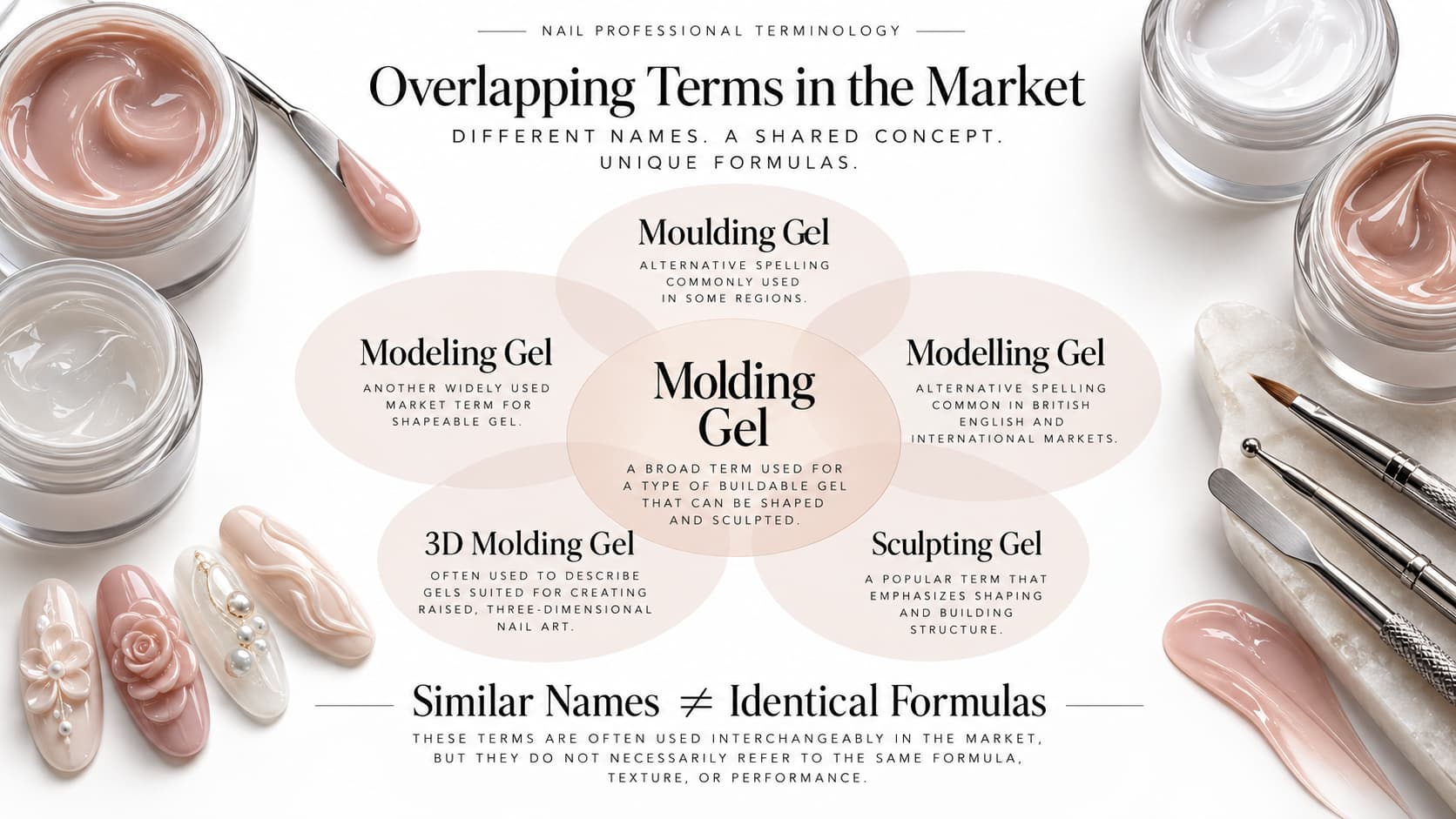
Are Molding Gel and Modeling Gel the Same?
They may be used interchangeably in some product listings, but they should not automatically be treated as identical formulas.
For professional purchasing, a more reliable comparison follows this sequence:
Product Name → Intended Use → Working Consistency → Shape Retention → Tool Compatibility → Curing Requirements → Finishing → Removal
For example, two products may both be marketed as modeling gel, but one may be designed for transparent water-drop effects while another is intended for opaque sculpted flowers or a different shaping application.
They may require different tools, compatible surfaces, curing conditions, and removal procedures.
Professional takeaway: Treat molding, moulding, modeling, and modelling as product-naming and search terms first. Confirm the exact formulation and intended application before drawing technical conclusions.
3. Molding Gel vs. 3D Sculpting Gel, Builder Gel and Regular Gel Polish
Molding gel is part of the broader dimensional nail-art category, but not every gel used in nail services is intended for the same purpose.
Some products are formulated for structural support, others for smooth color application, and others for decorative shaping.
The distinction should be based on documented function and application requirements rather than thickness alone.
The term "molding gel polish" is also sometimes used in product listings. However, this wording does not necessarily describe conventional self-leveling gel polish. The exact formulation and intended application should be checked.
Molding Gel vs. 3D Sculpting Gel
The terms molding gel and 3D sculpting gel often overlap.
Molding gel commonly emphasizes manually shaping a decorative material.
3D sculpting gel is a broader description that may include products designed for petals, ornamental structures, relief patterns, or other raised decorations.
A product may be marketed under both names.
However, a gel designed for large molded ornaments may not offer the same fine-line control as a gel intended for embossed painting.
Molding Gel vs. Builder Gel
Builder gel is primarily intended for nail reinforcement, overlays, apex construction, repairs, or extensions where the exact formulation supports those functions.
Molding gel is generally selected for decorative shape retention.
Some builder gels are relatively firm, while others are more self-leveling. Similarly, some molding gels may feel softer than expected but still provide sufficient control for their intended decorative applications.
Viscosity alone does not establish structural suitability.
A decorative molding gel should not be used as a structural extension product unless the manufacturer specifically supports and validates that application.
Molding Gel vs. Regular Gel Polish
Regular gel polish is primarily used to create a color coating.
Its working behavior generally supports relatively even spreading and a smooth appearance.
Molding gel is selected when the artist needs to maintain raised contours, curved petals, or decorative ridges.
Some specialty art gels can produce limited dimensional effects, but ordinary gel polish should not automatically be treated as a substitute for a dedicated molding product.
Molding Gel vs. Clear Modeling Gel
Clear modeling gel may be intended for transparent or translucent dimensional effects.
Possible applications include water-drop decorations, clear domes, glass-like petals, and crystal-inspired accents.
For these uses, optical clarity may be as important as shape retention.
A highly pigmented or opaque molding gel may be more appropriate when the design requires visible color coverage rather than transparency.
Professional Product Comparison Matrix
| Product Category | Primary Intended Role | Relevant Working Characteristic | Typical Application |
|---|---|---|---|
| Molding Gel | Manually shaped dimensional decoration | Shape retention and tool control | Flowers, bows, sculpted accents |
| 3D Sculpting Gel | Raised decorative nail art | Controlled dimensional shaping | Relief designs and ornamental details |
| Builder Gel | Nail enhancement and reinforcement | Structural properties defined by the formula | Overlays, apex building, extensions |
| Regular Gel Polish | Color coating | Relatively smooth spreading and leveling | Full-color nail coatings |
| Embossed / Liner Art Gel | Controlled decorative lines | Line definition and placement | Fine raised patterns and outlines |
| Clear Modeling Gel | Transparent dimensional effects | Optical clarity and appropriate shape retention | Water drops, crystal-inspired details |
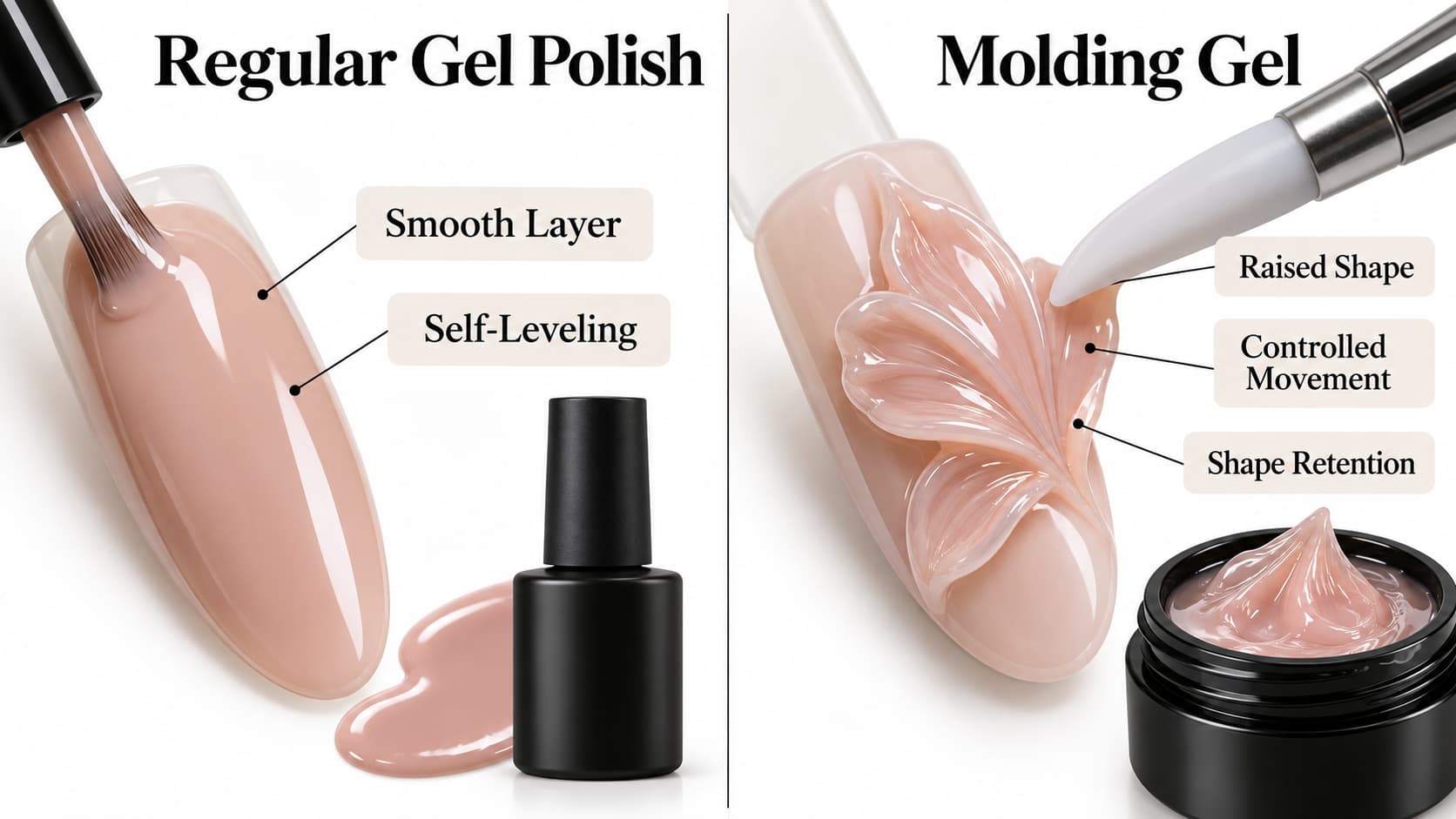
These descriptions indicate typical product roles, not universal standards.
A specific commercial formulation may combine several characteristics.
For example, a clear molding gel may also be firm and non-wipe, while another formulation may be translucent and require a separate finishing step.
For a broader explanation of 3D gel categories and professional applications, visit the 3D Nail Art Gel Guide.
4. Types of Molding Gel: Clear, Colored, Opaque and Shape-Retentive Formulas
Molding gels can differ in color, transparency, consistency, surface finish, and intended design.
These characteristics should be evaluated as a combination of properties rather than mutually exclusive categories.
A single product may be clear, firm, and non-wipe simultaneously.
Clear Molding Gel
Clear molding gel is used when transparency forms part of the intended decorative effect.
Depending on the formula, it may support transparent domes, raised water-drop effects, glass-like details, or dimensional patterns over colored backgrounds.
Important product characteristics include:
- Optical clarity.
- Bubble appearance.
- Clouding or haze.
- Shape retention.
- Compatibility with the intended background.
- Product-specific curing requirements.
- Appearance after the approved finishing process.
Transparency alone does not prove that a thick design will cure adequately.
For a focused discussion of transparent decorative effects, see Clear 3D Modeling Gel for Crystal Nail Designs.
Colored Molding Gel
Colored molding gel contains color as part of the sculpting formulation.
It may be useful for raised hearts, flowers, bows, and other decorations where the color should be integrated into the sculpted material.
Professional evaluation should consider pigmentation, edge definition, color consistency, and the manufacturer's supported application conditions.
The addition of pigments may affect light transmission and curing behavior.
Therefore, a colored molding gel should not automatically be processed using the same conditions as a different clear formulation.
Opaque and White Molding Gel
Opaque molding gels are useful when a decorative detail needs strong visual definition against the background.
White molding gel may be selected for raised bridal flowers, embossed textures, shell-inspired patterns, and other high-contrast designs.
Relevant evaluation criteria include:
- Opacity.
- Color consistency.
- Control of raised edges.
- Resistance to unwanted spreading.
- Appearance after the prescribed curing procedure.
- Compatibility with the intended finish.
White or opaque molding gel should not automatically be described as suitable for structural nail extensions.
That application requires separate product-specific validation.
For additional discussion of white decorative molding products, see the White 3D Molding Gel Guide. Any extension-related application discussed in that guide must be verified against the actual product's intended structural use.
Firm and Shape-Retentive Formulas
Some molding gels provide firmer working behavior for detailed or relatively prominent sculpted decorations.
This may help artists maintain curved petals, bow loops, or sharply defined relief structures before curing.
However, greater firmness is not automatically better.
An excessively stiff product may be difficult to press, refine, or blend for certain techniques.
Professional suitability depends on the balance between shape retention and practical tool control.
Non-Wipe Molding Gel
A non-wipe formulation is designed to provide a specified cured surface without an additional wiping step.
This property may be useful for certain textured or decorative finishing systems.
However, non-wipe does not automatically mean that a product is compatible with every chrome pigment, powder, or top coat.
The finishing procedure should be established for the exact product system.
Professional takeaway: Select molding gel according to the intended decorative effect, not simply whether the product is described as clear, thick, colored, or non-wipe.
5. What Makes a Molding Gel Hold Its Shape?
The defining performance characteristic of molding gel is its ability to maintain a controlled three-dimensional form during application.
However, shape retention is not determined by thickness alone.
It is influenced by the gel's formulation and flow behavior, as well as the conditions under which it is handled.
Shape Retention and Flow Behavior
A molding gel suitable for raised decorative work should resist excessive spreading while the artist forms the intended design.
For example, a petal should remain sufficiently defined after the tool is lifted.
A raised line should not immediately spread into a flat coating.
A bow loop should retain its intended contour during the permitted working stage.
These outcomes depend on how the formula behaves when placed, pressed, and released.
Some gels may feel firm when undisturbed but become easier to manipulate under tool pressure.
This type of behavior can be relevant to professional sculpting, although not every molding gel is designed to exhibit the same flow properties.
Tool Control
Tool control describes how predictably the material responds during placement and shaping.
A professional user may evaluate whether the gel:
- Transfers consistently from the container.
- Can be positioned without excessive dragging.
- Responds predictably to sculpting pressure.
- Maintains defined edges.
- Separates cleanly from the tool when intended.
- Allows corrections during the supported working stage.
- Remains manageable across repeated design elements.
A product that provides strong shape retention but is extremely difficult to manipulate may not suit all techniques.
The useful working consistency depends on the intended decorative task.
Stringing and Tool Sticking
Some sculpting gels form strings or cling to tools during pickup and shaping.
A certain amount of tackiness may be characteristic of a particular formulation, but excessive dragging can make detailed work difficult.
Possible contributors include the product's working properties, tool condition, application technique, and material quantity.
The recommended approach should follow the product instructions.
Do not assume that alcohol, cleanser, or a slip solution can be added to every molding gel without affecting its behavior.
Any tool liquid or handling aid must be compatible with the formulation.
Professional tool cleanliness and protection from unintended curing-light exposure are also important.
Edge Definition
Edge definition is particularly relevant to petal shapes, bows, raised lines, and shell textures.
For example:
- A flower requires identifiable petal edges.
- A bow needs controlled loops and a center connection.
- A shell-inspired texture relies on consistent relief ridges.
- A raised line requires predictable width and continuity.
A product may perform well for one effect but provide insufficient precision for another.
Therefore, shape retention should be evaluated using representative designs rather than only observing a gel in its container.
A Practical Shape-Retention Observation Example
When evaluating a molding gel intended for raised flower petals, a technician can document the following under defined working conditions:
- Application surface: Record the exact nail tip, base, or approved background system.
- Product identification: Record the formulation, sample identification, and batch where applicable.
- Tool and placement: Identify the sculpting tool, approximate material quantity, and intended petal geometry.
- Initial definition: Observe the petal immediately after shaping, including its edge and contour.
- Shape retention: Record whether the petal maintains its intended appearance during the supported working period.
- Tool responsiveness: Note stringing, unwanted dragging, and difficulty refining the edges.
- Repeatability: Repeat the same supported application method to identify inconsistent handling behavior.
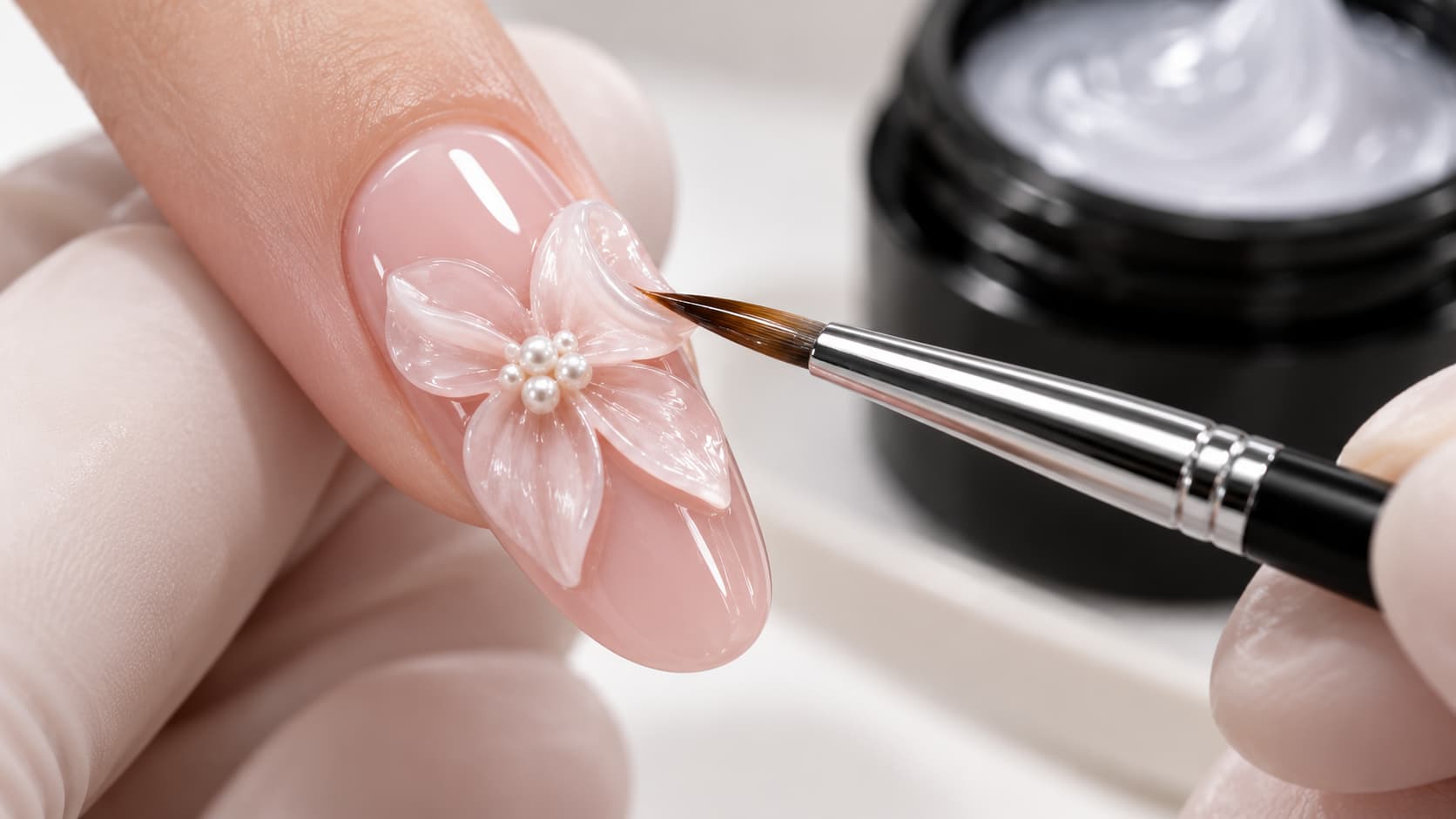
Photographs taken from comparable angles may help document visible shape changes.
These observations assess uncured working performance, not the degree of cure, long-term wear durability, or overall product safety.
Curing suitability must be established separately using the manufacturer's supported system and appropriate evidence.
This is a proposed evaluation method; it does not claim that Hanyinails has completed this particular test or achieved a specified result.
Clear and Opaque Performance
Transparent and opaque molding gels may require different visual checks.
For clear formulations, optical clarity, bubbles, clouding, and appearance over the background can affect the result.
For opaque formulations, pigmentation consistency, edge visibility, and the appearance of sculpted contours may be more important.
Both types still require an appropriate curing process.
Repeatability Across Technicians and Production Batches
Professional salons and nail brands need more than one attractive demonstration design.
The product should also be evaluated for repeatable working behavior.
Useful questions include:
- Can another trained technician produce a comparable decorative effect using the same instructions?
- Does the material respond consistently to the intended tools?
- Can repeated petals or beads be formed with controlled proportions?
- Does the product maintain expected working characteristics across appropriately identified samples?
- If comparing different production batches, are there unexplained differences in consistency, pigmentation, or handling?
To compare repeated applications meaningfully, keep the intended design, tools, application surface, material handling conditions, and observation criteria consistent wherever practical.
Differences should be recorded rather than automatically attributed to the formulation.
These are recommended evaluation questions, not claims that every molding gel or Hanyinails product has already passed a particular test.
Actual performance conclusions require testing of the exact formulation under documented conditions.
Professional takeaway: The best molding gel for a particular application is not necessarily the thickest. It is the formulation that provides an appropriate combination of shape retention, tool responsiveness, edge definition, curing compatibility, and repeatable handling.
6. What Is Molding Gel Used For in Professional Nail Art?
Molding gel is primarily selected when the artist wants raised decorative effects that are difficult to achieve with a conventional smooth color coating.
Different styles require different working properties.
Raised Flowers and Petals
Molding gel can be used to create flower petals, layered roses, and other botanical decorations.
The material should support controlled curves, defined edges, and the intended degree of dimensional relief.
A formulation that loses its shape too quickly may be unsuitable for detailed petals.
Sculpted Bows and Ribbons
Bows and ribbons depend on proportion, controlled loops, and suitable connections between decorative elements.
A molding gel intended for this application should provide sufficient shape retention without requiring unsupported material thickness.
Larger or more prominent decorations also need to be assessed for their practical wear conditions.
Shell Textures and Embossed Patterns
Shell-inspired designs, knitted textures, relief lines, and embossed patterns emphasize consistent surface detail.
Some of these effects may be better suited to specialized embossed painting gels than to very firm molding products.
The choice depends on whether the design requires raised volume, fine lines, or a combination of both.
Hearts and Small Decorative Ornaments
Raised hearts, miniature symbols, and small dimensional accents may be created using compatible molding gels.
For these designs, controlled portion size, symmetry, and edge definition are important.
The decorative material should be appropriate for the intended dimensions and application surface.
Transparent Domes and Crystal-Like Accents
Clear modeling gels may be selected for transparent water-drop effects, domes, and other decorative details where light transmission and optical appearance contribute to the design.
A suitable product should provide the required shaping behavior while maintaining the intended visual clarity.
Transparent appearance does not remove the need for product-specific curing validation.
Minimalist and Seasonal Nail Art
Molding gel is not limited to large or dramatic decorations.
Small raised beads, narrow relief lines, and carefully positioned accents may suit minimalist designs.
Botanical motifs, shell textures, bows, and raised ornaments may also be adapted for seasonal collections.
These are styling applications rather than separate technical gel categories.
Choosing the Right Product for the Design
Professional selection begins with the intended decorative outcome:
- Raised petals: prioritize edge definition and controlled shape retention.
- Bows: prioritize forming and retaining balanced contours.
- Embossed lines: prioritize line continuity and fine-tool control.
- Transparent effects: prioritize optical clarity and supported curing.
- Small ornaments: prioritize placement accuracy and consistent portioning.
- Multiple decorative techniques: evaluate whether one formulation can support the required applications or whether several specialized products are more appropriate.
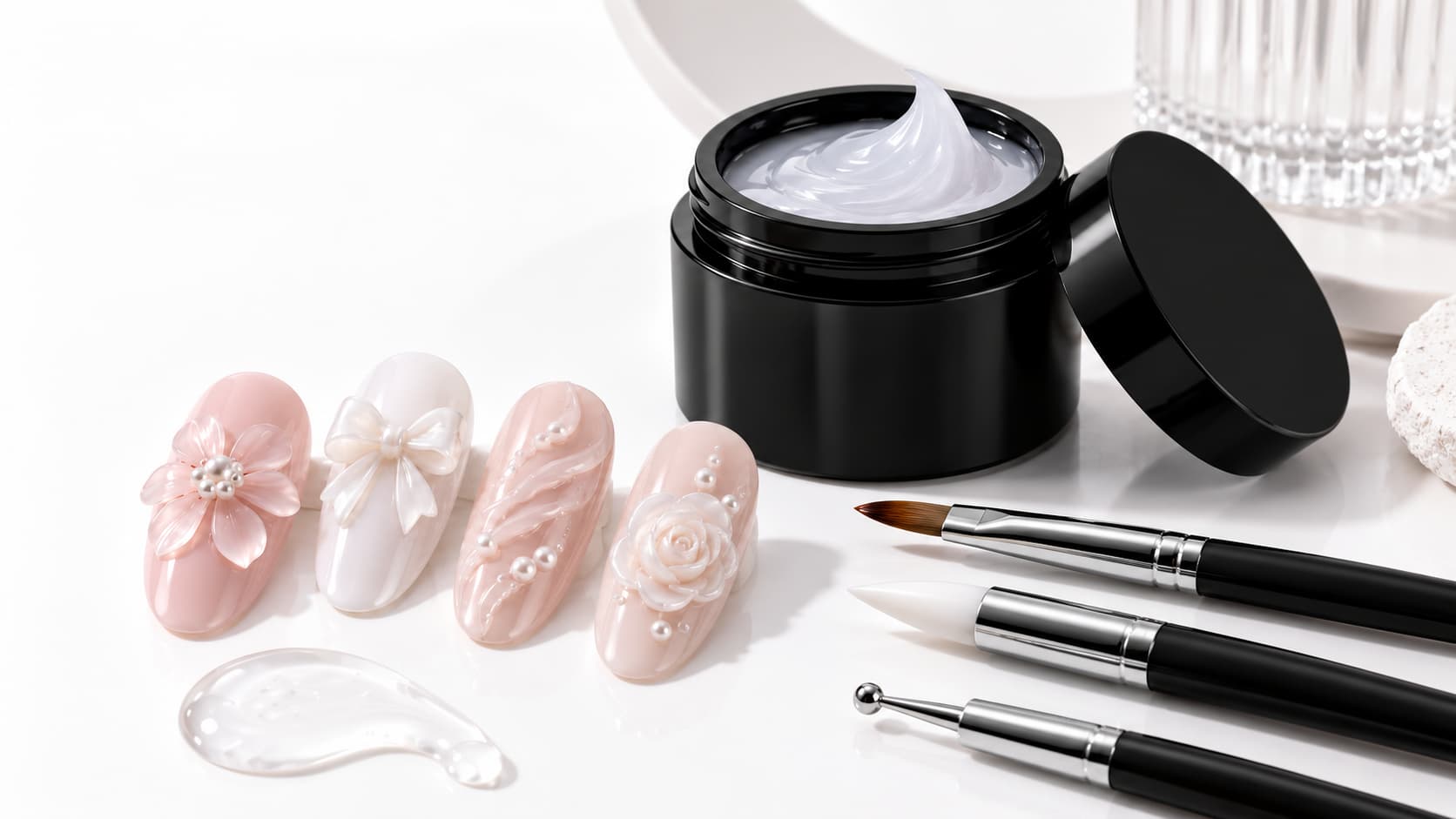
For complete step-by-step flower, bow, pearl, leaf, heart, and butterfly tutorials, read How to Use 3D Nail Art Gel: Step-by-Step Sculpting Tutorial.
This molding gel guide focuses on material selection and product behavior rather than repeating those full tutorials.
7. How Is Molding Gel Applied? A General Workflow
Professional molding gel application should follow the instructions for the exact product and compatible nail system.
The following six-stage workflow explains the general process without replacing a formulation-specific procedure.
Stage 1: Prepare the Compatible Surface
Start with an appropriate natural nail, enhancement, or artificial tip.
Follow the required preparation procedure for the selected product system.
Check the condition of the nail and surrounding skin, and avoid applying cosmetic gel over visibly compromised or apparently infected areas.
The intended background system must be compatible with the molding gel.
Stage 2: Apply the Required Base or Background
Apply any necessary base or background products according to their instructions.
For light-curable coatings, use the prescribed equipment and curing process.
Do not assume that every molding gel adheres equally well to a glossy, matte, tacky, or non-wipe surface.
Any required surface preparation should be confirmed for the complete product system.
Stage 3: Pick Up a Controlled Amount of Gel
Transfer a manageable portion of molding gel using a suitable tool.
The amount should match the intended decorative component.
For example, a small raised accent may require less material than a sculpted flower petal.
Avoid unnecessary bulk and keep uncured gel away from the surrounding skin.
Stage 4: Shape the Decorative Detail
Use an appropriate brush, silicone tool, dotting tool, or other supported applicator.
Shape the gel according to the intended design and review:
- Position.
- Edge definition.
- Symmetry.
- Surface appearance.
- Shape retention.
- Supported material dimensions.
If the gel repeatedly spreads, strings excessively, or cannot retain the intended shape, review product suitability and technique rather than adding material indefinitely.
Stage 5: Cure According to the Exact Product Instructions
Use the product manufacturer's specified curing system and application conditions.
Curing requirements can depend on the formulation, lamp, pigmentation, design geometry, and material thickness.
Where the product supports staged construction, individual components may be processed according to the approved sequence.
A temporary flash-cure stage does not automatically replace the required complete curing process.
If adequate curing cannot be confirmed or the material behaves abnormally after the prescribed process, stop further finishing and verify the product system.
Stage 6: Finish and Inspect the Design
Complete the required finishing process.
Some molding gels may require a compatible top coat, while others are designed to retain a particular textured or non-wipe appearance.
Inspect the design for visible shape defects, unintended sharp projections, and placement suitability.
Visual inspection is useful for identifying obvious problems, but it cannot independently establish the degree of cure throughout the material.
Removal and aftercare requirements should also be confirmed.
For more detailed sculpting procedures, visit the 3D Nail Art Gel Application Guide.
8. Curing, Finishing, Removal and Product Safety
Molding gel performance depends on more than its working texture.
The product must also be appropriate for the intended application surface, curing system, finishing process, and removal method.
These considerations are particularly important when raised decorations contain thicker sections than conventional color coatings.
Curing Compatibility
For UV/LED-curable molding gels, the required curing process is formulation-specific.
Relevant factors include:
- Photoinitiator chemistry.
- Lamp emission spectrum.
- Effective irradiance.
- Exposure conditions.
- Design geometry and thickness.
- Pigmentation and optical properties.
- Lamp condition and positioning.
A lamp's advertised electrical wattage does not independently demonstrate that it provides the light required to cure a particular gel.
Similarly, a fixed curing time copied from an unrelated product cannot establish correct processing.
Follow the manufacturer's specified lamp, exposure, and application conditions.
Additional background on gel-curing factors is available from NailKnowledge: The Complexity of Curing UV Nail Gels.
Why Thickness and Pigmentation Matter
Raised decorations may create different curing challenges from thin color coatings.
The geometry of a flower, bow, or sculpted ornament may affect how curing light reaches the material.
Pigmented formulations may also interact differently with light than clear formulations.
This does not mean that every thick decoration can be made suitable simply by increasing exposure.
Instead, use supported material dimensions and any manufacturer-approved staged application process.
A firm-looking surface should not be treated as proof of complete curing.
Verify the Complete Application System
Curing and application compatibility should be assessed together, not as unrelated individual checks.
For the exact formulation, confirm:
- Approved application surface: The natural nail, enhancement, base, or background system is appropriate for the product.
- Supported design thickness and geometry: The intended raised detail remains within the manufacturer's validated application conditions.
- Compatible curing equipment: The lamp and exposure procedure match the product's requirements.
- Product-layer compatibility: Any base, color, sculpting, and finishing materials are suitable for use together.
- Defined finishing and removal: The completed service follows the supported product system.
Passing one individual check does not establish that the complete application is suitable.
For example, using a compatible lamp does not make an unsupported thick design acceptable. Likewise, adequate shape retention does not prove appropriate curing or adhesion.
If the available product information does not support the intended application, seek specific technical guidance or use another suitable system.
Finishing and Top Coat Compatibility
Not every molding gel requires the same finishing method.
Some formulas may need a compatible top coat.
Others may be intended to retain their sculpted texture or specified cured surface.
Chrome pigments, metallic effects, and other finishing materials require additional compatibility checks.
Do not assume that every non-wipe molding gel is suitable for every chrome or sealing system.
Soak-Off vs. File-Off Removal
The product's removal method must be established before application.
Some formulas are designed for soak-off removal, while others require file-off or another manufacturer-defined procedure.
The names molding gel, modeling gel, or soft sculpting gel do not independently establish the removal category.
Avoid peeling, prying, or forcibly scraping attached material from the natural nail.
Follow the specific product's removal instructions.
Can Molding Gel Be Used on Natural Nails?
Some molding gels may be suitable for decoration over appropriately prepared natural nails when used with a compatible product system.
Suitability depends on the nail condition, required base, product instructions, supported decoration thickness, curing equipment, and removal method.
Direct application to an unprepared natural nail should not be assumed suitable for every formulation.
The intended surface, permitted design geometry, and specified curing procedure should be checked as one complete application system.
Is Molding Gel Suitable for Nail Extensions?
A gel marketed for decorative molding should not automatically be used as a structural enhancement material.
Some specialized products may support more than one application, but structural performance must be established for the exact formulation.
Do not assume that a decorative gel is appropriate for apex building, reinforcement, or full nail extensions based only on its thickness.
Acrylate Sensitization and Professional Handling
Some nail-gel systems contain reactive acrylate or methacrylate ingredients that can cause irritation or allergic contact dermatitis in susceptible individuals.
Uncured products should not be deliberately placed on skin.
Professionals should follow the manufacturer's handling instructions, minimize inappropriate skin exposure, and discontinue use if a suspected adverse reaction occurs.
A HEMA-free claim indicates the absence of that specified ingredient; it does not establish that the whole formulation is allergy-free.
Relevant safety information is available from:
Ingredient and Market Compliance
For nail cosmetic products intended for the European Union, applicable ingredient restrictions must be reviewed for the actual formulation.
The EU prohibition on Trimethylbenzoyl Diphenylphosphine Oxide (TPO) in cosmetic products has applied since September 1, 2025, including relevant commercial professional use.
See the European Commission's TPO in Nail Products Questions and Answers.
Ingredient, safety, labeling, and compliance statements should be supported by information relevant to the exact product and destination market.
A general company certificate or an SDS alone does not establish that every finished cosmetic formulation meets all requirements in every market.
Professional takeaway: Molding gel should be evaluated as a complete product system. Attractive sculpting behavior does not replace curing compatibility, safe handling, suitable finishing, or defined removal procedures.
9. Common Molding Gel Problems and Practical Checks
Molding gel problems should be evaluated according to when the issue occurs and whether it concerns ordinary sculpting behavior or a possible product-system failure.
A design that spreads before curing is not necessarily experiencing the same problem as a decoration that remains unexpectedly soft after a prescribed curing process.
These situations require different responses.
Routine Working Problems
Some issues occur while the material is still being shaped.
Examples include:
- Excessive stringing during gel pickup.
- Poor release from a sculpting tool.
- Loss of petal definition.
- Uneven bow contours.
- Unwanted spreading of raised lines.
- Difficulty refining a firm material.
Possible contributing factors include product consistency, tool choice, portion size, application method, and working environment.
These should be evaluated within the manufacturer's supported handling procedure.
Routine shaping adjustments are appropriate only when the formulation, background system, and application method are otherwise supported.
Potential Curing or Compatibility Problems
Unexpected softness, abnormal deformation, separation, or other defects after the specified curing process may require technical investigation.
Such observations do not prove one specific cause.
Do not cover suspected incompletely cured material with additional product or assume that a different lamp or longer exposure will correct the issue.
Stop normal finishing and verify the complete product system.
A suspected curing failure is not simply a routine sculpting mistake. It must be resolved through the product's documented requirements before the application can be considered suitable.
Sculpting and Technical Compatibility Matrix
| Observed Problem | Possible Contributing Factors | Appropriate Evaluation or Action |
|---|---|---|
| Gel loses shape before curing | Formula consistency, excessive material, unsuitable design | Reassess product suitability and placement technique |
| Gel strings excessively | Material behavior, tool interaction, handling method | Evaluate approved tools and controlled pickup |
| Gel sticks to sculpting tools | Tool condition, formulation tackiness, incompatible handling aid | Follow manufacturer-approved tool and cleaning methods |
| Petal or ridge edges lose definition | Product flow, tool pressure, design geometry | Review shape retention and edge control |
| Raised line becomes wider than intended | Unsuitable line-control properties | Consider a formula intended for embossed details |
| Product behaves unexpectedly after curing | Possible curing or material-processing issue | Stop finishing and verify the documented curing system |
| Decoration lifts or separates | Surface preparation, compatibility, mechanical stress, curing-related factors | Investigate the complete system before correction |
| Finishing product changes the texture | Incompatible or unsuitable top coat | Review approved finishing procedures |
| Product appearance varies between samples | Formulation, handling, storage, or batch-related differences | Compare appropriately identified samples under controlled conditions |
When Should a Professional Stop the Application?
Stop routine finishing when:
- The prescribed curing compatibility cannot be established.
- The material shows concerning behavior after the required curing process.
- The application appears incompatible with the intended background system.
- Uncured material repeatedly contacts surrounding skin.
- A suspected adverse skin reaction occurs.
Do not treat uncertain curing, unexpected post-cure material behavior, or a suspected adverse reaction as problems that can automatically be solved by adding another decorative layer.
Follow the manufacturer's instructions and seek appropriate professional or medical advice when required.
For detailed explanations of cracking, bubbles, lifting, and other common gel-art failures, read Common Mistakes When Working with 3D Nail Art Gel.
10. How Salons and Private Label Brands Should Evaluate Molding Gel
For professional salons and nail brands, the main evaluation question is not simply whether a molding gel feels thick or creates an attractive demonstration nail.
The more useful question is:
Can the exact formulation support its intended decorative applications under documented, compatible, and repeatable working conditions?
Professional product evaluation should begin with the intended end use.
A clear gel for transparent domes may require different visual acceptance criteria from an opaque gel used for sculpted flowers.
A formula used for fine embossed lines may also require different tool behavior from a product designed for larger decorative elements.
Professional Molding Gel Evaluation Matrix
| Evaluation Area | What to Review | Suggested Evidence or Record |
|---|---|---|
| Intended Product Role | Decorative shape, embossed line, clear effect, or another defined application | Product specification and intended-use statement |
| Shape Retention | Ability to maintain the intended geometry before curing | Identified sample photographs and working observations |
| Tool Control | Pickup, placement, stringing, shaping, and release | Repeatable application notes |
| Edge Definition | Petals, curves, and raised lines | Representative decorative swatches |
| Pigmentation or Clarity | Opacity, color consistency, haze, bubbles, transparency | Appropriate visual comparison |
| Curing Compatibility | Exact product and supported lamp/procedure | Manufacturer documentation and relevant validation evidence |
| Background Compatibility | Intended base, color, enhancement, or approved surface | Defined application-system evaluation |
| Finishing Behavior | Texture, gloss, non-wipe performance, compatible top coat | Finishing observations under specified conditions |
| Removal Method | Soak-off, file-off, or another defined route | Product-specific removal instructions |
| Technician Repeatability | Comparable outcomes across trained users | Controlled repeated application records |
| Batch Consistency | Comparable working behavior between identified lots | Lot-specific quality and evaluation records |
| Packaging and Storage | Product protection, clean access, labeling, light exposure | Packaging specifications and handling instructions |
| Market Documentation | Ingredient information, warnings, and applicable compliance records | Product-specific documentation |
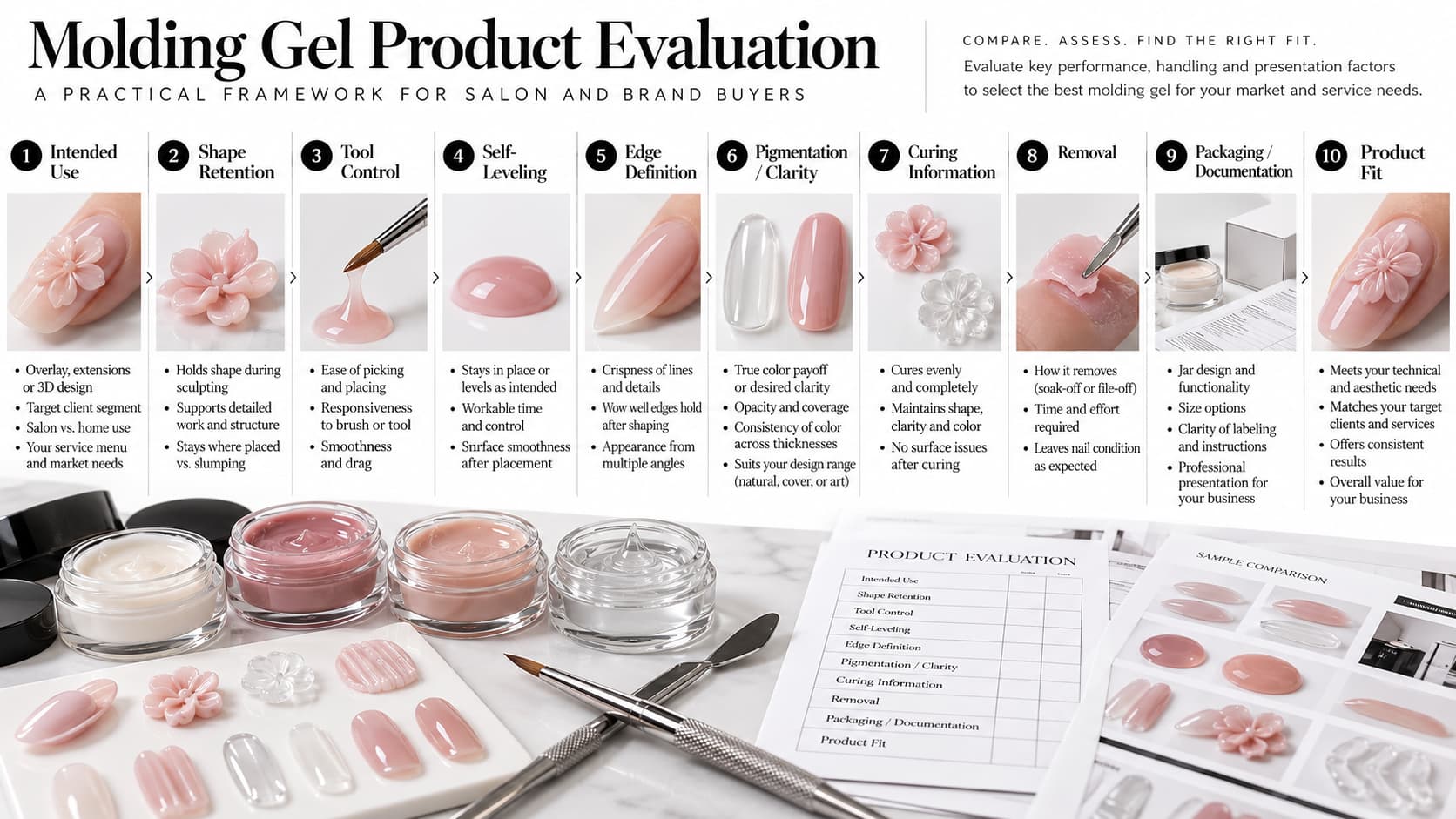
This matrix is a recommended evaluation framework, not a claim that Hanyinails has completed every listed test for every molding gel formulation.
Actual acceptance criteria should be defined for the intended product and destination market.
Start With the Intended Decorative Application
Professional evaluation should begin by identifying the product's intended role.
Examples include:
- Firm sculpting gel for flowers and bows.
- An embossed product for narrow raised details.
- Clear modeling gel for transparent effects.
- Opaque molding gel for high-contrast decoration.
- Coordinated art-gel products for multiple techniques.
A collection does not necessarily need one universal formula for every application.
Selecting an appropriate product role can make technical instructions and product expectations clearer.
Separate Document Review from Practical Observations
Professional assessment should distinguish between information supplied by the manufacturer and observations obtained during application.
Document-based review may include:
- Product identity and intended use.
- Specification of the formulation or product type.
- Supported application surfaces.
- Curing equipment and instructions.
- Applicable finishing and removal methods.
- Ingredient, labeling, and other market-specific documentation.
Practical application observations may include:
- Pickup and tool response.
- Petal or raised-line definition.
- Shape retention during the supported working period.
- Material stringing and dragging.
- Visible color or transparency.
- Repeated handling behavior.
- Visible appearance after the documented processing procedure.
Practical observations can identify questions for further evaluation, but they do not independently establish regulatory compliance, adequate polymerization, or long-term wear performance.
Likewise, possessing a product specification does not prove that every intended decorative application has been validated.
The two forms of evidence should be considered together.
Evaluate Representative Designs
A useful assessment should include designs reflecting the product's intended use.
For example, a salon evaluating opaque molding gel for raised flowers may observe:
- Controlled gel pickup.
- Defined petal edges.
- Predictable tool responsiveness.
- Intended color appearance.
- Application within documented conditions.
- Compatibility with the prescribed finishing system.
A clear modeling gel intended for water-drop accents would require a different emphasis, particularly on optical clarity and the appearance of transparent raised structures.
These evaluations should not be treated as interchangeable.
Assess Technician and Batch Repeatability
A professional product should be evaluated beyond one successful decorative swatch.
Where appropriate, repeated applications can be compared under defined conditions.
The evaluation record should identify:
- The exact product and formulation.
- The sample or batch identification.
- The intended decorative technique.
- The tools and working method.
- The background or base system.
- The prescribed curing equipment and procedure.
- The finishing method.
- The observations and any deviations.
When comparing different production batches, buyers should use appropriately identified samples and relevant acceptance criteria.
A single photograph or visually attractive demonstration is not sufficient evidence of overall formulation consistency.
Any claims about batch-to-batch performance should be supported by actual records, not inferred from product appearance alone.
Packaging and Product Information
Molding gel packaging should support appropriate handling and protection of the formulation.
Depending on the product, evaluation may include:
- Container suitability.
- Access for sculpting tools.
- Protection from unintended light exposure.
- Sealing and cleanliness.
- Clear labeling.
- Relevant storage instructions.
- Product identity and batch traceability.
Professional buyers should also confirm that the technical and safety information applies to the actual formulation.
Better Product Roles and Technical Guidance
For professional nail-art collections, it may be useful to organize products according to intended techniques.
For example, distinguishing flower-sculpting gel from fine-line embossing gel can make application guidance more specific.
Similarly, clear modeling gel may require information emphasizing optical appearance, while opaque molding gel may emphasize color coverage and shape definition.
This is a practical product-development consideration, not a prediction that every brand or market will follow the same direction.
Useful professional support connects:
Intended Product Role → Compatible Tools → Application Technique → Curing Instructions → Finished Effect → Removal Method
Clear documentation of that relationship can help salons and distributors evaluate the product more consistently.
Hanyinails OEM/ODM Molding Gel Development
Hanyinails works with nail brands, professional salons, distributors, and wholesalers interested in private-label nail-product development.
For molding gel projects, businesses can discuss intended decorative applications, formulation direction, working consistency, color or transparency preferences, packaging, product instructions, and relevant documentation.
A useful project brief should identify the desired product behavior rather than rely only on general descriptions such as "very thick" or "professional quality."
For example, a private-label brand developing a raised-flower collection may prioritize petal definition and shape retention.
A collection designed around transparent crystal effects may require closer attention to clarity and surface appearance.
A product intended for embossed lines may require more precise application control.
Exact formulation options, technical suitability, customization capabilities, and documentation should be confirmed for the particular development project.
Explore:
- Hanyinails Liner Art Gel & 3D Art Gel Collection
- Create Your Own Nail Brand
- Contract Manufacturing Services
For broader supplier selection and procurement evaluation beyond molding gel's technical characteristics, read How to Choose the Best 3D Nail Art Gel.
11. Frequently Asked Questions About Molding Gel for Nails
1. What is molding gel for nails?
Molding gel is a shape-retentive nail-art gel used to create raised decorative designs, including flowers, bows, relief lines, and embossed patterns. Exact consistency, curing, finishing, and removal requirements depend on the formulation.
2. Is molding gel the same as modeling gel?
The terms sometimes describe similar products, but they are not guaranteed formula equivalents. Modeling gel may refer to decorative or other specified shaping products. Check the product's intended use and technical instructions.
3. Is moulding gel different from molding gel?
Moulding is the British-English spelling of molding. The spelling itself does not establish a technical difference, although individual commercial formulations may vary.
4. Is molding gel the same as 3D sculpting gel?
The terms often overlap. Molding gel commonly emphasizes manual shaping, while 3D sculpting gel is a broader description for dimensional decorative products. Compare the exact formulation and intended application.
5. What is the difference between molding gel and builder gel?
Molding gel is primarily used for raised decorative details. Builder gel is mainly designed for nail enhancement and structural applications where supported by the formulation. Thickness alone does not make them interchangeable.
6. How do you use molding gel for nails?
Prepare a compatible surface, apply the required background, place and shape a controlled amount of gel, cure according to the exact product instructions, and complete the approved finishing process.
7. What is the difference between clear and opaque molding gel?
Clear molding gel emphasizes transparency and optical appearance. Opaque molding gel provides stronger visible color definition. Both require suitable shape retention and product-specific curing compatibility.
8. Does molding gel require a UV or LED lamp?
UV/LED-curable molding gels require a compatible curing system specified for the formulation. Do not assume one universal lamp wattage or exposure time applies to every product.
9. Can molding gel be used for nail extensions?
A decorative molding gel should not automatically be used for structural extensions. Structural use requires a formulation specifically intended and validated for that purpose.
10. Is molding gel soak-off or file-off?
It depends on the formulation. Some products are soak-off, while others require filing or another specified removal process. Confirm the manufacturer's removal instructions.
11. What should professional buyers check when evaluating molding gel?
Check intended use, shape retention, tool control, application compatibility, curing requirements, finishing, removal, and product documentation. Repeatability, packaging, and batch-related evidence may also be relevant.

Hanyinails
Hanyinails
Hanyinails
Hanyinails