


How to Make Rubber Base Gel Last Longer: Lifting, Layers & Aftercare Guide
Rubber base gel is a game-changer for strong, flexible nails—but if it keeps peeling or lifting too soon, you’re missing out on its full potential. In this guide, you’ll learn 10 proven ways to make rubber base last longer, including prep tricks, application secrets, and maintenance tips to keep your manicure flawless for 3+ weeks.
- Quick Answer: How Long Does Rubber Base Gel Last?
- Key Takeaways
- How Long Does Rubber Base Gel Last?
- What Is Rubber Base Gel Used For?
- Why Does Rubber Base Gel Lift or Peel?
- Nail Prep Checks Before Applying Rubber Base Gel
- How Many Layers of Rubber Base Gel Should You Apply?
- Curing Checks: Lamp, Layer Thickness, and Product Instructions
- How to Apply Rubber Base Gel for Better Wear
- Aftercare Tips to Help Rubber Base Last Longer
- Can Rubber Base Gel Be Soaked Off?
- What to Do If Rubber Base Starts Lifting
- Rubber Base Troubleshooting Table
- What Nail Professionals Should Record During Service
- What Private Label Buyers Should Confirm for Rubber Base Gel
- How Hanyinails Supports Rubber Base Gel OEM Projects
- Common Mistakes That Shorten Rubber Base Gel Wear
- FAQ: Rubber Base Gel Longevity, Lifting, Layers, and Removal
Rubber Base Gel Longevity Guide
Quick Answer: How Long Does Rubber Base Gel Last?
Rubber base gel commonly lasts around 2–3 weeks when nail prep, thin application, curing, product compatibility, and aftercare are handled correctly. However, wear time is not guaranteed. It can be shorter if the nail surface has oil, dust, moisture, lifting, weak curing, thick layers, edge flooding, repeated water exposure, cleaning chemicals, or heavy nail impact.
To make rubber base gel last longer, focus on clean nail prep, controlled layer thickness, proper curing, free edge sealing, product-system compatibility, and careful aftercare. If rubber base gel starts lifting or peeling, do not simply seal over the lifted area. The lifted material should be assessed, removed where necessary, and reapplied according to the product system and professional practice.
Key Takeaways
- Rubber base gel wear time depends on nail condition, product system, prep, layer thickness, curing, application technique, and aftercare.
- A common wear expectation is around 2–3 weeks, but no wear time should be treated as guaranteed.
- Lifting often starts from oil, dust, moisture, cuticle contact, thick layers, under-curing, free edge wear, product incompatibility, or heavy nail stress.
- Thin, controlled layers are usually easier to cure and manage than thick layers.
- Curing time should follow the product instructions and lamp compatibility, not a fixed universal number.
- Rubber base gel may be soak-off or file-off depending on the product system, so removal instructions should be confirmed before use.
- Private label buyers should test rubber base gel samples for adhesion, flexibility, viscosity, leveling, curing, removal behavior, packaging, and batch consistency.
How Long Does Rubber Base Gel Last?
Rubber base gel commonly lasts around 2–3 weeks, but actual wear time can vary. It depends on the product formula, nail plate condition, nail prep, layer thickness, curing, lamp compatibility, base and top coat system, client lifestyle, and aftercare.
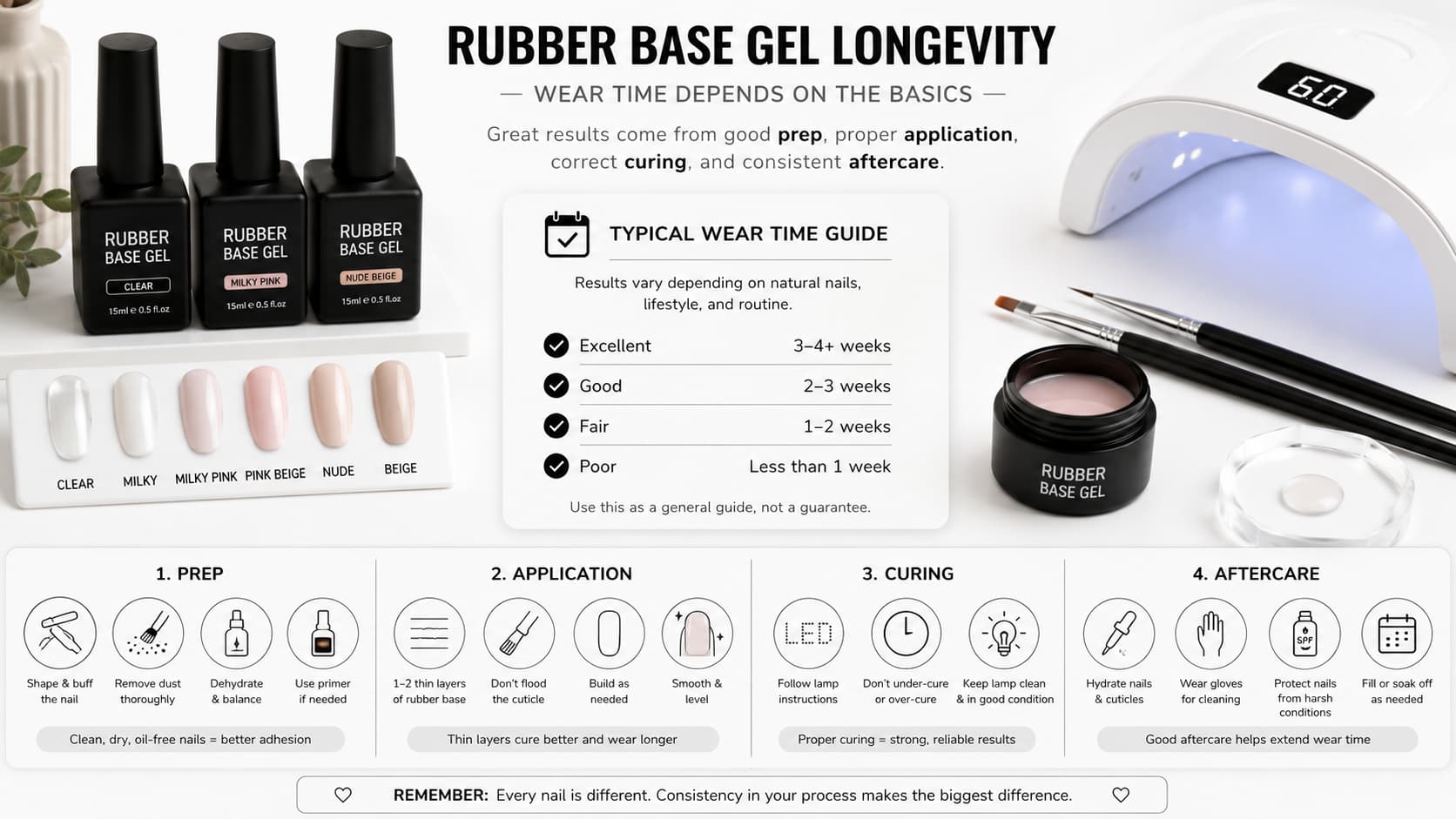
Rubber base gel may wear for a shorter time when:
- The natural nail surface is oily or dusty
- Cuticle or skin is not properly cleared from the nail plate
- The nail plate has moisture or residue
- The product floods the sidewall or cuticle area
- Layers are too thick
- The free edge is not sealed where appropriate
- The product is not cured according to instructions
- The UV/LED lamp is not compatible with the product
- The client has frequent water exposure
- Cleaning chemicals contact the nails without protection
- The nails are used as tools
- Previous lifting is sealed over instead of corrected
A useful way to think about rubber base longevity is this: the product does not last because of one single trick. It lasts better when prep, application, curing, product compatibility, and aftercare all work together.
What Is Rubber Base Gel Used For?
Rubber base gel is a flexible gel base product used in nail services to help support gel polish application, smooth minor nail surface unevenness, improve wear in suitable systems, and create a more cushioned base layer compared with some standard base coats.
It may be used for:
- Gel polish base application
- Short natural nail overlays
- Mild surface leveling
- Flexible base support
- Nail color application support
- Salon gel services
- Private label nail gel product lines
Rubber base gel is not the same as builder gel, hard gel, acrylic, or nail glue. It should be selected and applied according to the intended nail service and product system. Buyers exploring related product options can review the Rubber Base Gel page.
Why Does Rubber Base Gel Lift or Peel?
Rubber base gel lifting or peeling can happen for several reasons. In many cases, the problem is not only the product formula. It may be connected to nail preparation, curing, layer thickness, edge application, aftercare, or product-system compatibility.
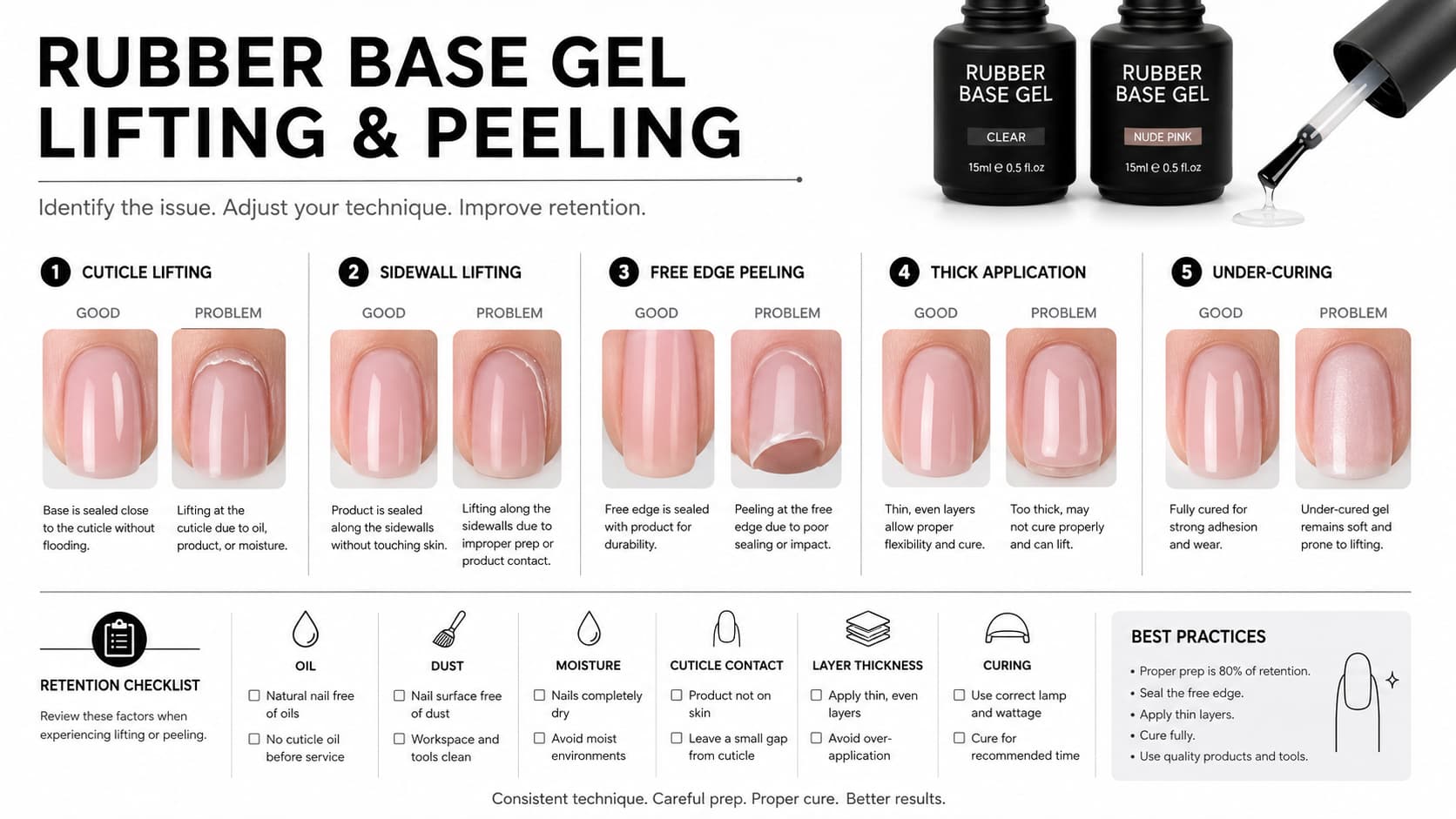
Common causes include:
- Natural oil left on the nail plate
- Dust or filing residue not removed properly
- Moisture on the nail before application
- Cuticle tissue left on the nail plate
- Product touching the skin or cuticle
- Thick rubber base layers
- Insufficient curing
- Incompatible lamp and gel system
- Weak free edge coverage
- Product applied over previous lifting
- Mixing products from incompatible systems
- Heavy hand use soon after service
- Frequent water exposure
- Cleaning chemical exposure
- Picking, peeling, or forceful removal
Lifting should be handled carefully. If an area has already lifted, water, dust, oil, or residue may enter the gap. Covering that area with more product can trap contamination and lead to further service problems. A more professional approach is to remove the lifted material as needed, reassess the nail, and reapply according to the product instructions.
Nail Prep Checks Before Applying Rubber Base Gel
Good nail prep is one of the most important factors in rubber base gel wear. Prep should follow the product system and salon practice.
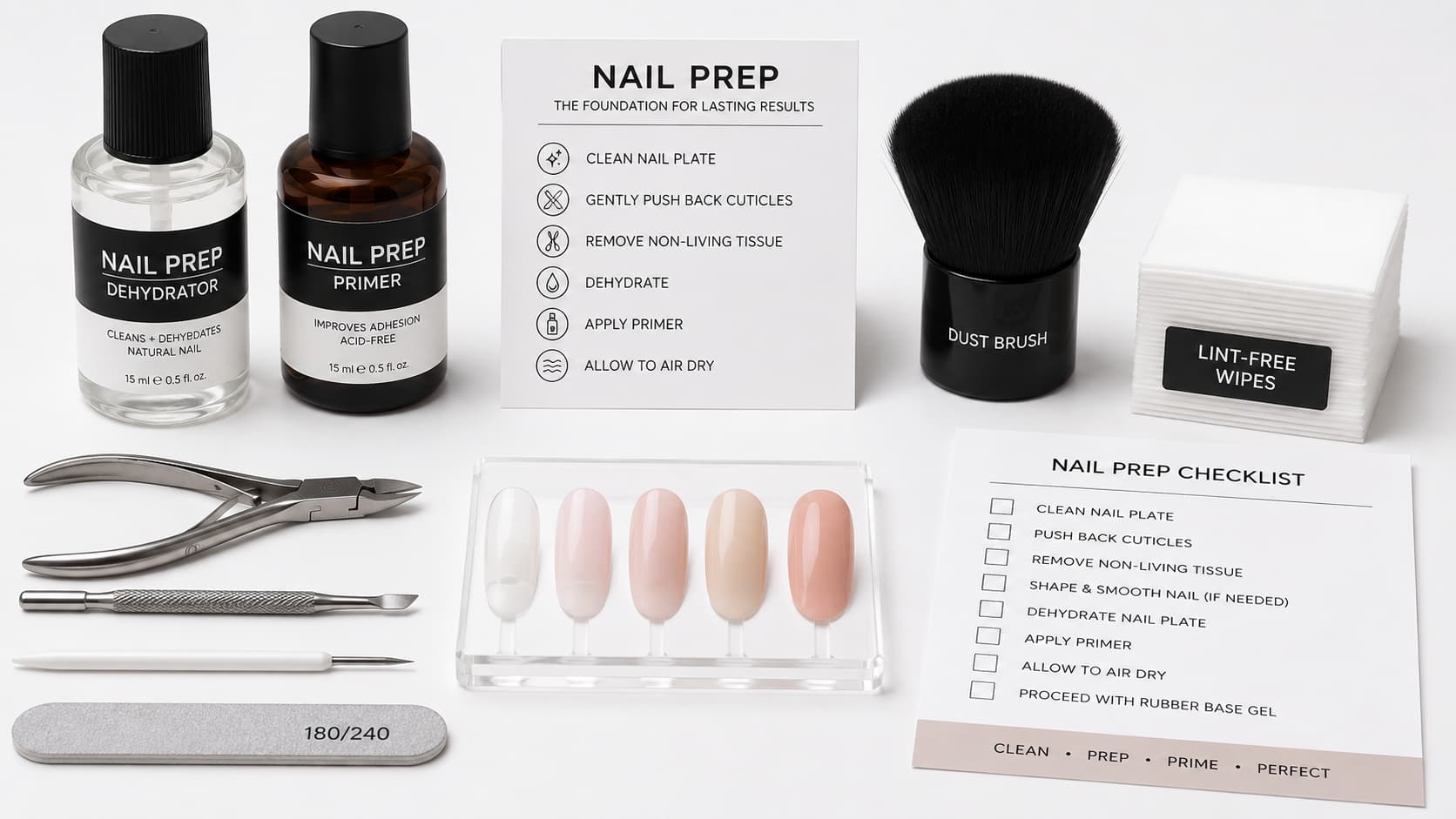
Common checks include:
- Remove old lifted product where necessary
- Shape the nail
- Clean the free edge
- Gently manage the cuticle area according to professional practice
- Remove non-living tissue from the nail plate
- Lightly refine the nail surface if required by the product system
- Remove dust
- Ensure the nail surface is dry
- Use dehydrator or primer only when required by the system
- Avoid touching the prepared nail plate with fingers
- Keep product away from skin and cuticle during application
Primer choice should follow the product system and the client’s nail condition. It should not be described as universally required or universally unnecessary. For deeper nail preparation content, buyers and nail professionals can review the Pro Nail Prep for Rubber Base Gel guide.
How Many Layers of Rubber Base Gel Should You Apply?
The number of rubber base gel layers depends on the product system, nail condition, and service goal. Many applications use a thin base layer followed by a controlled leveling layer if needed, but the exact method should follow product instructions.
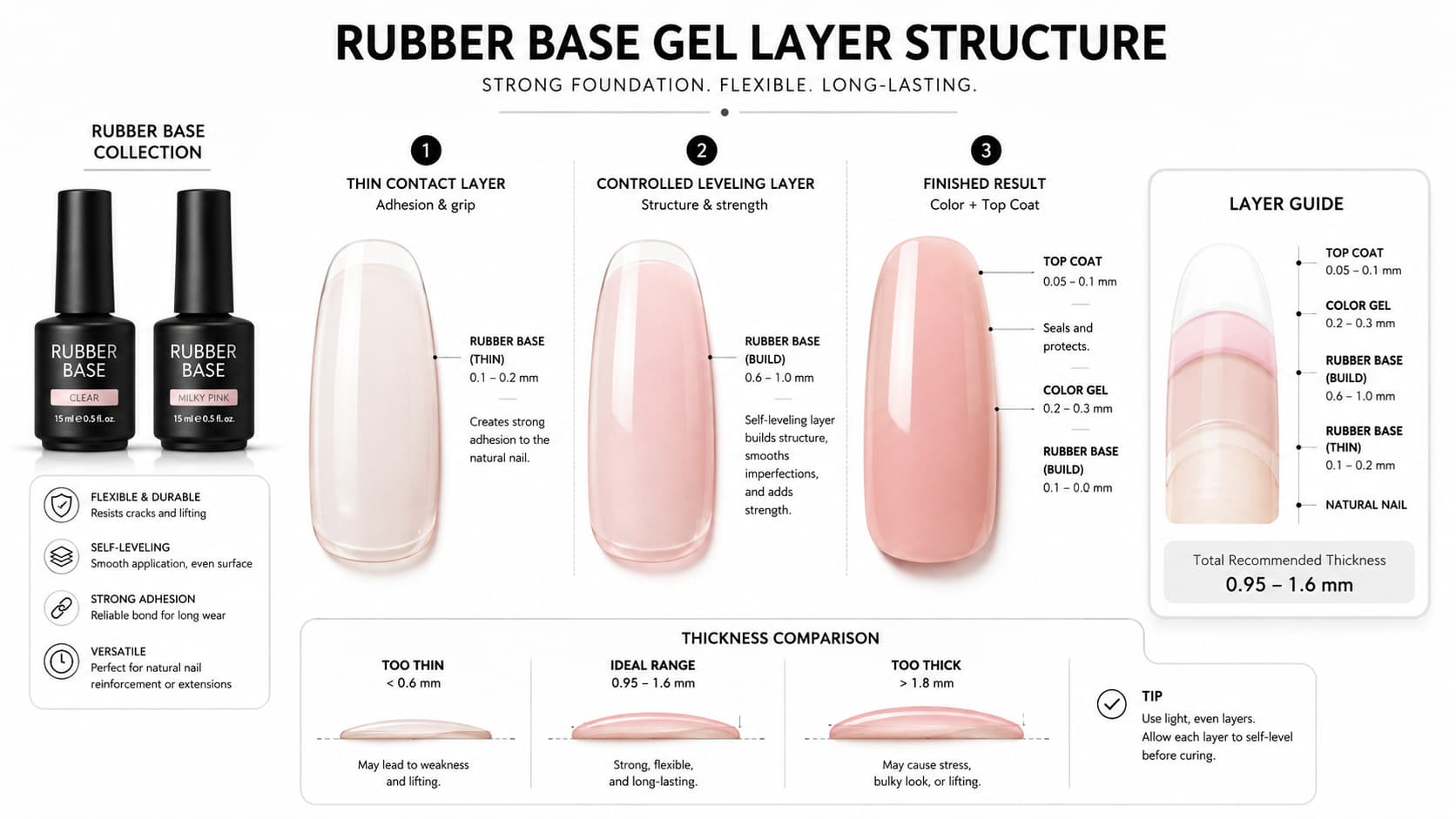
| Layer | Purpose | Key Check |
|---|---|---|
| Thin base layer | Helps create contact with the prepared nail surface. | Keep it thin and avoid flooding skin or cuticle. |
| Leveling layer, if needed | Helps smooth minor unevenness or create structure for short natural nails. | Do not overbuild; check curing and thickness. |
| Color or gel polish layer | Adds the desired nail color. | Confirm compatibility with the rubber base. |
| Top coat | Protects the finished service. | Cure according to the system instructions. |
Too many layers or layers that are too thick can create wear problems. Thick rubber base may look smooth at first but can affect curing, heat sensation, surface shape, and lifting risk. For most nail professionals, the goal is not to apply more product. The goal is to apply the right amount of product in controlled layers.
Curing Checks: Lamp, Layer Thickness, and Product Instructions
Curing should not be treated as one universal time for every rubber base gel. Different formulas, pigments, opacity levels, lamps, wattage, wavelength, and layer thickness can affect curing.
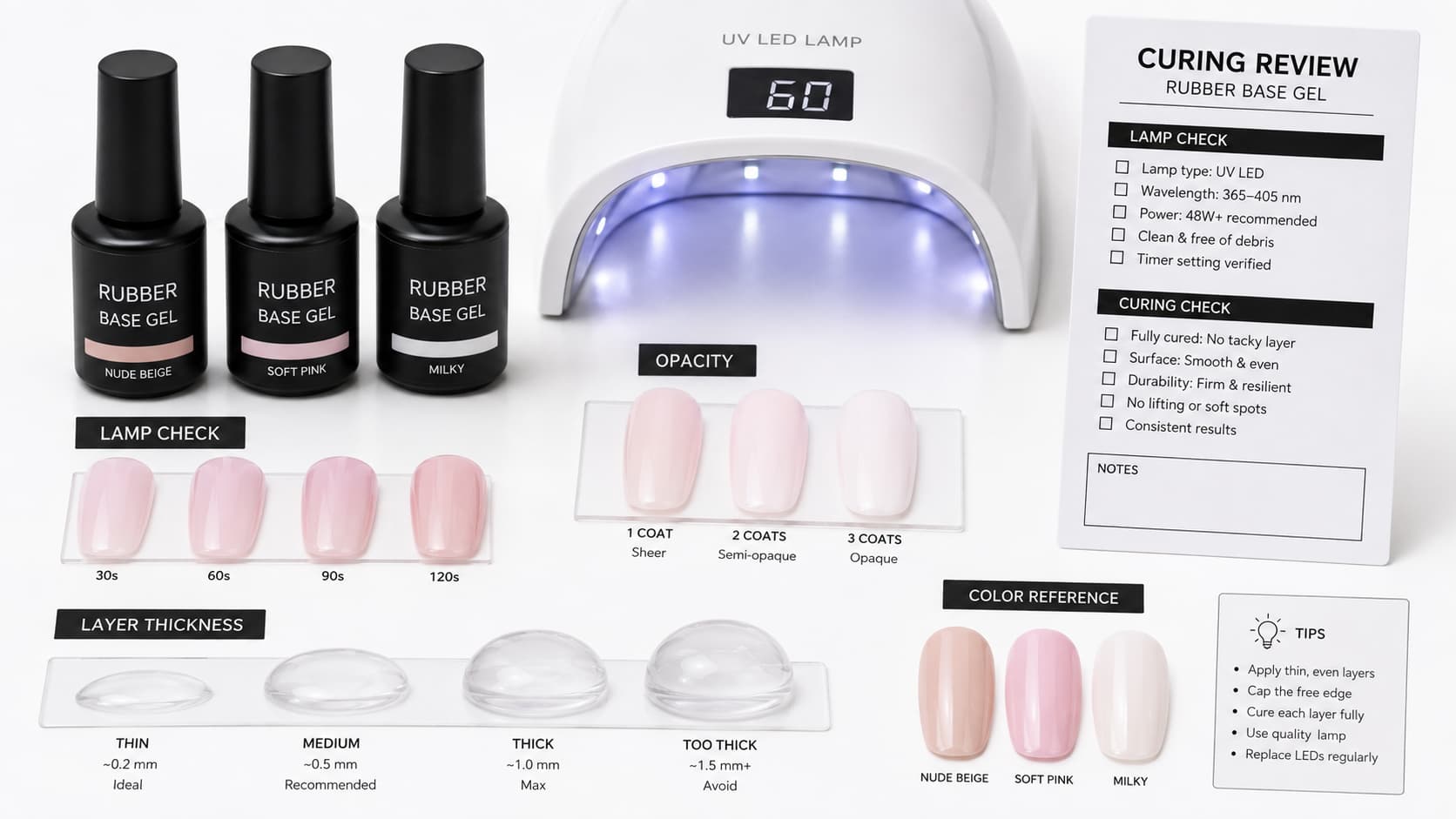
Before service, check:
- Recommended UV/LED lamp type
- Product curing time
- Lamp condition
- Whether bulbs or LEDs are aging
- Layer thickness
- Product opacity
- Whether the rubber base is clear, nude, milky, tinted, or pigmented
- Whether the product is used under color gel or top coat
- Whether the product system has specific instructions
Under-cured rubber base can affect wear, surface stability, removal, and comfort. Overly thick layers may also create curing problems even when the lamp appears to work properly. A good professional habit is to test new rubber base products on swatches before salon use, especially when changing brands, lamps, colors, or top coats.
How to Apply Rubber Base Gel for Better Wear
The exact process depends on the product system, but a careful rubber base gel application usually includes the following steps.
Step 1: Prepare the Natural Nail
Shape the nail, manage the cuticle area, remove dust, and prepare the nail plate according to the product instructions. Do not apply rubber base over visible lifting or residue.
Step 2: Clean and Dry the Nail Surface
The nail surface should be free from oil, dust, and moisture before application. If the system requires dehydrator or primer, apply it as directed.
Step 3: Apply a Thin Contact Layer
Apply a thin layer of rubber base gel to the nail. Keep product away from the sidewalls and cuticle area. Avoid flooding the skin.
Step 4: Cure According to Product Instructions
Cure using the recommended lamp and curing time. Do not rely on a single fixed curing time for all rubber base gels.
Step 5: Add a Controlled Leveling Layer, If Needed
If the service requires leveling, apply a controlled layer. Guide the product carefully and avoid excessive thickness.
Step 6: Seal the Free Edge Where Appropriate
For suitable nail lengths and systems, careful free edge coverage may help reduce edge wear. Avoid bulky product buildup at the tip.
Step 7: Continue with Color and Top Coat
Apply compatible color gel and top coat according to the product system. Cure each layer as instructed.
Step 8: Check the Final Result
Review the surface, sidewalls, cuticle area, free edge, curing, shape, and finish before completing the service.
Aftercare Tips to Help Rubber Base Last Longer
Aftercare affects how long rubber base gel can wear. Even when application is correct, repeated water exposure, chemical contact, heavy pressure, or picking can shorten wear.
Clients and nail users should be reminded to:
- Avoid using nails as tools
- Avoid picking or peeling product
- Wear gloves when cleaning or using chemicals
- Avoid long repeated water exposure when possible
- Keep nails at a practical length for lifestyle
- Use cuticle oil as appropriate
- Return for maintenance when lifting appears
- Avoid forceful removal at home
- Follow the nail professional’s product-specific aftercare advice
Aftercare should be presented as support, not a guarantee. Even with good aftercare, wear time may vary.
Can Rubber Base Gel Be Soaked Off?
Some rubber base gels can be soaked off, while others may require filing or professional removal depending on the formula and product system. Buyers and nail professionals should confirm removal instructions before use.
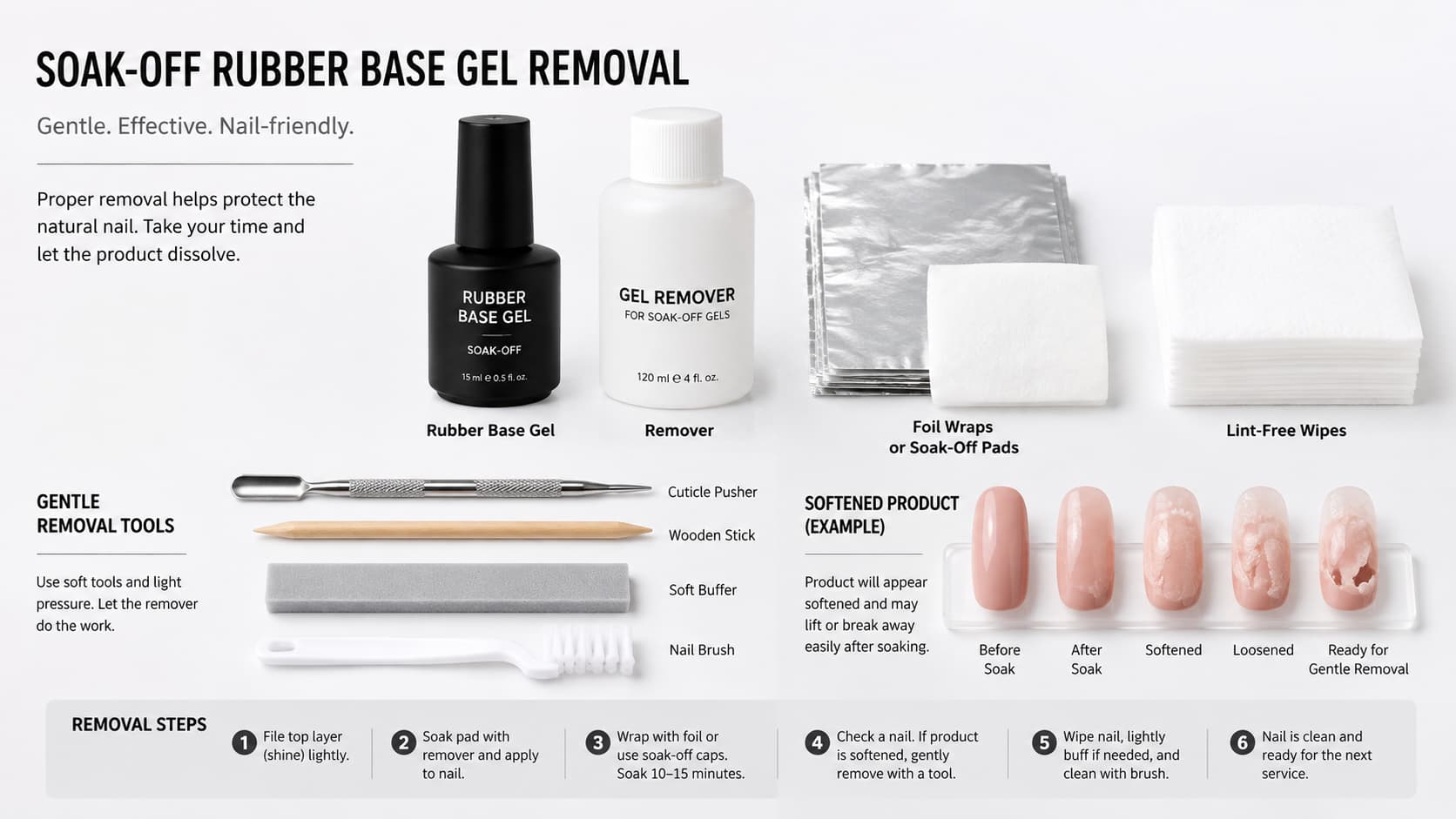
A soak-off rubber base gel may require:
- Removing top coat shine or surface seal, if required
- Using suitable remover according to the product instructions
- Allowing enough removal time
- Avoiding forceful scraping
- Repeating the process if needed
- Gently removing softened product
- Protecting the natural nail from over-filing
If the product does not soften as expected, do not force it off. The removal method may not match the formula, the top coat may block remover penetration, or the product may require a different removal process. Private label buyers should confirm whether a rubber base gel is intended to be soak-off, file-off, or used within a specific removal system before approving label wording or product instructions.
What to Do If Rubber Base Starts Lifting
If rubber base starts lifting, the response depends on how much product has lifted and where the lifting occurs.
General professional checks include:
- Identify whether lifting is at the cuticle, sidewall, center, or free edge
- Check whether the product touched skin or cuticle
- Check whether the free edge is worn
- Check for signs of moisture, residue, or contamination under lifted product
- Remove lifted material where necessary
- Do not seal over open lifting without assessment
- Re-prep the exposed nail area according to the product system
- Reapply only when the nail surface is clean and suitable
- Review aftercare factors with the client
If lifting repeats across several clients, the nail professional should review the full system: prep, lamp, product age, layer thickness, curing, primer, base, color, top coat, and aftercare instructions.
If lifting appears only on one client, review nail condition, lifestyle, hand use, water exposure, product picking, nail length, and service timing.
Rubber Base Troubleshooting Table
| Problem | Possible Cause | What to Check |
|---|---|---|
| Rubber base lifts near the cuticle | Product may have touched cuticle or skin, or prep may be incomplete. | Check cuticle cleanup, product control, and application gap. |
| Rubber base peels from the free edge | Edge wear, poor free edge coverage, or nail impact. | Check nail length, free edge sealing, and aftercare. |
| Rubber base lifts in sheets | Nail surface may have oil, dust, moisture, or incompatible prep. | Review nail cleaning, dehydrator or primer use, and product system. |
| Rubber base wrinkles after curing | Layer may be too thick or curing may be incomplete. | Check layer thickness, lamp compatibility, and curing time. |
| Rubber base feels soft after curing | Product may be under-cured or applied too thickly. | Check lamp, curing time, and product opacity. |
| Rubber base chips quickly | Nail stress, product incompatibility, or insufficient top protection. | Check top coat, nail length, and client hand use. |
| Rubber base peels after a few days | Prep, curing, free edge, or aftercare may be inconsistent. | Review the full application process and client aftercare. |
| Product burns or feels hot during curing | Layer may be too thick or product may create a heat spike. | Apply thinner layers and follow product instructions. |
| Rubber base will not soak off easily | Top coat, formula, or removal method may not match soak-off instructions. | Confirm whether the product is soak-off and follow removal guidance. |
| Wear time varies by client | Nail condition and lifestyle differ. | Record client history, nail condition, and aftercare habits. |
What Nail Professionals Should Record During Service
Recording service details helps nail professionals understand why rubber base gel lasts longer for some clients than others.
- Client nail condition
- Nail length and shape
- Previous lifting history
- Prep method
- Dehydrator or primer used
- Rubber base product name
- Layer thickness approach
- Lamp type
- Curing time
- Color gel and top coat used
- Free edge method
- Client aftercare notes
- Wear time at next visit
- Lifting location, if any
- Removal method and removal time
These details can help identify whether issues come from product compatibility, application, curing, nail condition, or aftercare.
What Private Label Buyers Should Confirm for Rubber Base Gel
Private label buyers should evaluate rubber base gel through sample testing and documentation, not only by color or bottle appearance.
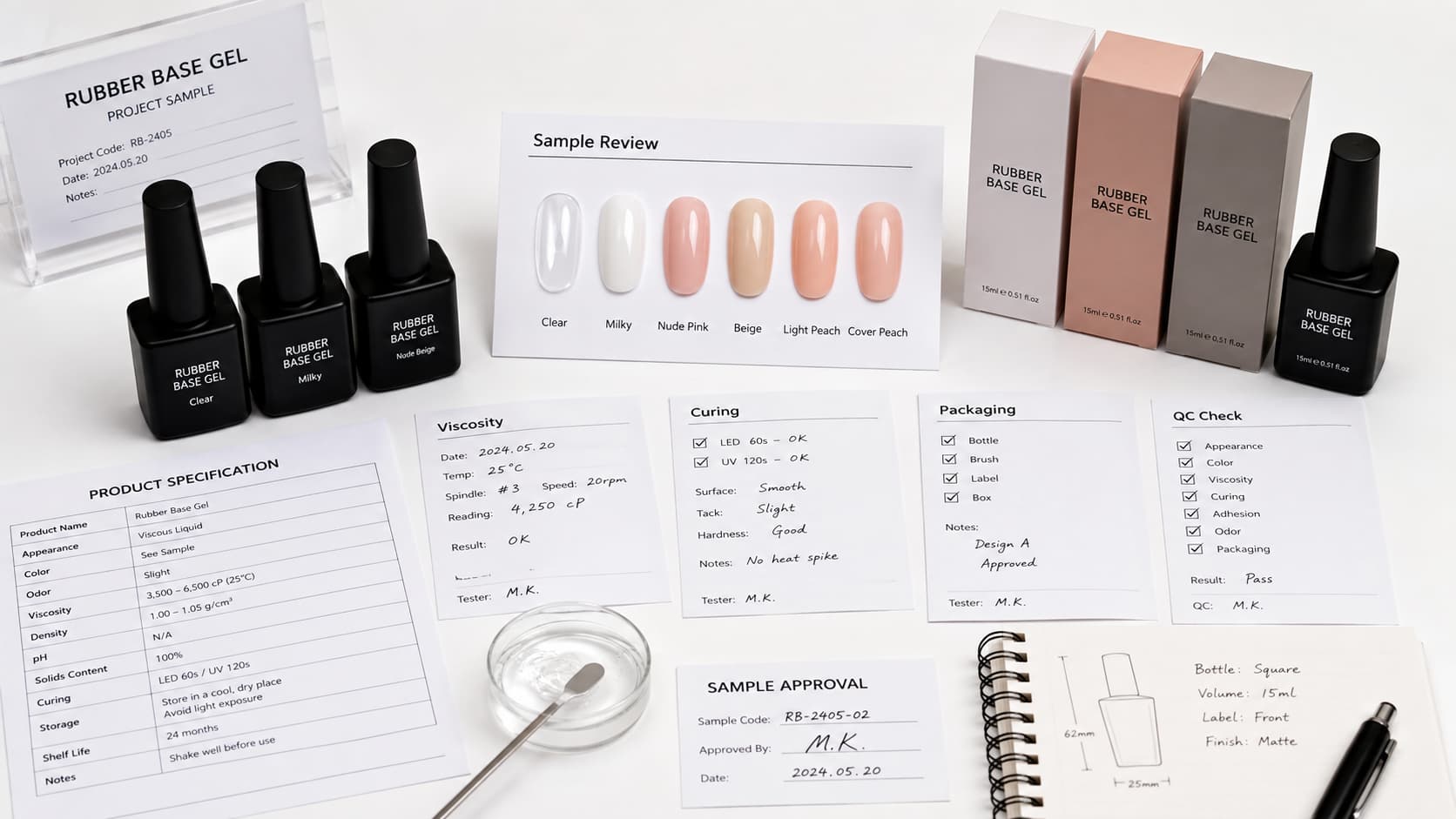
Before OEM or private label production, buyers should confirm:
- Product type
- Target market
- Clear, nude, milky, tinted, or color rubber base options
- Viscosity
- Self-leveling behavior
- Flexibility
- Adhesion performance within the product system
- Curing requirements
- Lamp compatibility
- Layer thickness guidance
- Heat sensation during curing
- Wear test plan
- Soak-off or removal method
- Bottle and cap options
- Label requirements
- Packaging requirements
- Color chart or swatch requirements
- Batch consistency checks
- Sample approval process
- Product documents
- Target market compliance responsibilities
Buyers should also decide whether they need rubber base gel for salons, professional nail technicians, distributors, retail kits, or private label gel polish lines. Different channels may need different packaging, instructions, claims, and support materials. For OEM-oriented rubber base projects, buyers can also review the OEM Custom Rubber Base Gel Guide.
How Hanyinails Supports Rubber Base Gel OEM Projects
Hanyinails is a professional nail products manufacturer focused on professional nail gel items. The company supports OEM customization and one-stop customization for nail brands, salons, distributors, wholesalers, retailers, and beauty businesses.
For rubber base gel OEM discussions, buyers can share product type, target market, viscosity preference, color direction, bottle style, cap style, label design, packaging plan, sample testing needs, product documents, and launch schedule.
Verified Hanyinails manufacturing and customization capabilities include:
- 12 years of OEM customization experience
- 10 production lines
- 60 production machines
- 8 QA/QC inspectors
- 8000㎡ workshop
- 2000 new colors per year
- More than 50 styles of stock bottles and caps
- More than 600 styles of customized bottles and caps
- More than 100 different styles of kit boxes
- More than 200 styles of color chart design
- Participation in exhibitions in more than 10 countries every year
Buyers interested in product category options can review the Rubber Base Gel for Nails page.
Buyers planning private label packaging can review the Create Your Brand page.
Buyers reviewing documentation can review the Certifications page.
Discuss a Rubber Base Gel Project
Share your target market, rubber base gel type, viscosity preference, color direction, packaging plan, sample testing needs, product document requirements, and launch schedule with Hanyinails for project-specific discussion.
Common Mistakes That Shorten Rubber Base Gel Wear
Mistake 1: Applying Rubber Base Over Oil, Dust, or Moisture
Rubber base gel may lift quickly if the nail surface is not clean and dry before application.
Mistake 2: Flooding the Cuticle or Sidewalls
Product touching skin or cuticle can create lifting points and reduce wear.
Mistake 3: Applying Layers Too Thick
Thick layers can affect curing, shape, comfort, and wear. Controlled thin layers are usually easier to manage.
Mistake 4: Using a Lamp Without Checking Compatibility
Different rubber base formulas may require specific curing conditions. Lamp compatibility should be confirmed.
Mistake 5: Treating Curing Time as Universal
One curing time does not apply to every product, shade, layer thickness, or lamp.
Mistake 6: Sealing Over Lifted Product
Lifted product may contain moisture, dust, oil, or residue. It should be assessed and corrected before reapplication.
Mistake 7: Ignoring Free Edge Wear
Free edge wear can lead to peeling, especially on clients who type, clean, open packages, or use nails as tools.
Mistake 8: Removing Rubber Base by Force
Forceful peeling or scraping can affect the natural nail. Removal should follow the product system.
Mistake 9: Using Unsupported Product Claims
Claims such as extra-long wear, best rubber base, sensitive nail friendly, or guaranteed durability should not be used unless properly supported.
Mistake 10: Not Testing Samples Before Private Label Approval
Private label buyers should test rubber base gel samples for application, curing, wear, removal behavior, packaging, and consistency before bulk production.
FAQ: Rubber Base Gel Longevity, Lifting, Layers, and Removal
How long does rubber base gel last?
Rubber base gel commonly lasts around 2–3 weeks, but wear time depends on product formula, nail prep, nail condition, layer thickness, curing, product compatibility, and aftercare. It should not be treated as guaranteed.
How long do rubber base nails last?
Rubber base nails commonly last around 2–3 weeks when the application and aftercare are suitable. They may last for a shorter time if there is oil, dust, moisture, lifting, thick application, under-curing, or heavy nail stress.
Why is my rubber base gel lifting?
Rubber base gel may lift because of oil, dust, moisture, cuticle contact, product flooding, thick layers, under-curing, incompatible products, free edge wear, or aftercare issues.
Why does rubber base peel after a few days?
Peeling after a few days may happen when nail prep is incomplete, the free edge is not protected, the product is too thick, curing is weak, or the nail is exposed to repeated water, cleaning chemicals, or impact.
How many layers of rubber base gel should I apply?
The number of layers depends on the product system and nail condition. Many applications use a thin base layer and a controlled leveling layer if needed, but the product instructions should be followed.
How many coats of rubber base gel do you need?
Some services may use one thin layer, while others may use a thin contact layer plus a leveling layer. Avoid excessive thickness and confirm curing requirements for the product.
Can rubber base gel be soaked off?
Some rubber base gels can be soaked off, while others may require filing or professional removal. Check the product instructions before using soak-off wording or removal methods.
How do you soak off rubber base gel?
Follow the product instructions. A typical soak-off process may include removing surface shine, using suitable remover, allowing enough removal time, and gently removing softened product without forceful scraping.
Can I file rubber base gel?
Rubber base gel may be lightly refined during service or removal depending on the system, but over-filing can affect the natural nail. Nail professionals should follow product instructions and professional practice.
How do I use rubber base gel?
Prepare the nail, clean and dry the surface, apply a thin rubber base layer, cure according to instructions, add a controlled leveling layer if needed, continue with compatible color and top coat, and provide aftercare guidance.
Is rubber base gel the same as builder gel?
No. Rubber base gel and builder gel are different product types. Rubber base is usually used as a flexible base or short natural nail overlay support, while builder gel is often used for stronger structure or extensions depending on the system.
What should nail professionals check before applying rubber base?
Nail professionals should check nail condition, previous lifting, prep, product system, primer needs, lamp compatibility, layer thickness, curing time, free edge method, client aftercare, and removal instructions.
Heritage Hands AW26: Why Plaid, Argyle & Tweed Are Taking Over Nails — And How Hanyinails Brings Them to Life
Beetles × Pantone Nail Glow 2026: Inside the First-Ever Pantone Nail Polish Collaboration — And How Hanyinails Helps Brands Launch Their Own Color Col
Brown-Toned Burgundy 2026: The Vampy Autumn Color Blend Replacing Classic Wine Red — And How Hanyinails Helps Brands Launch It
Mix-and-Match Manicures 2026: Why Uniform Nails Are Out — And How Hanyinails Helps Brands Capture the Trend

Cosy Cat Eye Polka Dot Nails 2026: The Autumn Tutorial You Need — And How Hanyinails Helps Brands Launch Their Own Cat Eye Collections

Blooming Gel Nail Art 2026: DIY Florals & Animal Prints in Just Seconds — And How Hanyinails Helps Brands Launch Their Own Blooming Gel Lines
Recommended for You

🔑 Key Features:
💪 Builder Strength + Base Flexibility—Reinforces natural nails, prevents breakage.
🧴 Rubber-Like Texture – Flexible and shock-absorbing, perfect for weak or peeling nails.
🧊 Self-Leveling Formula—Easy to apply; smooths evenly without flooding cuticles.
💅 Ideal for Overlays & Short Extensions—Can be used to build a natural apex.
🌈 Clear or Tinted Colors Available – Milky white, nude, pink, transparent, etc.
🧼 HEMA-Free Option Available – Safer formula for sensitive clients.

✨ Key Features:
✔ HEMA-Free Formula—Gentle on nails, reducing allergy risks.
✔ Vegan & Organic - Cruelty-free, eco-conscious, and skin-friendly.
✔ Ultra-Strong Yet Flexible—Bends with natural nails to prevent breaks
✔ Non-Lifting Technology—Acid-free primer not required (but compatible)
✔ Self-Leveling—Smooth application, no ridges
✔ Works Under All Products—Compatible with BIAB, polygel, and dip powders
✔ Customizable Sets—Tailor colors, packaging, and branding to your vision.

✨ Key Features:
✔ HEMA-Free Formula—Gentle on nails, reducing allergy risks.
✔ Vegan & Organic—Cruelty-free, eco-conscious, and skin-friendly.
✔ Customizable Sets—Tailor colors, packaging, and branding to your vision.
✔ Long-Lasting Neon Glow – Ultra-pigmented, UV/LED-cured for brilliant shine.
✔ OEM/ODM Support—From formula tweaks to bulk orders, we bring your brand to life.
Ideal for salons, indie brands, and retailers who value safety, sustainability, and standout style.
"Glow Bold. Glow Your Way."
Looking for a creative, premium, and reliable nail product manufacturer?
Whether you're an Amazon seller, Shopify store owner, chain store buyer, brand owner, distributor, wholesaler, or nail supply retailer — Hanyinails is your trusted partner for custom and wholesale nail solutions.
Hanyinails
Hanyinails
Hanyinails
Hanyinails