



Professional Chrome Nails: Polish, Powder, Mirror & Glazed Effects Explained
Compare chrome nail polish and Professional Chrome Nails polish with powder, mirror and glazed effects. Learn how each finish differs and which look best suits your next set.
- What Are Chrome Nails?
- 1. Chrome Nail Polish vs Chrome Powder: What Is the Difference?
- 2. Mirror Chrome, Soft Chrome, Glazed & Holographic: What Changes?
- 3. What Product System Creates a Mirror Chrome Finish?
- 4. How Does a Chrome Nail Application System Work?
- 5. Why Does Chrome Sometimes Look Patchy, Grainy or Dull?
- 6. What Should Salons Evaluate in Chrome Nail Products?
- 7. Chrome Powder vs Chrome Polish for Salon Services
- 8. What Should Nail Brands & Private Label Buyers Compare?
- 9. Why Sample Testing Matters for Chrome Products
- 10. Chrome Nail Product Buyer Checklist
- Planning a Chrome Nail Product Range?
- 11. Which Chrome Finishes Belong in a Product Range?
- 12. Where Do Chrome Base, Cat Eye Chrome & Other Specialty Systems Fit?
- Frequently Asked Questions About Chrome Nails
- Related Chrome Nail Guides
- Final Thoughts
- Choose the Next Step Based on Your Chrome Project
Chrome nails are not created through one single product format.
Depending on the intended finish, a chrome service or product range may use:
- a liquid chrome-effect product;
- fine chrome or mirror powder;
- a compatible gel receiving layer;
- a selected base color;
- and a finishing system designed to preserve the reflective surface.
Mirror chrome, soft chrome, glazed effects and holographic finishes can appear similar in photographs, but they may require different products, application control and finishing systems.
The useful question is not simply “Which chrome is the shiniest?” It is which finish is required, which product system creates it, how consistently it can be applied, and whether that system fits the intended salon or commercial use.
What Are Chrome Nails?
Chrome nails are reflective or pearlescent nail finishes designed to create a metallic, mirror-like, glazed or light-shifting surface.
The visual effect can be created through different systems.
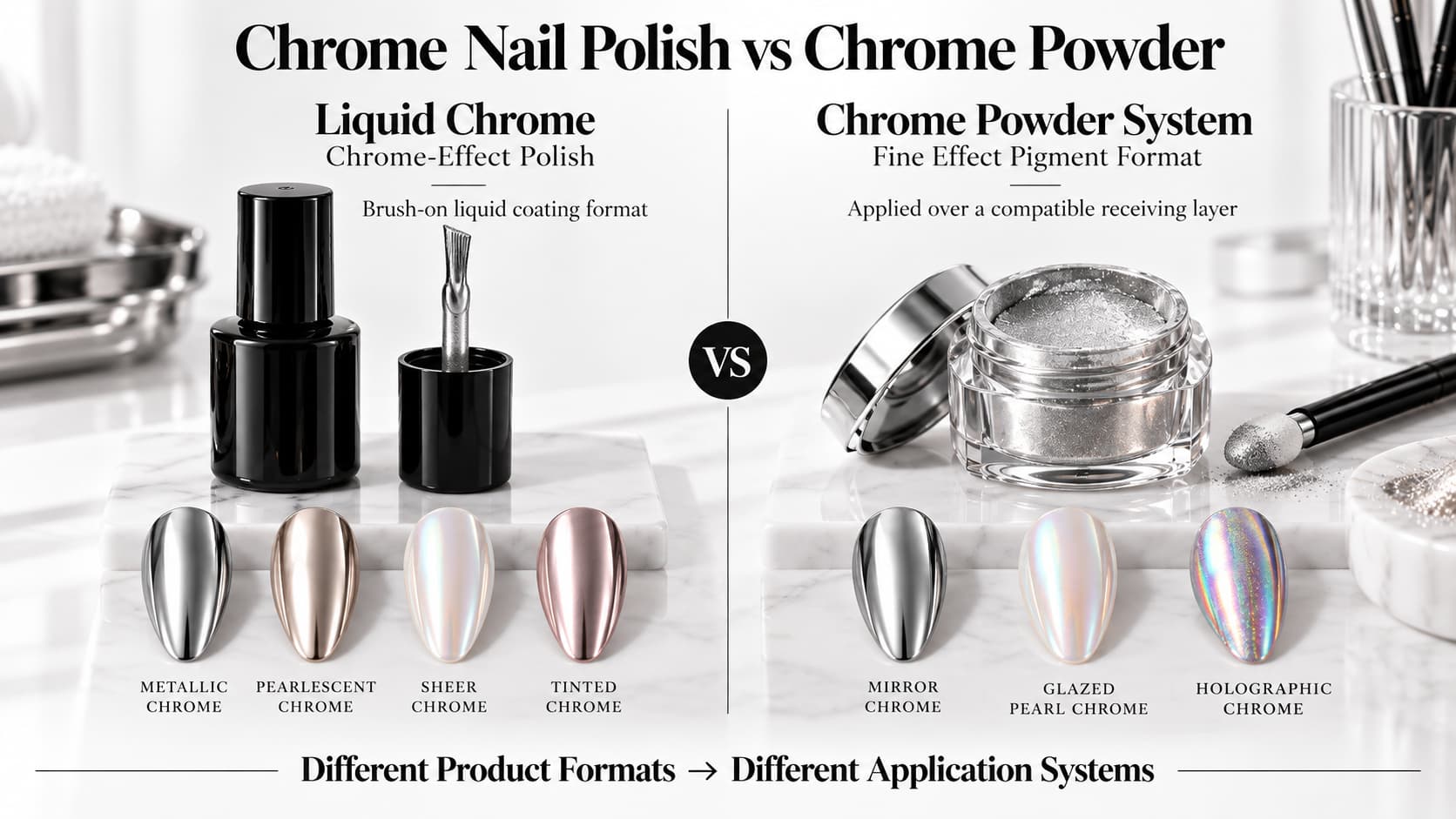
Liquid Chrome or Chrome-Effect Polish
A liquid product is applied with a brush and may create metallic shine, reflective color, pearl effects or other chrome-inspired finishes. The final appearance depends on the exact formula.
Chrome Powder
Chrome powder is a fine effect pigment applied over a compatible prepared surface. Depending on the pigment, base color, receiving layer, application method and finishing system, it can create mirror, pearl, glazed, holographic or other reflective effects.
Desired Finish → Product Format → Compatible Base System → Application Method → Curing Instructions → Sealing / Finishing System → Final Result
For a deeper introduction specifically to effect powders, see the Chrome Powder & Mirror Powder Guide .
1. Chrome Nail Polish vs Chrome Powder: What Is the Difference?
“Chrome nail polish” is used broadly online and can describe liquid products intended to create a metallic or reflective appearance.
Chrome powder is a different format: a fine effect pigment applied over a compatible nail surface.
Neither format should automatically be treated as better. They serve different product and service goals.
| Evaluation Area | Liquid Chrome / Chrome-Effect Polish | Chrome Powder System |
|---|---|---|
| Product Format | Liquid brush-on coating | Fine effect pigment |
| Application | Applied as a liquid nail coating | Applied over a compatible prepared surface |
| Finish | Formula-dependent metallic, pearl or reflective effect | Can create mirror, pearl, glazed or holographic effects |
| Surface Sensitivity | Brush application and leveling affect appearance | Receiving-surface quality strongly affects reflection |
| Base Color | Can influence the final appearance depending on formula | Often has a strong influence on the final effect |
| Salon Workflow | Can simplify some service formats | Allows more layered effect control |
| Buyer Evaluation | Coverage, leveling, brush marks and finish consistency | Smoothness, reflectivity, application behavior and system compatibility |
When a Liquid Chrome Product May Fit
A liquid format may be useful when the project prioritizes:
- brush application;
- simplified handling;
- repeatable shade application;
- reduced loose-powder handling;
- or a particular metallic liquid finish.
However, the phrase “liquid chrome” does not guarantee a glass-like mirror result. The exact appearance depends on the formula.
When a Chrome Powder System May Fit
A powder system may be useful when the service or collection requires:
- strong reflection;
- layered effects;
- different results over different base colors;
- pearl or glazed finishes;
- holographic effects;
- or more control over the final visual surface.
For the powder category itself, continue to the Chrome Powder & Mirror Powder Guide .
2. Mirror Chrome, Soft Chrome, Glazed & Holographic: What Changes?
Not every chrome finish is intended to look like polished metal.
The visual target should be defined before selecting the product system.
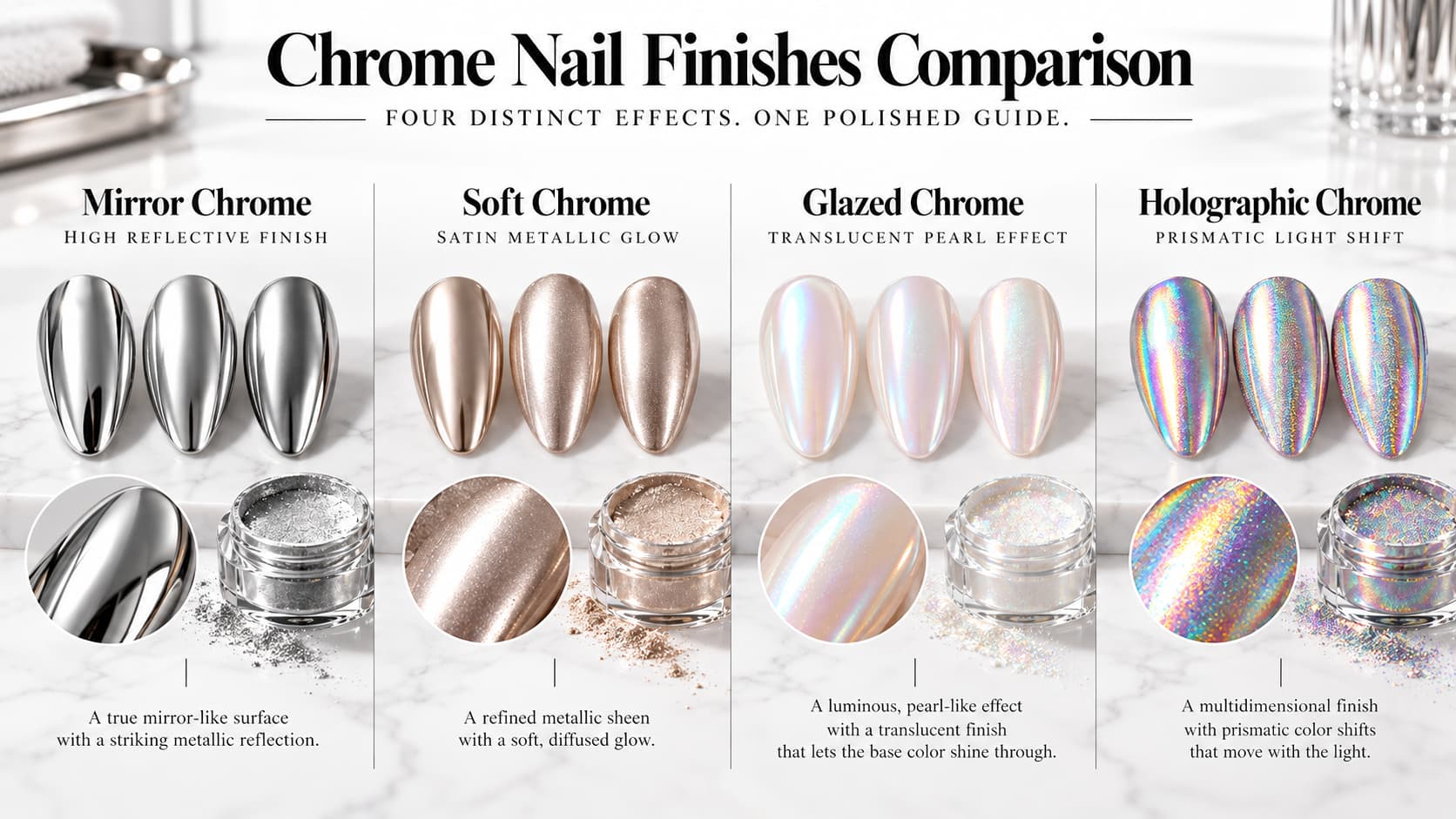
Mirror Chrome
Mirror chrome aims for a highly reflective metallic surface.
Important variables can include:
- surface smoothness;
- pigment behavior;
- application uniformity;
- base color;
- receiving layer;
- and finishing system.
Soft Chrome
Soft chrome provides a more diffused reflective effect.
Instead of maximum metallic reflection, it may create:
- satin shine;
- subtle metallic glow;
- softened pearl;
- or wearable reflective color.
Glazed Chrome
Glazed finishes generally emphasize translucency and glow rather than maximum mirror reflection.
The underlying nail color remains visually important. A chrome effect over nude, pink, white, beige or another base color can produce very different final results.
Holographic Chrome
Holographic or rainbow-shifting effects use specialty effect pigments intended to create a prismatic response to light. Their appearance should be evaluated separately from a conventional silver mirror finish.
Mirror → Soft Chrome → Pearl / Glazed → Holographic → Specialty Effect
For a deeper comparison between the first two finish families, see the Soft Chrome vs Mirror Chrome Guide .
3. What Product System Creates a Mirror Chrome Finish?
A mirror result is not created by chrome powder alone. It is the result of a system.
Prepared Nail Surface → Compatible Base / Color System → Chrome Receiving Surface → Effect Pigment → Controlled Application → Compatible Finishing System
Surface Preparation
A highly reflective finish can make surface irregularities more visible. A smooth working surface is therefore important when the intended result is a mirror-like appearance.
Base Color
The color underneath a chrome effect can influence:
- brightness;
- depth;
- undertone;
- opacity;
- and perceived final shade.
The same effect pigment can look different over black, white, nude, pink, blue or another gel color.
Chrome Receiving Layer
The layer receiving the pigment can influence:
- powder pickup;
- smoothness;
- coverage;
- and final reflection.
The exact receiving surface and curing process should follow the instructions for the specific product system.
For a dedicated comparison, see Chrome Base vs Regular Base .
Pigment Application
The effect product should be evaluated for how evenly it distributes across the intended receiving surface.
Finishing System
The sealing system should preserve the intended appearance and remain compatible with the products underneath it.
4. How Does a Chrome Nail Application System Work?
This page is not intended to replace a detailed chrome-powder tutorial.
At a high level, a chrome workflow can be summarized as:
Prepare Surface → Apply Compatible Base / Color → Create the Intended Chrome Receiving Surface → Apply the Chrome Effect → Remove Excess Product → Seal With the Compatible Finishing System
The exact process depends on the selected products.
Do not assume all chrome powders or chrome-effect systems use the same:
- receiving layer;
- lamp;
- curing time;
- base color;
- application pressure;
- or finishing system.
For detailed application technique, use the Mirror Powder Step-by-Step Guide .
5. Why Does Chrome Sometimes Look Patchy, Grainy or Dull?
A poor chrome result does not automatically mean that the pigment itself is defective. The finished appearance depends on the complete application system.
Patchy Coverage
Potential factors can include:
- an uneven receiving surface;
- inconsistent pigment application;
- contamination;
- product incompatibility;
- or application timing that does not match the selected system.
Grainy Appearance
A mirror effect depends on creating a visually smooth reflective surface.
Visible grain can be influenced by:
- pigment characteristics;
- surface texture;
- incomplete distribution;
- application method;
- or the receiving layer.
Dull Reflection
Potential causes can include:
- surface irregularity;
- uneven pigment distribution;
- base-color interaction;
- finishing-product interaction;
- or a mismatch between the intended finish and the product being used.
Streaking
Streaks can be related to:
- uneven application;
- inconsistent pressure;
- incomplete pigment coverage;
- receiving-layer variation;
- or a system that is not suited to the intended mirror result.
For a dedicated streaking guide, see How to Apply Chrome Powder Without Streaks .
For broader troubleshooting, see Chrome Powder Problems Solved .
If the goal is to understand the reflection principle, use Why Does Chrome Powder Create a Mirror Finish? .
6. What Should Salons Evaluate in Chrome Nail Products?
A salon should evaluate chrome products through actual service conditions rather than product photography alone.
Reflectivity
Does the finished effect match the intended service?
- full mirror;
- softer metallic reflection;
- pearl;
- glazed;
- or holographic.
Surface Smoothness
Does the finished surface appear smooth, or does it become grainy, patchy, streaked or visibly textured?
Application Control
Evaluate:
- pickup;
- distribution;
- buffing behavior;
- cleanup;
- and edge control.
Base-Color Interaction
Test the chrome effect over the actual colors planned for salon use. A product that performs well over black may create a very different result over nude, white, pink or another color.
Receiving-Layer Compatibility
The effect should be tested with the exact base, color system, receiving layer and finishing products planned for use.
Curing Information
A salon system should provide clear instructions for the exact products involved. Do not assume a curing time used for one gel system applies to another.
Edge & Finish Control
Evaluate whether the service can be sealed cleanly without dulling the effect, creating visible edge problems or changing the intended surface.
Removal
The removal route should be understood for the complete system rather than inferred from the word “chrome.”
7. Chrome Powder vs Chrome Polish for Salon Services
The choice between powder and liquid should reflect the service menu.
A Salon May Prefer a Liquid System When:
- the intended finish is available in a suitable liquid format;
- brush application fits the workflow;
- simplified handling is important;
- or loose-powder cleanup is undesirable.
A Salon May Prefer a Powder System When:
- strong mirror reflection is required;
- multiple base colors will be used;
- layered effects are important;
- glazed or holographic looks are part of the menu;
- or detailed effect control is required.
Some Salons May Use Both
A salon menu does not need to choose one format exclusively. Liquid and powder systems can serve different finish categories, service concepts, workflows and design needs.
The useful question is not “Powder or polish—which wins?” It is which system produces the intended finish consistently within the salon workflow.
8. What Should Nail Brands & Private Label Buyers Compare?
For a nail brand, distributor or private label buyer, chrome products should be evaluated as a product-and-application system.
Do not approve a chrome product only because one sample photograph looks reflective.
| Evaluation Area | What to Review |
|---|---|
| Product Format | Powder, liquid effect product or complete chrome system |
| Intended Finish | Mirror, pearl, glazed, soft chrome, holographic or specialty effect |
| Reflectivity | Strength and consistency of the intended reflective result |
| Surface Quality | Smoothness, grain, streaking and patch consistency |
| Base Interaction | Performance over relevant gel colors |
| Application | Product pickup, distribution, buffing or brush behavior |
| Receiving System | Compatibility with the intended gel surface |
| Curing Information | Exact product and system instructions |
| Finishing | Compatibility with the intended sealing system |
| Packaging | Container, closure, applicator and handling suitability |
| Shade / Effect Consistency | Repeatability across samples and production |
| Documentation | Relevant product information and instructions |
| Sample Testing | Finished salon-style application, not only loose pigment or bottle appearance |
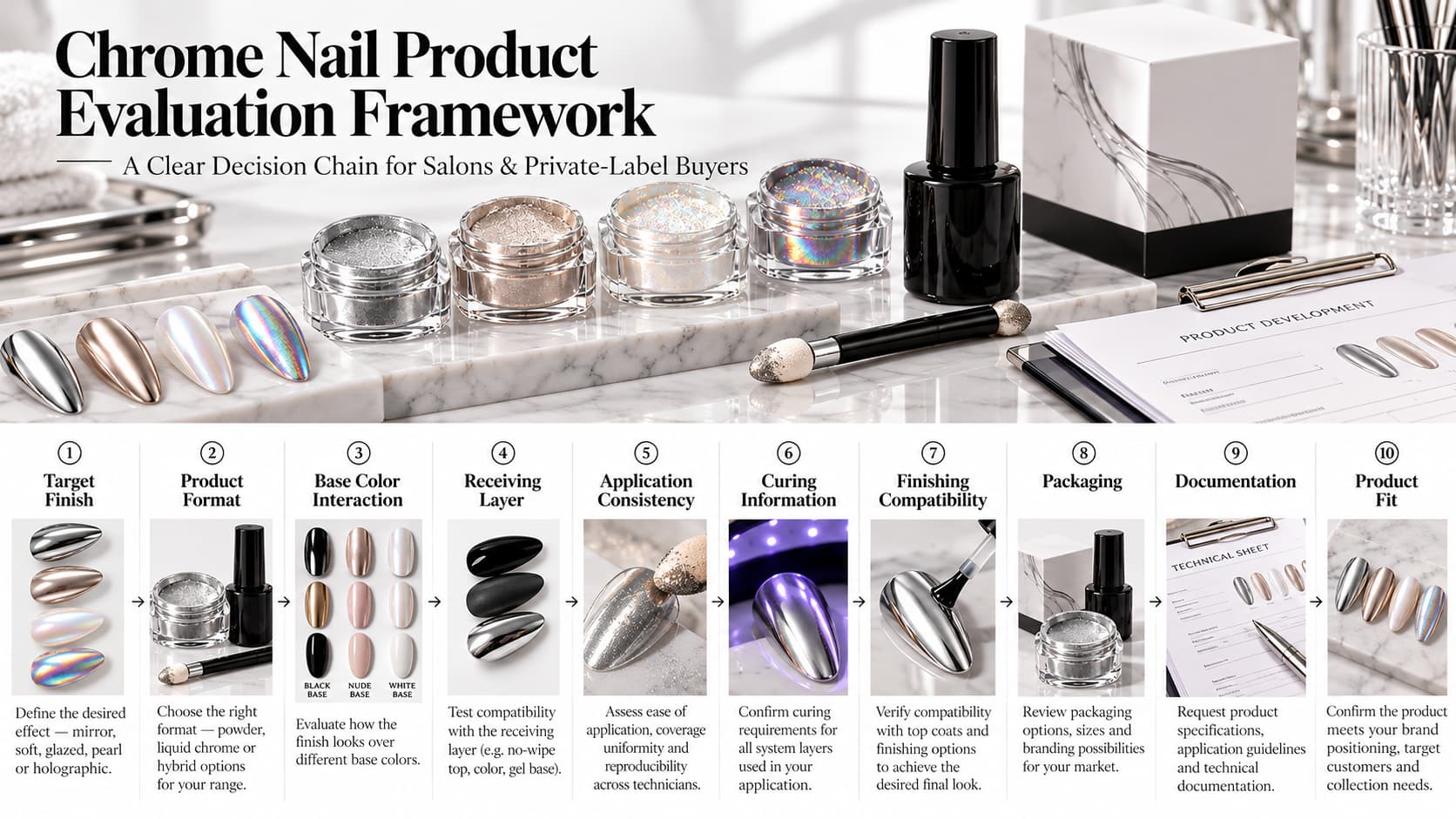
Define the Finish → Select the Product Format → Test Over Target Base Colors → Evaluate Application Consistency → Verify the Complete Product System → Review Packaging & Documentation → Approve the Exact Effect
9. Why Sample Testing Matters for Chrome Products
Chrome products are highly visual. That makes sample testing particularly important.
A useful evaluation should include more than one loose-pigment swatch or one photographed nail tip.
Test the Intended Base Colors
If the range will be used over black, white, nude, pink or colored gel, test those actual use cases.
Compare Lighting Conditions
Reflective and holographic products can appear different under:
- salon lighting;
- daylight;
- direct light;
- and photography lighting.
Test Complete Applications
Evaluate the product as a complete service system, including the receiving surface, effect application, finishing and final appearance.
Review Repeatability
Can the intended result be recreated across multiple nails and repeated applications?
For salon and commercial use, consistency matters more than one perfect sample.
10. Chrome Nail Product Buyer Checklist
Finish
- What visual effect is required?
- Mirror, soft chrome, pearl, glazed or holographic?
- How strong should the reflection be?
Product Format
- Loose powder?
- Liquid chrome-effect product?
- Complete gel-and-pigment system?
Application
- How is the effect applied?
- Which receiving layer is required?
- Which tools or applicators are recommended?
Base Color
- Which base colors have been tested?
- Does the effect change significantly over different shades?
Surface Quality
- Is the finish smooth?
- Does it show grain?
- Does it streak?
- Is coverage consistent?
Curing
- What product-specific curing instructions apply?
- Which curing system is compatible?
Finishing
- Which sealing or top system is intended?
- Does sealing preserve the reflective appearance?
Removal
Confirm the removal process for the complete nail system rather than assuming every chrome effect removes in the same way.
Packaging
For powder products, review:
- jar design;
- closure;
- contamination control;
- handling;
- and labeling space.
For liquid products, review:
- bottle;
- brush;
- closure;
- dispensing control;
- and formula-packaging compatibility.
Documentation
Review applicable:
- product instructions;
- ingredient information;
- specifications;
- application information;
- and other target-market documentation.
Samples
Test the exact product through finished nail applications rather than approving it only from packaging or supplier photography.
Planning a Chrome Nail Product Range?
Once the finish and system requirements are clear, the next step is to turn them into a manufacturer-ready project brief.
A useful brief can define:
- target customer;
- intended chrome finish;
- powder or liquid format;
- target base colors;
- application system;
- sample requirements;
- packaging direction;
- labeling;
- and documentation needs.
That makes manufacturer discussions more specific than simply asking for “a good chrome product.”
Create Your Brand Discuss Your Project11. Which Chrome Finishes Belong in a Product Range?
Instead of asking whether mirror chrome or glazed chrome is universally better, brands and salons should decide which visual roles are needed in the range.
Mirror Chrome
A mirror finish can support collections focused on:
- metallic impact;
- high-reflection effects;
- statement nail art;
- silver or gold looks;
- and visually bold surfaces.
Soft or Glazed Chrome
A softer reflective finish can support ranges focused on:
- translucent pearl;
- nude and pink layering;
- subtle reflective effects;
- softer salon looks;
- and base-color interaction.
Holographic & Specialty Effects
Specialty powders can extend the range into:
- prismatic effects;
- color shifts;
- multichrome finishes;
- or other light-reactive visual effects.
Build the Range Around Customer Use
A product range may need:
- one signature mirror effect;
- several wearable pearl effects;
- specialty holographic options;
- or a combination of different chrome systems.
For a deeper visual comparison between soft and mirror finishes, see the Soft Chrome vs Mirror Chrome Guide .
12. Where Do Chrome Base, Cat Eye Chrome & Other Specialty Systems Fit?
Chrome products can overlap with other nail-art systems, but those topics should remain distinct.
Chrome Base
The receiving layer is part of the chrome application system, but base selection deserves its own comparison.
See Chrome Base vs Regular Base .
Cat Eye Chrome
Magnetic cat-eye effects can be combined with chrome to create layered reflective designs. Because this introduces an additional magnetic system, it should be evaluated separately from a standard chrome workflow.
See How to Use Cat Eye Chrome Powder .
Chrome Optical Principles
If the goal is to understand why effect pigments can create a mirror-like appearance, use the dedicated optical article rather than turning this page into a materials-science guide.
Frequently Asked Questions About Chrome Nails
What are chrome nails?
Chrome nails are nail finishes designed to create a reflective, metallic, pearl, glazed or light-shifting appearance. Different effects can be created through liquid products, fine effect powders or combined gel-and-pigment systems.
Is chrome nail polish the same as chrome powder?
No. Chrome nail polish generally refers to a liquid coating with a metallic or chrome-like appearance, while chrome powder is a fine effect pigment applied over a compatible prepared surface. The visual result depends on the exact product system.
Which gives a stronger mirror finish: chrome polish or chrome powder?
It depends on the products being compared. Many high-reflection systems use fine effect powder over a compatible gel surface, but “chrome polish” covers different liquid formulas and should not be judged by the name alone.
What is the difference between mirror chrome and glazed chrome?
Mirror chrome aims for stronger metallic reflection. Glazed chrome generally creates a softer, more translucent pearlescent effect in which the underlying base color remains more visible.
Does the base color matter for chrome nails?
Yes. The underlying color can influence brightness, undertone, depth, opacity and overall appearance. The effect should be tested over the actual base colors planned for use.
Why does chrome powder look patchy?
Potential factors can include receiving-surface variation, inconsistent effect application, contamination, incompatible products or a mismatch within the application system. For detailed streaking guidance, see How to Apply Chrome Powder Without Streaks .
Why does chrome look grainy instead of mirror-like?
Grain can be influenced by surface smoothness, pigment behavior, application technique and receiving-layer compatibility. A mirror effect depends on the complete surface and application system rather than the effect pigment alone.
Does every chrome powder need the same curing time?
No. Curing requirements depend on the exact gel products used in the chrome system. Follow the instructions for the specific receiving and finishing products rather than applying one universal exposure time or lamp specification.
How long do chrome nails last?
There is no reliable universal wear time for every chrome system. Wear can depend on the product system, application, base and top compatibility, curing, nail condition, service conditions and aftercare.
Is chrome powder the same as holographic powder?
Not necessarily. Both can be effect pigments, but a holographic product is intended to create a rainbow or prismatic response to light rather than a conventional metallic mirror appearance.
What should salons look for in chrome products?
Useful evaluation points include reflectivity, smoothness, application consistency, base-color interaction, receiving-layer compatibility, finishing compatibility, removal and clear product instructions.
What should private label buyers test before approving a chrome product?
Test the intended finish, application behavior, target base colors, the complete receiving and finishing system, packaging, effect consistency and relevant product documentation. Do not approve a product from a loose-powder photograph alone.
Related Chrome Nail Guides
Chrome Powder & Mirror Powder Guide
Use this guide for the broader chrome and mirror-powder category.
Mirror Powder Application Tutorial
Use this page for detailed step-by-step powder application.
Chrome Powder Without Streaks
Use this guide for streaked or uneven mirror results.
Chrome Powder Troubleshooting
Use this guide for a broader diagnosis of powder application problems.
Soft Chrome vs Mirror Chrome
Use this guide for a deeper comparison of reflective finish styles.
Chrome Base vs Regular Base
Use this guide for receiving-surface and base-system selection.
Why Does Chrome Powder Create a Mirror Finish?
Use this article for the optical principles behind reflective effects.
Cat Eye Chrome Powder
Use this guide for combined magnetic and chrome-effect applications.
Chrome Product Sourcing
Use this guide for supplier and distributor-oriented evaluation.
Final Thoughts
Chrome nails are best understood as a product system, not as one universal polish or powder.
Define the Finish → Choose the Product Format → Select the Compatible Base / Receiving System → Test Application → Verify Curing Instructions → Evaluate the Finished Surface → Confirm Sealing & Removal
For salons, the priority is:
Finish → Application Control → System Compatibility → Repeatability
For private label buyers and distributors:
Target Customer → Product Format → Finish Portfolio → Sample Testing → Complete System Validation → Packaging & Documentation → Product Approval
That approach is more useful than choosing a chrome product only because it looks reflective in one photograph or is described as “mirror,” “professional” or “high shine.”
Choose the Next Step Based on Your Chrome Project
Continue with product education if you are still comparing formats and finishes. If you already have a defined product brief, move into brand development or manufacturer discussion.
Explore Chrome Powder Review Chrome SourcingThis article provides general product-category, application-system and buyer-evaluation information. Exact curing requirements, compatibility, removal method and finished performance depend on the specific chrome product and complete nail system being used.
The "Siren Eyes" of Nails: How Cat Eye Gels Became the Ultimate Femme Fatale Look
What Is 3D Nail Art Gel? How to Use 3D Sculpting Gel for Nails
How to Build a Proper Apex with Self-Leveling Builder Gel
The Psychology of Nail Color: What Your Manicure Says About Your Mood
How to Prevent Heat Spikes During Gel Curing: The Ultimate Guide
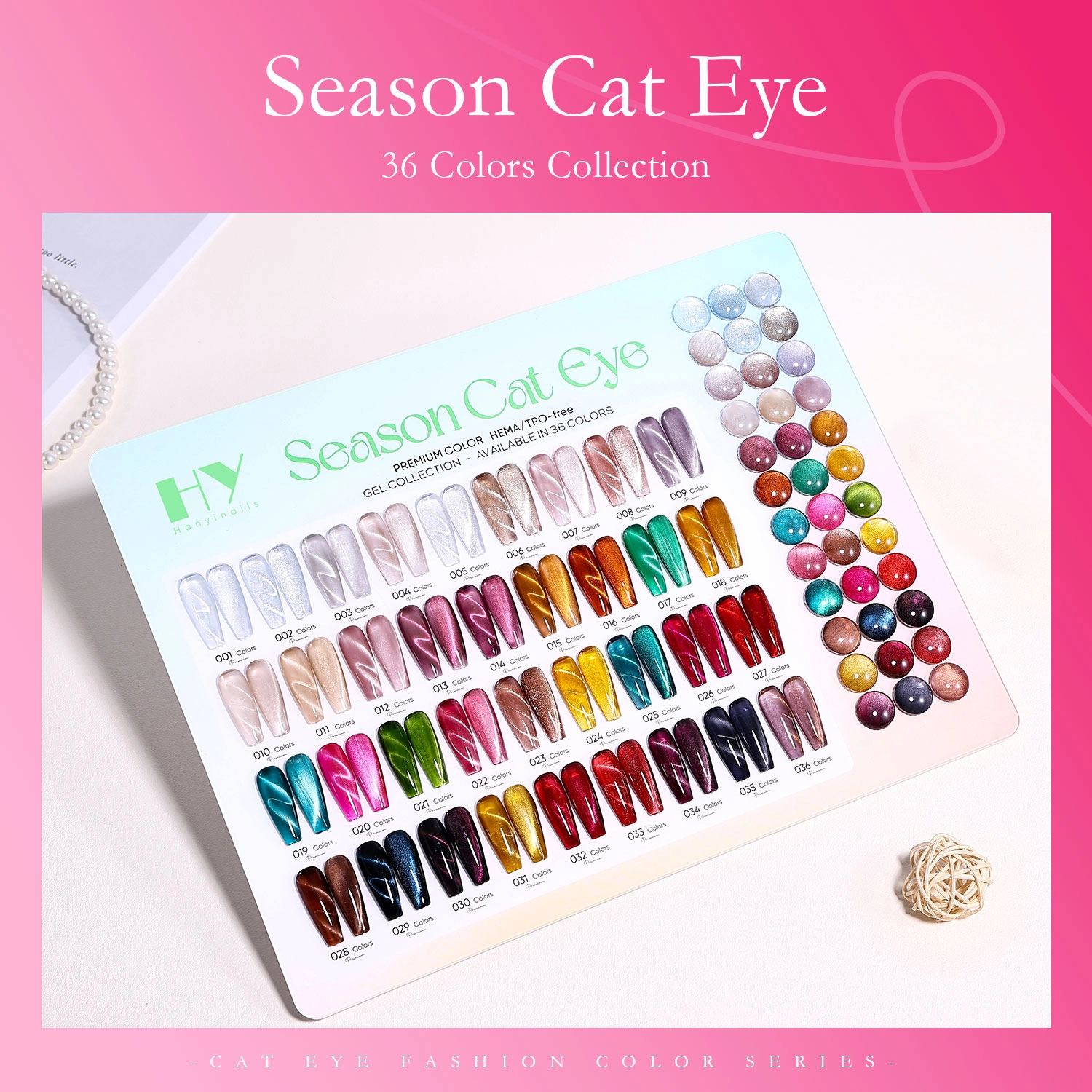
Cat Eye French Manicure: The Modern Upgrade to a Classic (2026 Guide)
Recommended for You

OEM Gel Polish Factory for Private Label 3D Nail Art – Custom Molding Gel Solutions
🔑 Key Features:
-
🌸 Vibrant Pitaya Pink Color—Trendy and bold, perfect for all skin tones and seasons.
-
💅 Long-Lasting Formula—Stays chip-free for up to 21 days with proper application.
-
✨ High Gloss Finish—Provides a salon-quality shine that won't dull.
-
🌿 Eco-Friendly & Cruelty-Free – Made with non-toxic ingredients, gentle on nails.
-
🛠️ OEM/ODM Support—Customize color, packaging, logo, bottle shape, and more.
-

HEMA-Free Builder Gel in a Bottle – Private Label Available | Professional Nail Strengthening Formula
Key Features:
✅ HEMA-Free & Low-Allergy Risk
✅ Self-Leveling & Easy Application
✅ Crystal Clear or Custom Colors
✅ Strong Adhesion, No Lifting
✅ Cures Under LED/UV Lamp
✅ Custom Branding / Private Label Support
Perfect for salons, nail techs, and beauty brands looking to offer a clean, high-performance builder gel under their own label. MOQ and bulk pricing available.
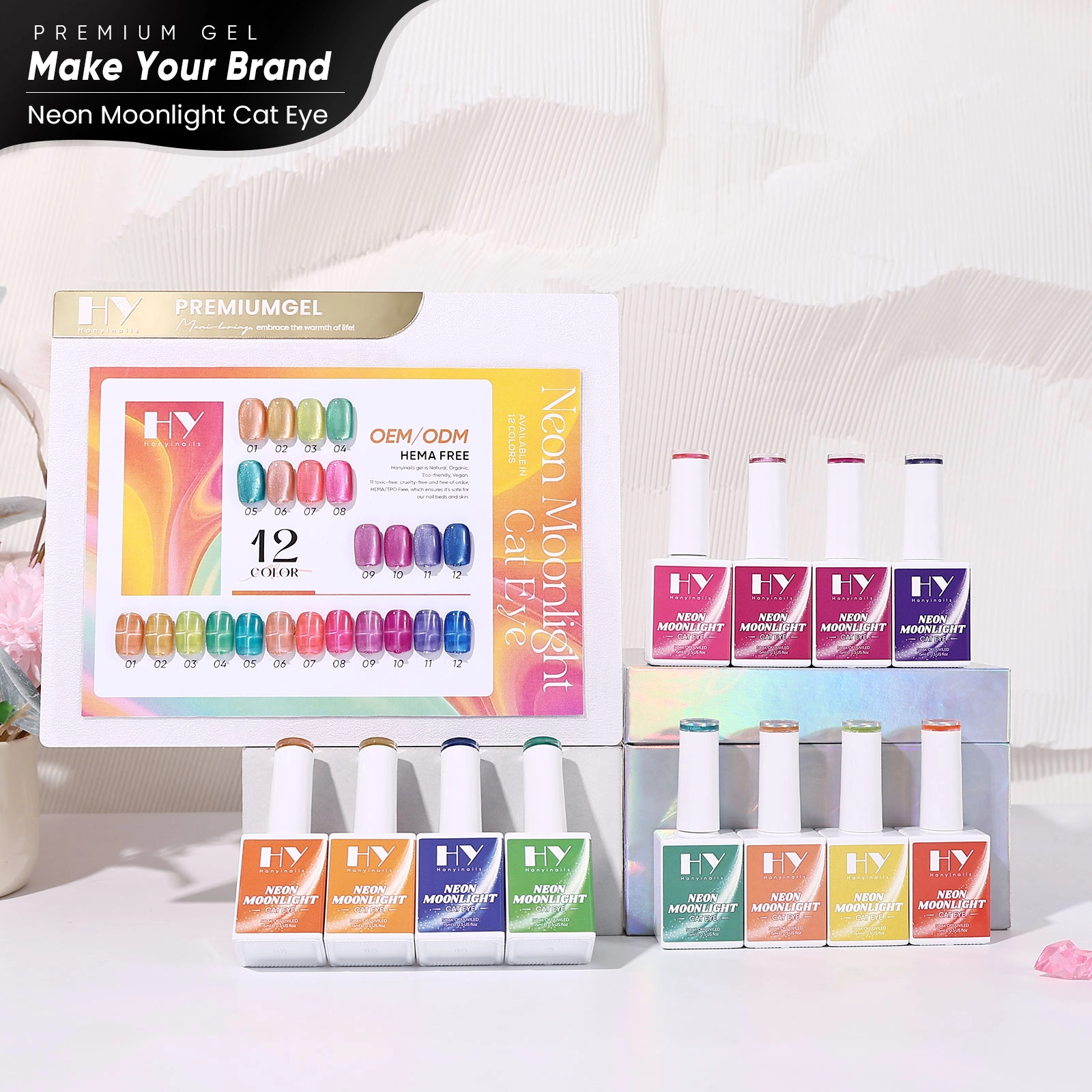
Glow-in-the-Dark Moonlight Cat Eye Gel Polish - Magnetic UV/LED Gel with Galaxy Effect
🔑 Key Features:
-
🌸 Dual Light Effects – Glows under UV and shifts colors like moonlight
-
💅 Razor-Sharp Cat Eye – Super-strong magnet for crisp, customizable lines
-
✨ 3-in-1 Finish – Sparkle (micro-glitter) + Glow (UV) + Shift (photochromic)
-
🌿 Long-Lasting – 21+ days wear, non-yellowing, 5-Free vegan formula
-
🛠️ Multi-Use – Perfect for galaxy nails, chrome powder bases, or solo wear
-

Metallic OEM Liner Gel for Nail Art | Private Label Chrome Striping Gel Factory Supply
-
-
💎 High Pigment Chrome Effect—Ultra-shiny metallic finish with bold color payoff
-
🖌️ Precision Liner Brush—Built-in ultra-thin brush for fine lines & custom art
-
🎨 12+ Popular Chrome Colors—Including silver, gold, rose gold, and more
-
🔧 OEM & Private Label Support – Logo, label, jar, outer box customization
-
💡 Easy Application & Long-Lasting – Smooth texture, no leaking, long wear for 3+ weeks
-
🏭 Factory Direct Supply—Stable production, low MOQ, fast delivery time
-
Looking for a creative, premium, and reliable nail gel product manufacturer?
Whether you're an Amazon seller, Shopify store owner, chain store buyer, brand owner, distributor, wholesaler, or nail supply retailer — Hanyinails is your trusted partner for custom and wholesale nail solutions.

Hanyinails
Hanyinails
Hanyinails
Hanyinails