



Compare BIAB™ and other builder gel systems by formula, structural use, base-coat requirements, curing, removal and suitability for professional nail brands.
1. Quick Answer: Is BIAB the Same as Builder Gel?
BIAB is a type of builder gel, but not all builder gels are BIAB. BIAB™ stands for Builder In A Bottle™, a branded product system associated with The GelBottle Inc. The wider builder gel category includes bottle-applied and pot-applied formulas designed for natural nail overlays, structural reinforcement, and certain nail extensions.
The main differences are not simply packaging or product names. They involve working viscosity, self-leveling behavior, cured mechanical properties, recommended applications, base-coat requirements, and removal methods.
Many bottle-style builder gels are developed for natural nail overlays, while some firmer builder gels are designed for more demanding structural work. However, their properties can overlap, and individual formulations must be evaluated separately.
| Common Question | Quick Answer |
|---|---|
| Is BIAB a builder gel? | Yes. BIAB™ belongs to the builder gel family. |
| Is every builder gel BIAB? | No. BIAB™ is associated with a branded system; builder gel is the broader category. |
| Does BIAB always come in a bottle? | The branded BIAB™ system is supplied in bottles, but other manufacturers also offer bottle-style builder gels. |
| Is builder gel always harder than BIAB? | No. Hardness and flexibility depend on the formulation. |
| Does BIAB always soak off? | No. Some BIAB™ formulations are soak-off; others are file-off. |
| Does BIAB require a base coat? | Some formulations include base functionality; others require a separate compatible base. |
| Which is better for extensions? | Choose according to the intended length, structural requirements, and the product's specified use. |
The practical answer: Choose the builder gel system that matches the client's nail condition, desired length, service type, and removal preferences—not simply a product labeled BIAB or builder gel.
For salons and nail brands, understanding these distinctions helps prevent inappropriate product substitutions and supports more informed purchasing decisions.
2. What Is BIAB and What Is Builder Gel?
BIAB and builder gel are frequently compared as though they were completely separate categories.
In reality, BIAB™ is associated with a branded system within the broader category of light-curable builder gel products.
What Is BIAB?
BIAB™ is short for Builder In A Bottle™, a branded builder gel system associated with The GelBottle Inc.
The system includes formulations developed for natural nail overlays, structured manicures, and certain nail extensions.
Several BIAB™ products are self-leveling and supplied in bottles with integrated brushes. However, individual formulations differ in their intended applications, bonding requirements, curing instructions, and removal methods.
The manufacturer's official BIAB formulation guidance illustrates these differences.
Terminology note: Nail professionals sometimes use BIAB informally to describe builder gel in a bottle. In technical specifications and private label purchasing, builder gel in a bottle or bottle-style builder gel is a clearer generic description.
Hanyinails' builder gel products should not be interpreted as products manufactured by, endorsed by, or affiliated with The GelBottle Inc unless an authorized relationship is separately established.
What Is Builder Gel?
Builder gel is a category of light-curable nail enhancement products formulated to add structure to the nail.
Depending on the product system, builder gel may be used for:
- Natural nail overlays and reinforcement
- Creating or refining an apex
- Short or longer nail extensions
- Structural correction and shaping
- Certain encapsulation and enhancement techniques
Builder gels differ in viscosity, flexibility, hardness, adhesion, pigmentation, and removal behavior.
Some are self-leveling, while others offer more controlled placement during structural shaping.
Likewise, some are designed for acetone soak-off removal, while others require careful filing.
Builder gel should therefore not be defined as only a thick, rigid, file-off product.
Is BIAB Different from Traditional Builder Gel?
Not in the sense of being a completely separate nail enhancement technology.
Both belong to the wider family of light-curable builder gels.
A bottle-style formula may prioritize convenient brush application and controlled leveling. A firm pot builder gel may offer different handling characteristics for structural work.
However, neither packaging format guarantees a particular hardness, flexibility, durability, or removal method.
The meaningful comparison is between specific formulations and their documented properties.
3. BIAB vs Builder Gel: Key Differences
The most useful comparison considers product purpose, working behavior, structural performance, and removal requirements.
| Comparison Factor | BIAB™ / Bottle-Style Builder Gel | Traditional Pot Builder Gel |
|---|---|---|
| Product category | Builder gel | Builder gel |
| Packaging | Usually a bottle with integrated brush | Usually a jar or pot with separate brush |
| Working viscosity | Often self-leveling; formula-dependent | Ranges from self-leveling to highly shape-retentive |
| Main applications | Overlays, structured manicures, approved extensions | Overlays, structural enhancements, approved extensions |
| Apex building | Suitable when the formulation supports the structure | Suitable when the formulation supports the structure |
| Cured hardness | Formula-dependent | Formula-dependent |
| Flexibility | Formula-dependent | Formula-dependent |
| Base-coat requirements | Integrated or separate, depending on the formula | Determined by the product system |
| Removal method | Soak-off or file-off, depending on the formula | Soak-off or file-off, depending on the formula |
| Curing | Compatible UV/LED system | Compatible UV/LED system |
Difference 1: Product Packaging
Bottle-style builder gel is commonly supplied with an integrated brush, which may support convenient product application for overlay services.
Pot builder gel allows technicians to select a separate application brush and control product pickup differently.
Neither format guarantees superior adhesion, durability, or curing performance.
Difference 2: Viscosity and Self-Leveling
Viscosity describes resistance to flow, while self-leveling refers to how a product moves and settles after application.
These characteristics influence product placement, apex formation, application control, and the amount of refinement required.
A self-leveling formula may help achieve a smooth overlay but requires control to avoid flooding the surrounding nail folds.
A more shape-retentive gel may offer advantages for specific structural techniques.
Neither consistency is universally better.
Difference 3: Cured Hardness and Flexibility
A builder gel must provide appropriate mechanical support for its intended enhancement.
However, two bottle-style gels may have substantially different cured properties. The same applies to pot builder gels.
Professionals should not assume that all BIAB products are flexible or that all traditional builder gels are rigid.
Difference 4: Extension Capability
Some bottle-style builder gels are intended primarily for overlays and short extensions. Others may support additional extension techniques when specified by the manufacturer.
Pot builder gels also vary in structural applications.
Product suitability should be determined by the intended length, nail shape, apex design, and the manufacturer's documented requirements.
A product should never be used beyond its intended structural application simply because it is labeled builder gel.
Difference 5: Removal and Maintenance
Some BIAB™ formulations and other bottle-style builder gels are soak-off products. Others are file-off.
Pot builder gels can also have different removal classifications.
The product formulation—not the container or general product name—determines the removal method.
4. Bottle Builder Gel vs Pot Builder Gel: Does Packaging Determine Performance?
The choice between bottle and pot packaging often begins with application convenience, but packaging should not replace technical evaluation.
Advantages of Bottle-Style Builder Gel
A bottle-style formula may support an efficient workflow when designed for brush application.
Potential advantages include convenient dispensing, fewer separate tools, and organized shade management.
It may suit salons performing natural nail overlays and structured manicures.
For private label brands, bottles also provide opportunities for coordinated colors, applicators, caps, labels, and collection packaging.
However, these features do not establish that the product cures faster, adheres better, or provides greater protection to natural nails.
Advantages of Pot Builder Gel
Pot packaging allows technicians to select an appropriate brush and control the amount of material picked up for each service.
This format is common for products used in structural shaping, although actual working properties depend on the formula.
Pot products also require appropriate hygienic handling, brush management, and protection from unintended light exposure.
Which Packaging Format Is Better for Salons?
The answer depends on the service menu.
For salons primarily performing natural nail overlays, a suitable bottle-style builder gel may offer a convenient workflow.
For salons providing more varied structural enhancements, having access to different viscosities and application systems may be beneficial.
A professional product assortment can include both formats.
What Does Packaging Mean for Private Label Buyers?
For nail brands, packaging should be selected alongside the formula.
Important considerations include:
- Bottle or jar capacity
- Applicator characteristics
- Formula viscosity and dispensing behavior
- Closure and packaging compatibility
- Labeling requirements
- Intended professional use
A formulation that works well in one container may need further compatibility assessment when presented in another format.
Procurement takeaway: Evaluate the formula, packaging, applicator, and instructions as a complete product system.

5. Strength, Flexibility, and Nail Structure: Which Gel Performs Better?
Strength is one of the most misunderstood aspects of BIAB vs builder gel comparisons.
A product described as strong may behave differently from another builder gel with a similar marketing claim.
Enhancement performance depends on the formulation, cured structure, application thickness, adhesion, nail shape, and forces encountered during wear.
Does a More Flexible Builder Gel Protect Natural Nails Better?
Not automatically.
Natural nails can flex during everyday activities, while a cured enhancement provides additional structure.
A formula with suitable flexibility may accommodate some movement, but greater flexibility does not always mean less lifting or breakage.
A product that is too flexible for a particular enhancement may provide insufficient structural support.
Conversely, a very rigid product may not be appropriate for every client's nail or service.
The correct objective is not maximum flexibility or maximum hardness.
It is appropriate mechanical performance for the intended nail enhancement.
Why Apex Structure Matters
An apex forms part of a nail enhancement's structural design.
Its purpose is to help distribute forces and support the intended nail length and shape.
The required structure varies with nail anatomy, extension length, shape, and product properties.
A short natural nail overlay generally has different structural demands from a long sculpted extension.
However, even short enhancements need appropriate product placement and adequate curing.
Applying a thicker layer does not automatically create a stronger or more balanced structure.
Does BIAB Help Natural Nails Grow?
BIAB and builder gel do not directly accelerate the biological growth of natural nails.
An appropriately applied enhancement may provide protection against some mechanical damage while the natural nail grows.
This can help certain clients maintain length by reducing breakage during everyday activities.
However, results depend on nail condition, product suitability, application, maintenance, and removal.
Statements such as BIAB makes nails healthier or builder gel repairs damaged nails are too broad to be treated as general facts.
Builder gel is a cosmetic enhancement, not a medical treatment for nail damage or disease.
When Does Rigidity Become Important?
Longer enhancements and complex shapes may require greater structural support.
Technicians should choose products whose intended applications support the desired extension length and design.
Packaging, viscosity, and marketing descriptions alone cannot establish whether the cured enhancement will perform appropriately.
For professional purchasing, the central question is:
Has the formulation been evaluated for the enhancement the salon intends to perform?
6. Application, Base Coat, and Curing: What Professionals Need to Know
BIAB and other builder gels share general application principles, but their specific product systems can differ.
The appropriate procedure depends on the formula, bonding requirements, curing conditions, and intended service.
Does BIAB Need a Base Coat?
There is no universal answer.
Some builder gel formulations contain integrated base or bonding functions and may be applied without an additional base coat when the manufacturer specifies that procedure.
Others require a separate compatible base.
According to The GelBottle's published guidance for its specified BIAB™ formulations, Clear, White, and Milky BIAB™ require Rubber Base Coat, while its HEMA-Free BIAB™ formulations require HEMA-Free Bond Base.
These examples apply to the identified products and should not be treated as permanent instructions for every current or future BIAB™ formulation.
Professionals should consult the latest product-specific instructions before application.
Basic Builder Gel Application Workflow
A general professional workflow may include:
- Assess the natural nail and prepare the surface according to the product system.
- Apply a compatible base or bonding layer if required.
- Place and shape the builder gel for the intended enhancement.
- Cure within the manufacturer's specified conditions.
- Refine and finish the enhancement as required.
Avoid excessive abrasion of the natural nail and prevent uncured gel from contacting the surrounding skin.
This overview is not a substitute for individual product instructions.
For detailed application techniques, including apex construction and product placement, see the separate BIAB Builder Gel Application Guide.
Do BIAB and Builder Gel Use the Same Curing Time?
Not necessarily.
Both are generally light-curable systems, but curing requirements depend on the individual formulation.
Relevant variables include lamp wavelength output, irradiance, exposure conditions, pigmentation, product thickness, and placement within the curing device.
A higher lamp wattage does not automatically guarantee adequate curing.
A surface that appears firm also does not establish that a thicker enhancement has cured adequately throughout.
Follow the product's specified curing requirements using a compatible UV/LED system.
Why Under-Curing Matters
Inadequate curing can affect material performance and may increase exposure to reactive components.
Professionals should control application thickness, avoid deliberate skin contact with uncured material, and use the recommended curing system.
If a formula cannot be adequately cured with the available equipment, the appropriate response is to use a compatible system rather than guess a longer exposure time.
For additional safety information, consult the U.S. FDA's Nail Care Products guidance.
7. Soak-Off vs File-Off: Removal and Infills
Removal is one of the most important practical differences between individual builder gel formulations.
It is also an area where general BIAB comparisons frequently produce misleading advice.
Are All BIAB Products Soak-Off?
No.
According to The GelBottle's published file-off guidance, its Clear, White, and Milky BIAB™ formulations are file-off products.
Other specified BIAB™ formulations are designed for soak-off removal.
These examples refer to particular products documented by the brand, not to every builder gel supplied in a bottle.
Current product instructions should always take precedence over general descriptions or older guidance.
Soak-Off Builder Gel
A soak-off builder gel is formulated for removal using the solvent-based process specified by its manufacturer.
Depending on the system, the technician may need to reduce the top coat or product bulk before soaking.
The removal procedure and duration vary with the formulation and remaining thickness.
Do not assume that every builder gel will soften adequately after a fixed period in acetone.
If the material does not respond as expected, follow the manufacturer's instructions rather than forcing it away from the nail plate.
File-Off Builder Gel
File-off products require controlled mechanical reduction.
They should not be treated as soak-off products simply because they are supplied in bottles.
Appropriate filing equipment, professional technique, and careful assessment of the remaining material are essential to minimizing unnecessary natural nail damage.
Where supported by the product system and nail condition, maintaining a suitable residual layer may be preferable to aggressive filing down to the natural nail plate.
Can BIAB and Builder Gel Be Infilled?
Many builder gel systems support maintenance or infill services.
However, an infill should begin with an assessment of the existing enhancement.
Relevant factors include nail growth, structural balance, lifting, cracks, and the condition of the underlying surface.
A technician must determine whether the enhancement remains suitable for maintenance or requires partial or complete removal.
Fresh material should not simply be applied over significant lifting, trapped contamination, unexplained discoloration, or suspected adverse reactions.
How Often Should Builder Gel Be Maintained?
Maintenance intervals vary according to natural nail growth, enhancement length, daily activities, and the complete product system.
Some salon services are reviewed every few weeks, but no single interval is appropriate for every client.
A longer interval is not necessarily better, particularly when nail growth changes the position of the enhancement's structural balance.
Professional takeaway: Removal and maintenance decisions should be based on the actual formulation and the condition of the enhancement—not the BIAB or builder gel label alone.
8. Wear Time, Nail Health, and Common Problems
Both BIAB-style and other builder gel enhancements may provide durable wear when correctly applied and maintained.
However, performance depends on the complete system rather than one product characteristic.
How Long Do BIAB and Builder Gel Manicures Last?
There is no universal guaranteed wear duration.
Performance depends on nail preparation, adhesion, product compatibility, curing, structural balance, natural nail growth, and daily mechanical exposure.
A manufacturer may specify expected wear or service intervals for an individual formulation, but these claims should not automatically be transferred to other builder gels.
Professionals should distinguish between how long an enhancement remains attached and when it requires maintenance for structural or practical reasons.
Common Problems and What They May Indicate
| Problem | Possible Contributing Factors | Professional Assessment |
|---|---|---|
| Lifting near the cuticle | Surface contamination, incompatible layers, skin contact during application | Review preparation, bonding, and placement |
| Cracking at the stress area | Inadequate structure, mechanical stress, material mismatch | Assess apex, length, and formula suitability |
| Peeling or separation | Adhesion or curing problems | Check the complete application system |
| Excessive bulk | Poor product control or unsuitable consistency | Review application and structural design |
| Strong heat sensation during curing | Formula, material thickness, exposure conditions | Stop the exposure if burning or pain occurs and assess the procedure |
| Irritation or itching | Possible irritation or allergic reaction | Discontinue exposure and seek appropriate medical assessment |
These are possible contributing factors, not definitive diagnoses.
A technician should not assume that every lifting problem is caused by poor preparation or that every crack results from excessive hardness.
For more detailed diagnosis, see Why Is My Builder Gel Lifting?.
What Should Technicians Do If a Client Feels Burning During Curing?
If a client experiences significant burning or pain during curing, stop the light exposure immediately.
Do not instruct the client to tolerate severe discomfort or automatically continue curing.
Review the product's safety guidance, application thickness, and specified curing procedure before deciding whether the service can safely continue.
If irritation, burns, persistent pain, or another concerning reaction occurs, stop the service and seek appropriate medical assessment.
The response should follow the product's safety instructions rather than an improvised curing method that could leave the gel inadequately polymerized.
Is BIAB Better for Weak or Brittle Nails?
Not automatically.
Some clients may benefit from an appropriate protective overlay, but the choice must consider natural nail condition, structural requirements, and product suitability.
A flexible nail is not necessarily best served by the softest gel.
Likewise, a harder formula is not automatically the safest option.
Incorrect preparation, unsuitable application thickness, inadequate curing, or aggressive removal can contribute to problems regardless of the product name.
If the natural nail or surrounding skin shows inflammation, unexplained separation, infection, or other concerning changes, a cosmetic enhancement should not be used to conceal the problem.
HEMA-Free and Acrylate Safety
Some builder gels are available in HEMA-free formulations, but HEMA-free does not mean allergy-free.
Other reactive acrylates and methacrylates may still cause sensitization.
Minimizing skin contact with uncured material and following the specified application and curing procedures are important precautions.
For additional background, see DermNet: Allergy to Acrylates.
TPO and Destination-Market Compliance
For builder gel products supplied to the European Union, formulation compliance must reflect current cosmetic requirements.
Since September 1, 2025, cosmetic products containing Trimethylbenzoyl Diphenylphosphine Oxide (TPO) have been prohibited from being placed or made available on the EU market, including use in paid professional nail services.
The European Commission's TPO in Nail Products Q&A explains the prohibition.
Manufacturers, importers, and distributors should verify the actual formula and relevant documentation rather than relying on broad claims such as safer, non-toxic, or HEMA-free.
9. Which Builder Gel Is Right for Different Clients?
Choosing between a BIAB-style builder gel and another builder gel should begin with the intended nail service.
The product name is less important than working properties, structural requirements, and compatibility with the complete nail system.
Client Scenario Comparison
| Client or Service Requirement | Product Characteristics to Prioritize | Important Limitation |
|---|---|---|
| Natural nail overlay | Suitable adhesion, controlled leveling, appropriate structural support | Not every bottle gel is self-bonding |
| Short structured manicure | Application control and reliable apex formation | Structure must match nail length and shape |
| Short nail extension | Formula specified for the chosen extension technique | Not all overlay gels support extensions |
| Longer sculpted extension | Product validated for the required length and structure | Packaging does not establish suitability |
| Flexible natural nails | Appropriate balance of adhesion, flexibility, and support | Greater flexibility does not guarantee less lifting |
| Clients requesting soak-off removal | A product specifically classified as soak-off | Some BIAB™ and bottle gels are file-off |
| High-volume salon overlay services | Consistent dispensing and manageable working time | Convenience must not override technical suitability |
| Nail-art encapsulation | Appropriate clarity, structural performance, and system compatibility | Not all builder gels suit every decorative technique |
When a Bottle-Style Builder Gel May Be Appropriate
A bottle-style formula may be convenient for natural nail overlays or short structured manicures when it is specifically designed for those services.
Technicians may value the integrated brush and controlled leveling behavior.
However, the product should still be evaluated for adhesion, cured mechanical properties, base requirements, and removal method.
When a Firmer Builder Gel May Be Appropriate
A firmer formula may be useful when greater placement control is needed for specific structural techniques.
The decision should be based on the intended enhancement and the manufacturer's documented application guidance.
A harder product should not be selected solely because a client wants longer-lasting nails.
Can BIAB Replace Traditional Builder Gel?
Sometimes, but not in every application.
A suitable bottle-style builder gel may support the same intended service as a pot builder gel, including overlays and certain extensions.
However, a formula intended mainly for short overlays should not automatically replace a product developed for more demanding structural work.
The reverse also applies: a firm builder gel may not offer the preferred application behavior for a quick, natural-looking overlay.
The deciding factor is the formulation's specified use and technical performance.
10. What Should Salons and Private Label Buyers Check?
For salons, distributors, wholesalers, and nail brands, selecting builder gel involves more than comparing product packaging or promotional photographs.
A commercially suitable formulation must match the intended service, provide clear application instructions, and meet the requirements of the target market.
Six Key Product Evaluation Factors
| Evaluation Factor | What Buyers Should Confirm | Why It Matters |
|---|---|---|
| Intended Application | Overlay, apex building, extensions, or multiple services | Prevents inappropriate product substitution |
| Working Behavior | Viscosity, leveling, placement, applicator compatibility | Affects professional application |
| Cured Properties | Suitable hardness, flexibility, and structural behavior | Supports the intended enhancement |
| Curing System | Compatible lamp, specified conditions, permitted thickness | Supports appropriate product use |
| Removal Method | Soak-off, file-off, or another specified procedure | Determines maintenance and removal |
| Documentation and Consistency | Relevant product information and repeatability requirements | Supports reliable professional sourcing |
A Practical Buyer Evaluation Framework
Consider a distributor comparing two builder gel formulations: one supplied in a bottle and another in a pot.
For a collection intended for natural nail overlays, evaluation may prioritize controlled leveling, application consistency, bonding compatibility, and maintenance procedures.
For a collection intended for structural extensions, assessment may emphasize supported extension length, apex formation, structural suitability, and removal requirements.
Both products should be evaluated through representative applications and the manufacturer's documented instructions.
This is a suggested evaluation framework, not a claim that Hanyinails has performed these particular comparative tests or achieved specific performance results.
Buyers should define acceptance criteria based on their customers' actual service requirements.
Matching Hanyinails Products to Professional Applications
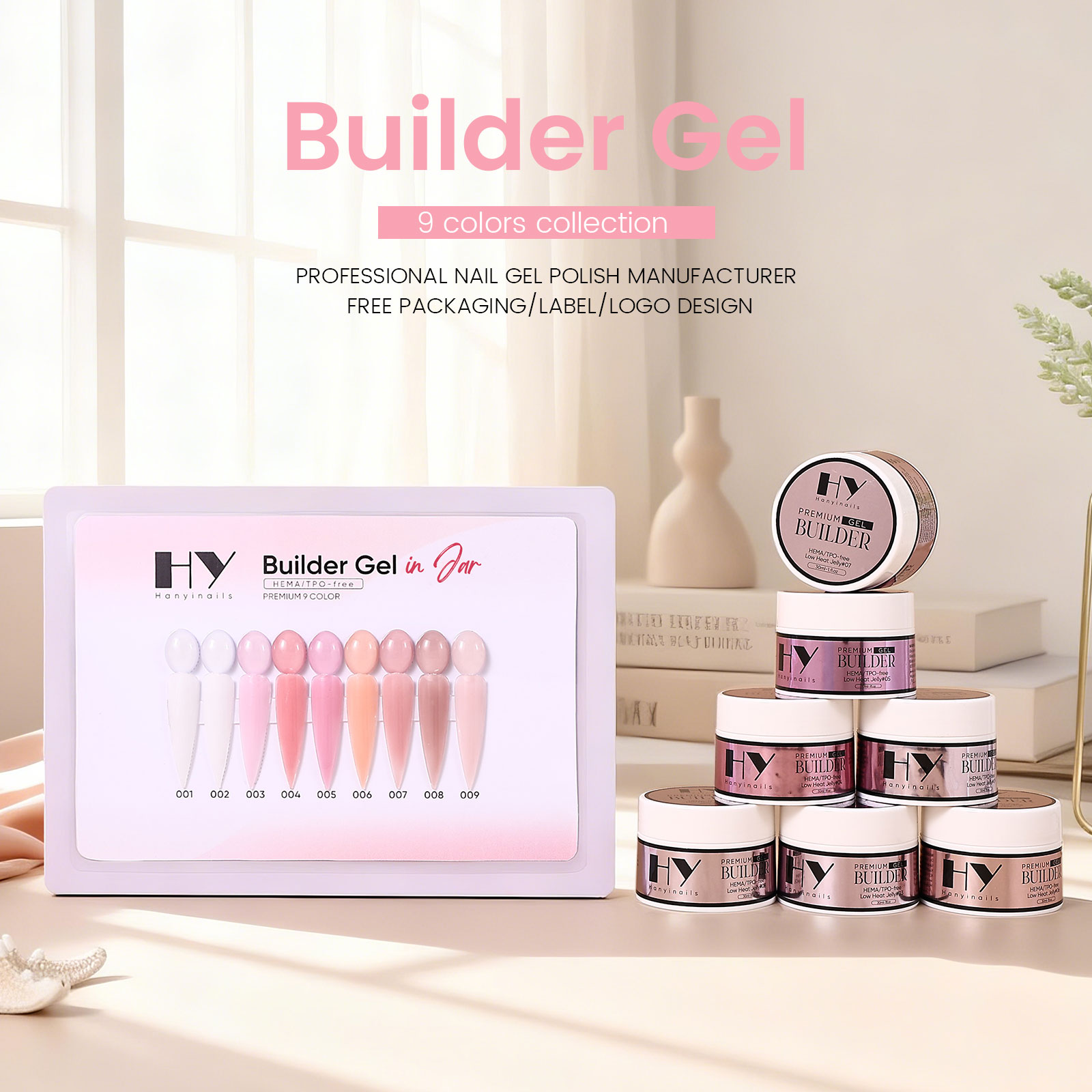
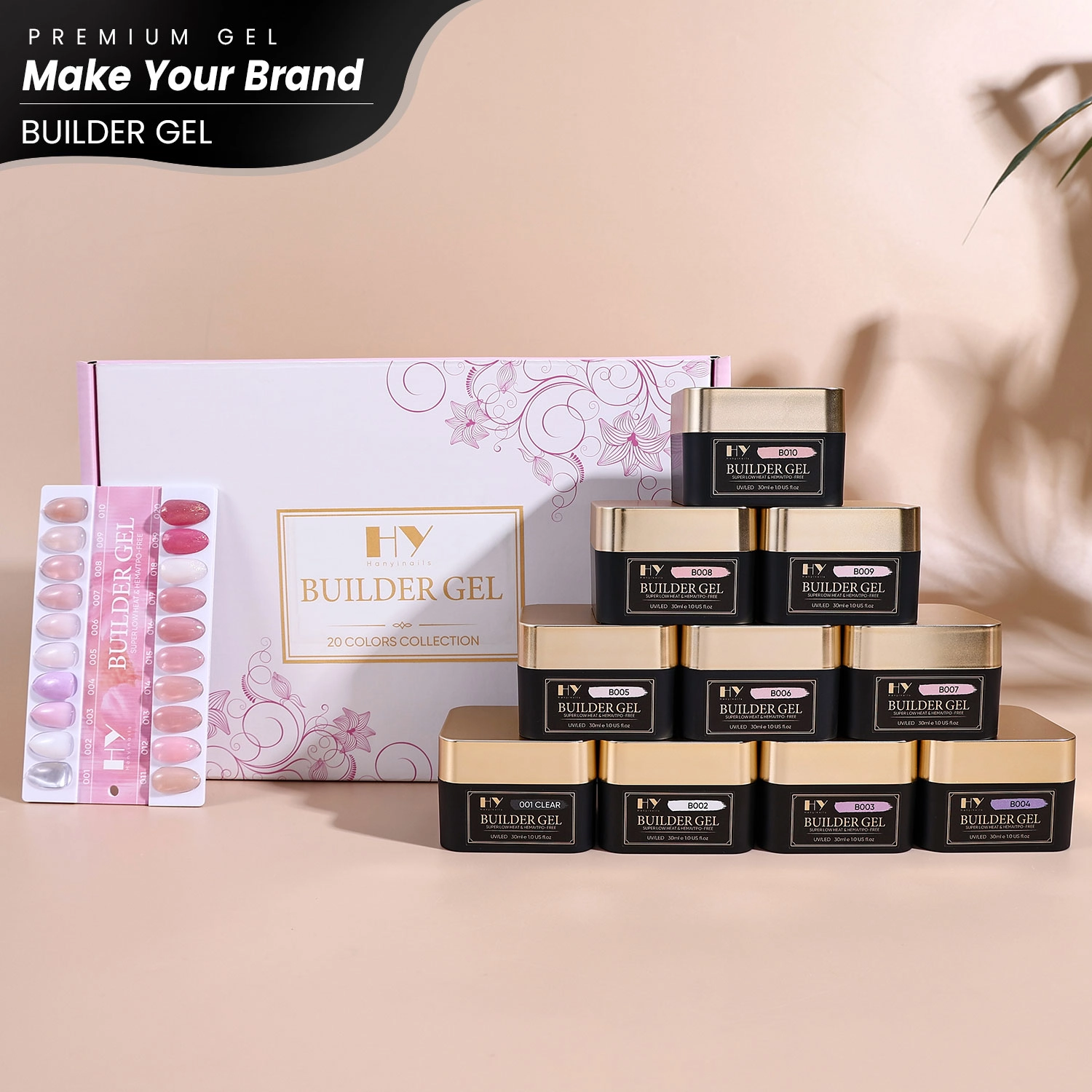
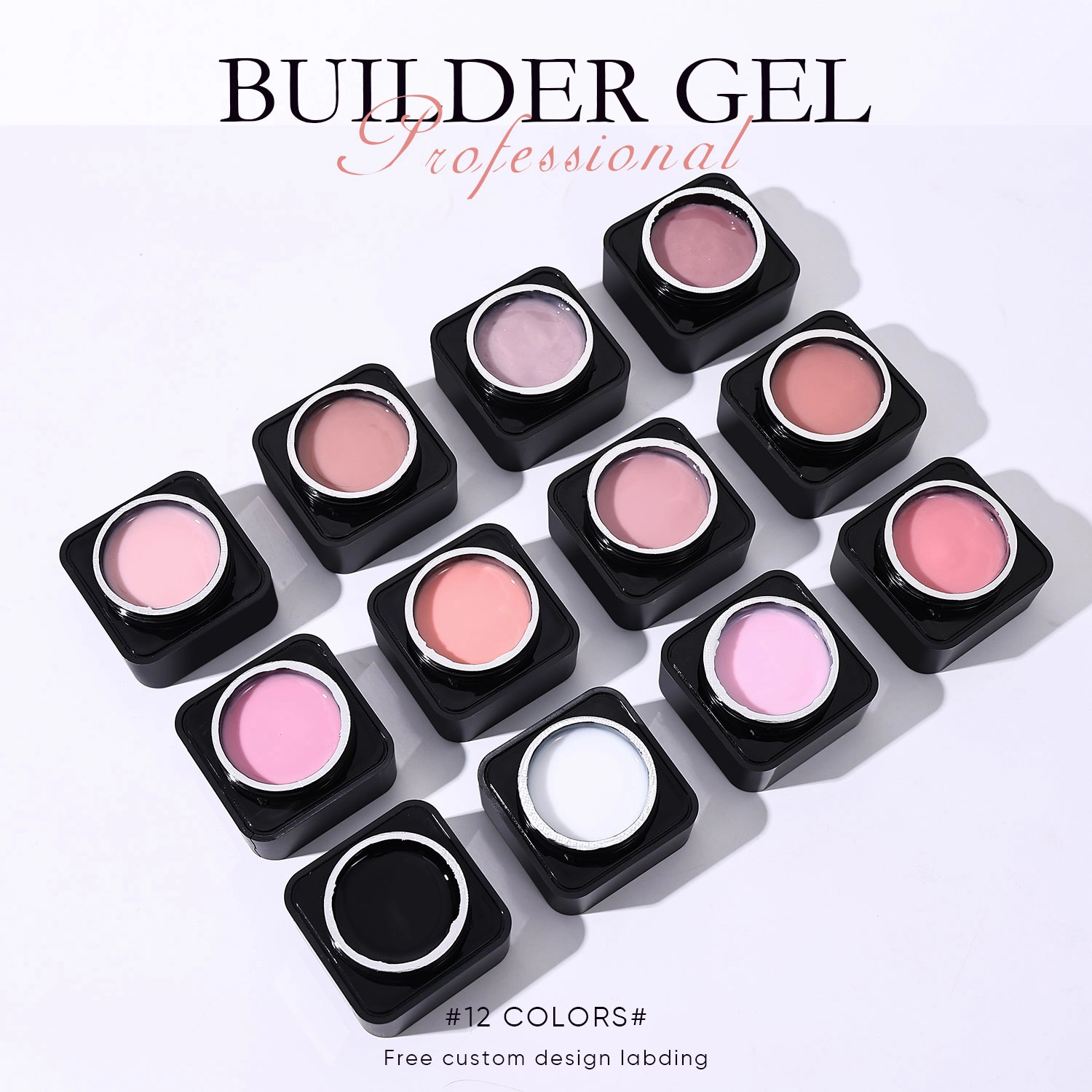
Hanyinails displays bottle-style builder gel, pot-style builder gel, and related base products within its professional nail gel range.
These options support different product-development and service-planning directions.
| Hanyinails Product Direction | Relevant Application or Buying Need | What Must Be Verified |
|---|---|---|
| Builder Gel in a Bottle | Natural nail overlays and structured manicures where the formula supports them | Self-leveling behavior, bonding system, curing, removal |
| Pot-Style Builder Gel | Techniques requiring a separate application brush or particular shaping behavior | Viscosity, approved structural applications, curing |
| Base / Bonding Gel | Supporting adhesion within a compatible enhancement system | Formula compatibility and required application sequence |
| Customized Builder Gel Collection | Brand-specific shades, packaging, product positioning | Technical specifications, labeling, target-market requirements |
These are product categories and evaluation considerations, not assertions that every Hanyinails formula has the same mechanical properties or intended uses.
Buyers can review the Hanyinails BIAB, Rubber Base & Builder Base Collection and Hanyinails Builder Gel – Professional Nail Extension Solution to explore available product directions.
For individual products, the actual formulation, base-coat requirements, curing instructions, and removal classification should be confirmed before specifying their use.
What Product Documentation Should Buyers Request?
Depending on the destination market and intended use, relevant information may include:
- Product specifications and instructions
- Ingredient information and required labeling
- Suitable curing and removal guidance
- Available safety documentation
- Formula and batch identification
- Packaging specifications
- Applicable regulatory compliance records
An SDS, general company certification, or promotional claim does not automatically establish that every finished product meets the requirements of a particular destination market.
Buyers should verify the scope and relevance of documentation for the exact formulation being purchased.
Private Label Builder Gel: What Can Be Customized?
Builder gel product development may involve formula characteristics, color presentation, bottle or jar formats, applicator design, labeling, and branded packaging.
The product architecture should be established before packaging artwork is finalized.
For example, a professional collection may differentiate between overlay-focused products, formulas intended for specified extension techniques, and systems with different removal methods.
Each product should have a clear intended role and suitable application guidance.
Hanyinails Builder Gel and OEM/ODM Manufacturing
Hanyinails supplies professional nail gel products and OEM/ODM customization services for nail brands, salons, distributors, and beauty businesses.
Companies developing a builder gel collection can discuss product positioning, color options, packaging, applicator selection, and manufacturing requirements according to their intended applications and markets.
The appropriate formula and supporting documentation should be confirmed for each project.
Learn more about Hanyinails, review its available company certifications, or explore Create Your Brand.
Manufacturer's perspective: A useful private label builder gel collection should distinguish products through verified functions, compatible application systems, and clear technical information—not packaging terminology alone.

11. Frequently Asked Questions About BIAB vs Builder Gel
Is BIAB the same as builder gel?
BIAB™ is a branded Builder In A Bottle™ system within the broader builder gel category. Other manufacturers also offer bottle-style builder gels, but their formulas, applications, and removal requirements may differ. Not every builder gel is BIAB™.
What is the main difference between BIAB and traditional builder gel?
The visible difference is often packaging and application method. Technical differences depend on the specific formulas, including viscosity, flexibility, structural use, base-coat requirements, curing, and removal. Bottle and pot formats do not determine performance by themselves.
Is BIAB always a soak-off gel?
No. Some BIAB™ formulations are soak-off, while specified Clear, White, and Milky formulations are identified as file-off in the manufacturer's published guidance. Always check the latest instructions for the exact product.
Does BIAB need a base coat?
It depends on the formulation. Some products include integrated base functionality, while others require a separate compatible base or bonding product. Follow the current manufacturer's instructions rather than assuming all bottle-style gels can be applied directly to natural nails.
Can BIAB be used for nail extensions?
Some BIAB™ and other bottle-style builder gels support specified extensions. Suitability depends on the product's intended applications, length limitations, and structural requirements. An overlay-only formula should not automatically be used for demanding extensions.
Is BIAB more flexible than builder gel?
Not necessarily. BIAB is itself a builder gel system, and cured flexibility varies between individual products. Both bottle-style and pot-style formulas may have different mechanical properties.
Does BIAB make natural nails healthier?
BIAB does not directly accelerate natural nail growth or treat nail damage. A suitable enhancement may help protect nails from some mechanical wear while they grow, but outcomes depend on the nail condition, application, maintenance, and removal.
How long does BIAB or builder gel last?
There is no universal guaranteed wear period. Performance depends on the formula, preparation, curing, structure, nail growth, and daily use. Maintenance should follow the product's recommendations and the condition of the enhancement.
Can BIAB and builder gel be infilled?
Many builder gel systems support infills. Before maintenance, a technician should assess nail growth, structural balance, lifting, cracks, and the condition of the existing enhancement. Damaged or unsuitable material should not simply be covered with fresh gel.
What should private label buyers look for in builder gel?
Buyers should evaluate intended applications, working consistency, cured properties, curing compatibility, removal methods, product documentation, and manufacturing consistency. Packaging and customization should support the selected formula rather than determine the technical requirements.
Conclusion: Choosing BIAB or Builder Gel by Product Function
BIAB and builder gel are not opposing nail enhancement categories.
BIAB™ is associated with a branded system within the broader builder gel family, while other bottle-style and pot-style builder gels may support similar applications through different formulations.
For nail technicians, selection should be based on the desired service, natural nail condition, structural requirements, curing compatibility, and maintenance procedures.
For nail brands and distributors, the same principles support clearer product differentiation and more informed sourcing.
The best choice is the formulation whose documented properties match the intended professional application.
Develop Your Own Builder Gel Collection with Hanyinails
Hanyinails supports OEM/ODM nail gel projects for professional brands, salon suppliers, distributors, and wholesalers.
Whether your collection focuses on bottle-style builder gels, pot builder gels, natural nail overlay systems, or complementary base products, the starting point is defining the intended applications and technical requirements.
Explore Hanyinails OEM/ODM Services or contact the Hanyinails team to discuss product options, custom colors, packaging, documentation, and manufacturing cooperation.

Hanyinails
Hanyinails
Hanyinails
Hanyinails