

Private Label vs. White Label vs. OEM
Private label commonly starts with an established manufacturer formula and allows selected customization of color, packaging, and branding. White label usually uses an existing product with fewer changes for a faster route to market. OEM may involve manufacturing to a more detailed buyer specification, including selected product or formula adjustments.
These terms are not used consistently across suppliers. Define in writing what may be changed, who owns the formula and artwork, whether exclusivity applies, what testing or validation is included, and whether the same base formula may be supplied to other brands.
For a more complete comparison of these models, see the guide to starting your own gel polish brand.
Define Your Project Before Comparing Manufacturers
The right manufacturer depends on the product, market, channel, and commercial plan. Prepare a clear brief before requesting quotations.
- Target market and sales channel
- Product category and estimated SKU count
- Estimated quantity per SKU
- Formula, finish, viscosity, removal, or ingredient-positioning requirements
- Intended base coat, top coat, lamp, and curing protocol
- Stock or custom packaging preferences
- Required product and market-entry documentation
- Target launch date and delivery country
- Budget or target price range
A detailed brief allows suppliers to quote against the same requirements and makes comparisons more meaningful.
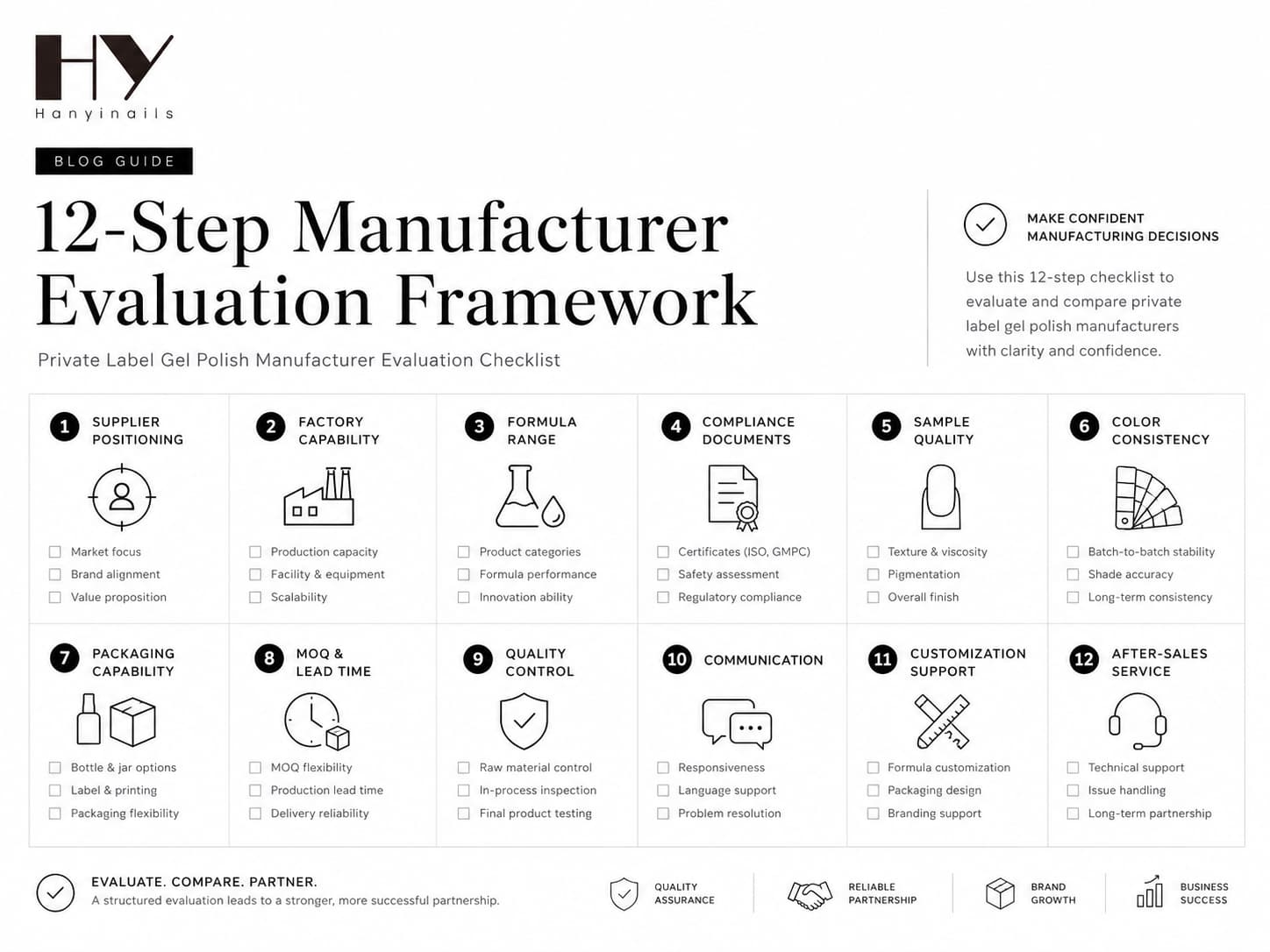
12-Point Manufacturer Evaluation Framework
Mandatory Pass-or-Fail Checks
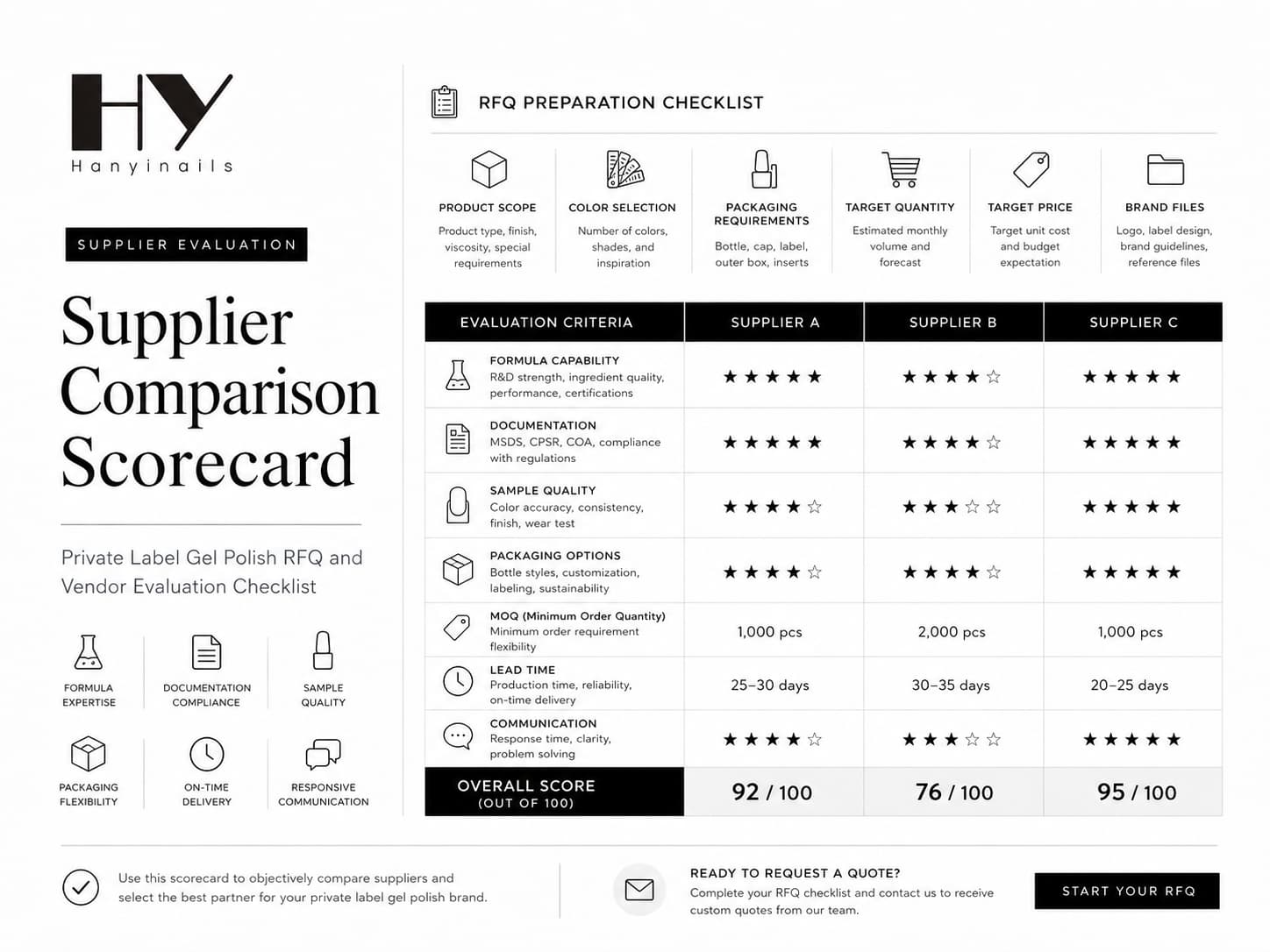
Manufacturer Scorecard
After completing the mandatory checks, rate each supplier on the remaining commercial and operational factors. A score from 1 to 5 can be used for each category, with the final score adjusted by the assigned weight.
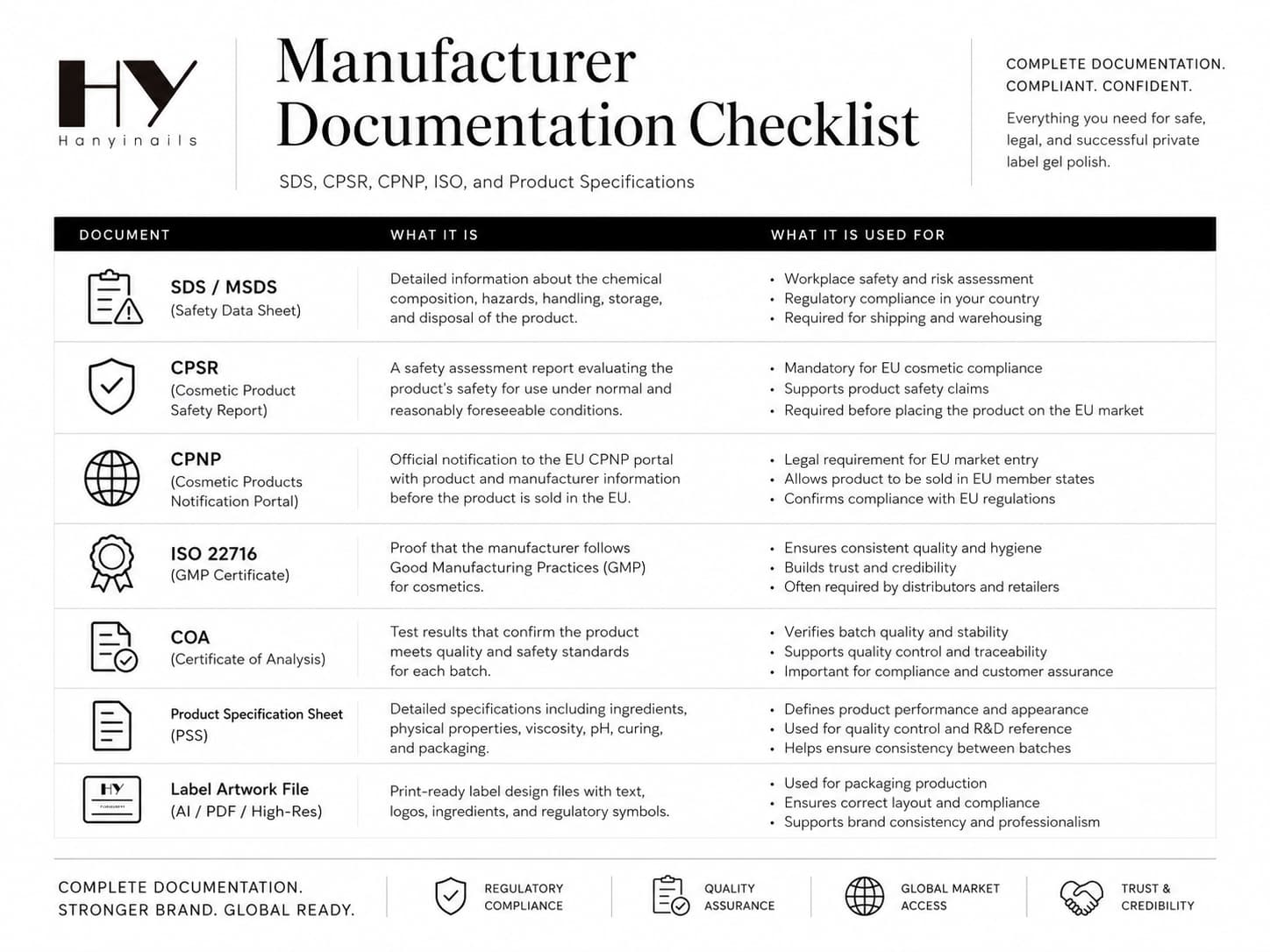
What Documents Should You Request?
Document requirements depend on the product, legal role, target country, and sales channel. Ask what each document covers, which product and manufacturing site it relates to, and whether it remains current.
SDS or MSDS
A Safety Data Sheet provides hazard, handling, storage, transport, exposure-control, and emergency information for the supplied product. It should not be treated as a complete ingredient disclosure or proof that a product is authorized for sale in a market.
Ingredient or INCI Information
This identifies ingredients using the naming format required for cosmetic ingredient communication. Confirm that the information applies to the exact finished formula being purchased.
Product Specification
A useful product specification may define shade, appearance, viscosity, cure protocol, fill quantity, packaging, and other agreed product characteristics. It should be connected to the approved reference sample and bulk-production requirements.
Test Reports
Test reports should identify the exact product tested, method, laboratory or responsible party, test date, and result. A report for one formula, shade, packaging system, or market should not automatically be assumed to cover every other product.
CPSR
A Cosmetic Product Safety Report relates to the exact finished cosmetic product placed on the EU market. The manufacturer may provide formula, raw-material, test, manufacturing, and packaging information needed to support the assessment, but a generic factory document does not replace a product-specific CPSR.
PIF
The Product Information File is maintained for the specific finished cosmetic product by or on behalf of the EU Responsible Person. The manufacturer may supply supporting formula, manufacturing, testing, batch, and packaging information for inclusion in that file.
CPNP
The Cosmetic Product Notification Portal is the EU online notification system used before a cosmetic product is placed on the EU market. It is not a certification, and notification is completed within the Responsible Person framework.
US Facility Registration and Product Listing
Cosmetic facility registration and product listing are regulatory submissions, not FDA product approval. They should not be described as FDA certification, endorsement, or proof that every product claim is compliant.
ISO 22716
ISO 22716 provides Good Manufacturing Practice guidance for cosmetics production, control, storage, and shipment. When reviewing an ISO 22716 certificate, check the legal entity, manufacturing address, certification scope, issuing body, validity period, and whether it covers the actual site producing the gel polish.
Hanyinails provides available product and manufacturing information according to the selected project. Buyers can review the site's gel polish certifications and documentation before requesting product-specific files.
How to Test Gel Polish Samples
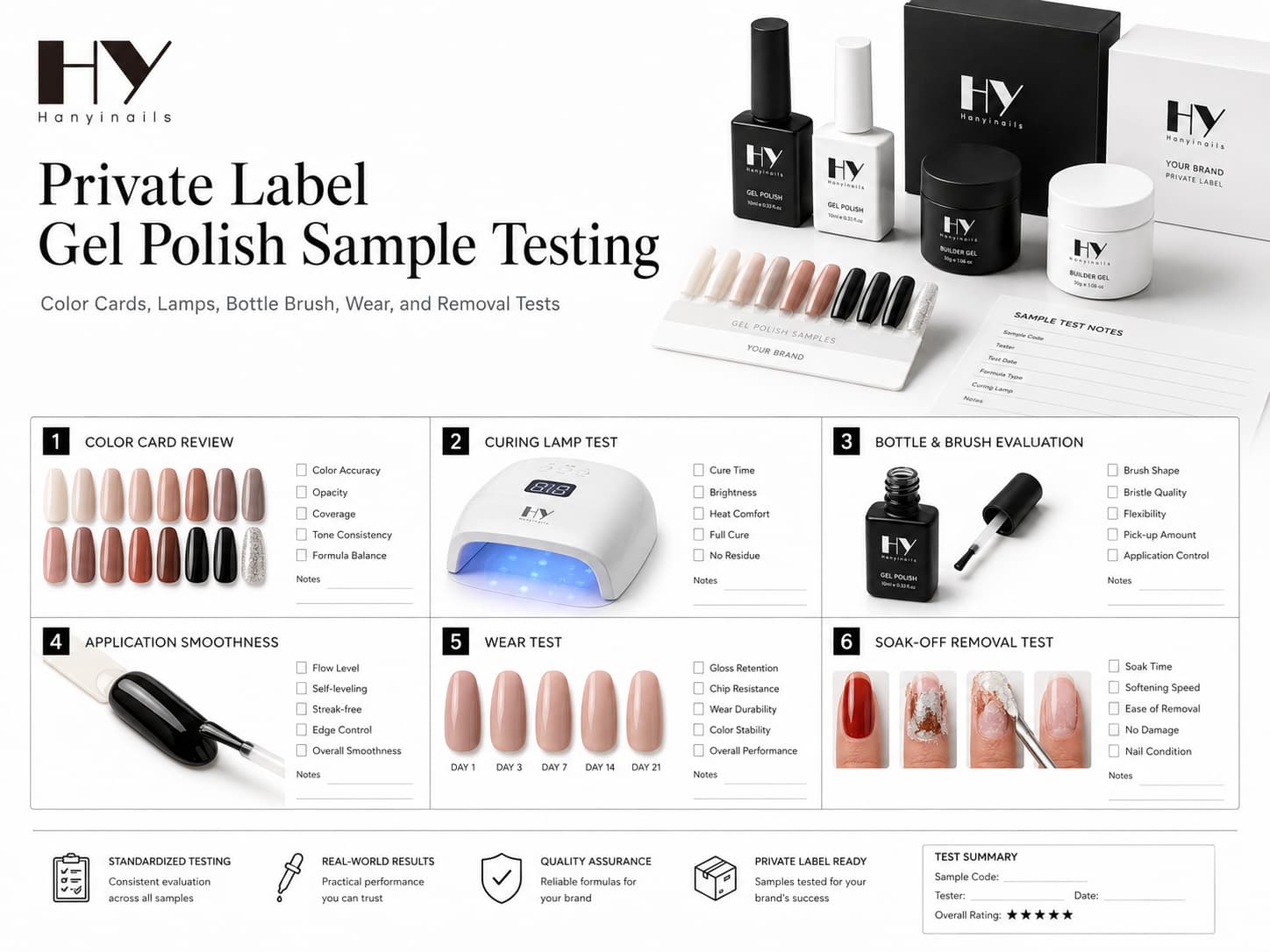
Sample approval should cover the complete intended product system, not only the color in the bottle. Test the formula with the planned base coat, top coat, lamp model, cure time, application thickness, bottle, brush, and removal method.
- Shade accuracy, opacity, and coverage
- Viscosity and self-leveling
- Brush loading, application control, and bottle-neck wiping
- Curing under the intended lamp model and wavelength range
- Curing at the intended layer thickness
- Center and edge curing, especially for dark or highly pigmented shades
- Shrinkage, wrinkling, pooling, surface softness, or incomplete internal curing
- Compatibility with the intended base and top system
- Gloss, color stability, adhesion, and wear
- Specified soak-off or file-off removal behavior
- Fill weight and bottle assembly
- Label resistance to handling, cleanser, and normal product contact
Use an Approved Reference or Golden Sample
The final approved sample should become the physical reference for bulk production, but it does not prove future batch consistency by itself. Support it with a written specification, agreed tolerances, pre-production or bulk samples, coded batch records, retention samples, and documented inspection results.
The approved reference and written specification should cover relevant characteristics such as shade, opacity, viscosity, self-leveling, cure protocol, gloss, adhesion, removal, fill weight, bottle and brush assembly, and packaging artwork.
How to Check Packaging Compatibility
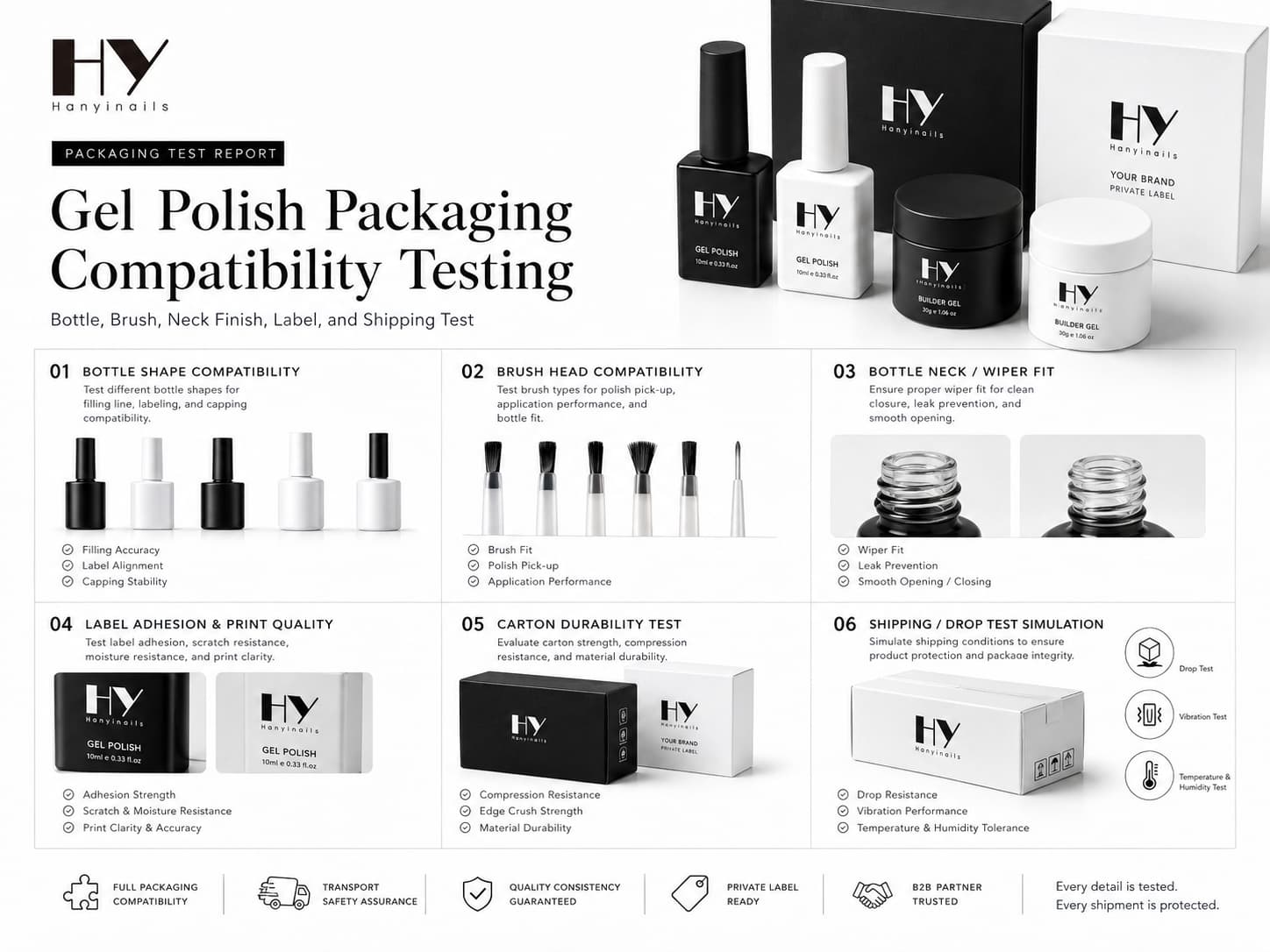
Packaging appearance alone is not enough. The formula and every product-contact component should be checked together before bulk production.
- Bottle material and any internal coating
- Bottle opacity and protection from unintended light exposure
- Bottle neck and wiper fit
- Brush stem length, flexibility, spread, and loading
- Cap thread, seal, and closing torque
- Formula leakage during storage and transport
- Long-term contact between the formula and packaging materials
- Label, printing, foil, and coating durability
- Box, insert, kit, and carton protection
- Simulated or actual transport performance
A supplier's ability to provide both product and packaging does not automatically prove compatibility. Approve the combined filled package under the intended storage, handling, and shipping conditions.
MOQ and Total Landed Cost
MOQ may involve several separate minimums, including formula, color, bottle, cap finish, printing method, label, box, insert, or kit components. Request an itemized breakdown rather than relying on one headline quantity.
Compare the full commercial cost:
- Product cost by formula and SKU
- Sample, development, and tooling fees
- Bottle, cap, printing, label, box, and kit costs
- Inspection and product-supporting documentation costs
- Shipping, duties, taxes, and customs-related costs
- Deposit percentage and balance-payment timing
- Storage, inventory carrying, and reorder deposits
- Expected defect, replacement, delay, and rework risk
- Currency movement and payment-processing costs
A higher bottle price may produce a lower total commercial cost when defect rates, replacement orders, rework, delays, and inventory risk are considered. Price should therefore be compared together with verified performance and quality controls.
Red Flags to Watch For
- Reluctance to provide samples or a written product specification
- Using the same generic certificate language for every product and market
- Presenting FDA registration, CPNP notification, or an SDS as product approval
- Verbal promises without written specifications or approval records
- No batch code, traceability, or retention-sample process
- No testing of the formula with the selected bottle, brush, cap, and label
- MOQ explanations that change during quotation or production
- Pricing significantly below comparable quotations without a clear reason
- No written procedure for shortages, defects, or quality claims
How Hanyinails Supports Manufacturer Evaluation
Hanyinails supports private label and OEM/ODM projects through a structured development and production process. The available steps depend on the product and customization program, but may include:
- Reviewing the buyer's target market, product, quantity, and packaging brief
- Recommending an existing formula, private label route, or development path
- Preparing formula, color, bottle, brush, label, and packaging samples
- Confirming the intended lamp, gel system, and sample-testing conditions
- Recording sample feedback and revisions
- Confirming approved product and packaging references
- Providing available product and manufacturing documentation
- Preparing bulk production, inspection, packing, and shipment information
- Supporting reorder and product-line planning
Learn more about Hanyinails manufacturing, review its contract manufacturing service, or explore available gel polish formulas and colors.




Hanyinails
Hanyinails
Hanyinails
Hanyinails