This pre-production summary condenses a supplier-to-buyer evaluation workflow for iridescent, magnet-activated nail systems: a structured sample submission protocol, standardized laboratory and bench checks for optical interference pigments, magnetic particle responsiveness, rheological and cure performance, packaging interaction, and a decision matrix that reduces production risk for brand owners and distributors.
Pre-production acceptance checklist for iridescent magnetized nail coatings
Sample submission and labeling requirements
Buyers should require a complete sample pack that includes: a minimum of 30 ml of the candidate lacquer/gel, a detailed formula sheet with INCI names and pigment manufacturer data, batch code and shelf-life claim, recommended cure parameters (LED/UV time and lamp wattage), and finished-product color swatches on both natural and artificial nail substrates. Clear labeling prevents misinterpretation during cross-functional evaluation by R&D, QA, and marketing teams.
Visual effect verification and magnetic responsiveness
Laboratory and bench technicians must evaluate the optical interference performance under controlled lighting: directional shimmer, holographic spark, and chameleon shift across angulations. Magnetic responsiveness testing involves a standardized magnet (typically 3000–4000 gauss handheld magnet) swept at fixed distance and speed to confirm repeatable pattern formation, intensity of field-induced alignment of ferromagnetic flakes, and the latency to stable patterning.
Chemical safety and regulatory screening
Pre-production screening must include a review of hazardous substance lists, formaldehyde donors, and heavy metal content (lead, cadmium, chromium VI). Request supplier-provided certificates: MSDS/SDS, RoHS declarations where applicable, and microbiological test results for water-containing formulations. For regulatory context, refer to authoritative resources such as Nail polish (Wikipedia) for product classification, the U.S. FDA Cosmetics guidance for labeling and claims, and ISO 22716 Good Manufacturing Practices for cosmetic production controls.
Technical validation protocols for batch release
Rheology, viscosity, and flow bead testing
Consistency across lots prevents application variability. Perform Brookfield viscosity measurements at specified rpm and temperature, and a flow bead test on an incline to evaluate self-leveling. Target acceptance windows should be set in the supplier contract; if the candidate formulation exhibits off-target thixotropy or sedimentation, request corrective measures such as anti-settling agents or optimized pigment milling.
Photocuring performance and lamp compatibility
Cure testing has both functional and safety implications. Validate cure under typical salon LED/UV lamps (e.g., 36W LED, 48W LED, 36W UV) with recommended times. Measure tack-free time, crosslink density proxies (e.g., solvent rub tests with isopropyl alcohol), and adhesion to standard primers and builder gels. Document any extended cure requirements or incompatibilities with gel-extensions systems such as builder resins or tips.
Pigment dispersion, particle morphology, and magnetically active flake stability
Optical and magnetic effects depend on controlled flake size, coating, and distribution. Use optical microscopy and dispersion index metrics to verify consistent particle layering and absence of large agglomerates. Assess long-term stability with centrifuge and thermal cycling tests to predict shelf performance and to avoid clogging of bottle necks or brushing anomalies on the bench.
Procurement decision matrix and quality control acceptance criteria
Acceptance thresholds and go/no-go criteria
Construct a decision matrix that weighs: visual effect fidelity (marketing pass/fail), magnetic pattern repeatability (technical pass/fail), curing reliability (laboratory pass/fail), safety documentation (compliance pass/fail), and packaging compatibility. Assign weighted scores to each dimension to quantify supplier readiness for pilot production.
Packaging compatibility and fill-line verification
Sample testing must include interaction trials with the proposed bottle, cap, and brush or wand: seal integrity under accelerated aging, stopper compatibility with anti-settling chemistry, and headspace oxygen levels if relevant. For OEM projects, require pre-approved stock or customized containers and request torque and leak test certificates from the supplier.
Documentation, traceability, and audit readiness
Request full traceability of raw pigments and magnetic powders, supplier declarations for critical raw materials, COAs (Certificates of Analysis) for each lot, and evidence of periodic third-party testing. Audit-ready documentation accelerates regulatory clearances and reduces time-to-market risk for multi-country launches.
| Evaluation Area | Conventional QC | Pre-production Analytical Protocol |
| Sample submission | Basic bottle sample, visual swatch | 30 ml min, full formula, pigment vendor data, cure settings, batch code |
| Optical effect | Subjective visual check | Directional light study, angle-resolved photos, colorimetric ΔE comparisons |
| Magnetic response | Quick magnet pass | Standardized magnet gauss test, repeatability across 10+ strokes |
| Cure verification | Finger cure in salon lamp | Lab-measured tack-free time, solvent resistance, adhesion tests |
| Safety & compliance | SDS provided | MSDS, COA, heavy metal checks, microbiology if water-based |
| Packaging | Visual fit test | Leak/torque/aging tests; compatibility with dispenser system |
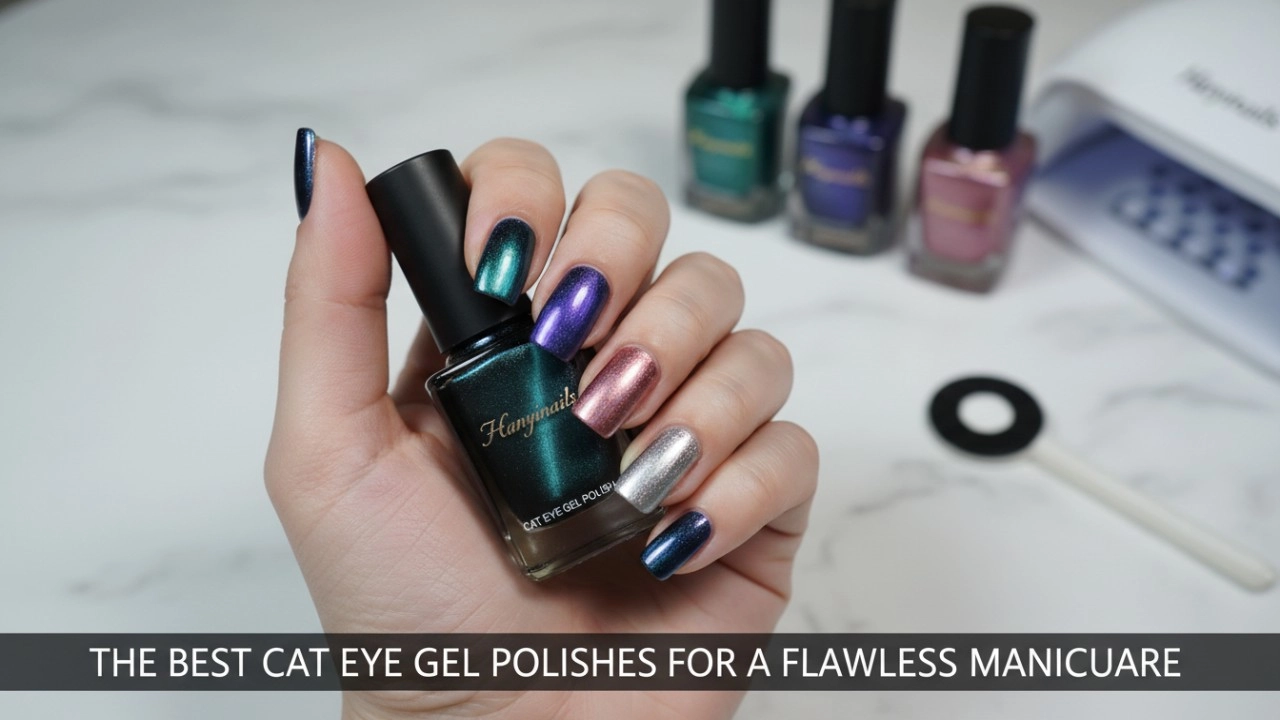
Why leading brands select Hanyinails for metallic-iridescent magnetic nail systems
Manufacturing scale and customization capabilities
Hanyinails operates 10 dedicated production lines and 60 production machines within an 8000㎡ workshop, enabling scalable pilot runs and fast transition to mass production. The company supports one-stop OEM customization across more than 50 stock bottle options and over 600 bespoke bottle and cap designs, which reduces time-to-shelf for private-label customers.
Quality assurance, R&D support, and compliance readiness
Our QA team comprises 8 dedicated QA/QC inspectors who enforce batch-level checks and maintain production records to meet buyer audit requirements. With 12 years of OEM delivery experience and participation in exhibitions across 10+ countries, Hanyinails invests in laboratory verification for curing profiles, pigment dispersion, and magnetically responsive flake stability to ensure consistent optical and functional performance.
Product portfolio that supports iridescent magnetic product families
We manufacture a broad range of professional salon-grade formulations that complement magneto-chrome systems, including 3D nail art gel, gel builder nail polish, colored lacquers, nail care oils, Gel X nail glue, Gelly nail tips, and durable nail hard gels. For hybrid systems, our Poly Acrygel and line gel nail art products are formulated for adhesion compatibility and are validated against common salon curing equipment.
Supply chain reliability and OEM advantages
Hanyinails releases approximately 2000 new color developments per year and offers over 100 kit box styles and 200+ color chart designs, enabling brand owners to differentiate with seasonal collections and limited editions. Our production capacity and engineering expertise reduce lead-time variability for large-volume orders, while our customization tooling options support unique bottle-and-cap assemblies for High Quality positioning.
For technical inquiries, bulk sourcing, or to request a customized pre-production evaluation template aligned to specific marketing effect goals, contact Hanyinails at sales@hanyinails.com or visit our website at Hanyinails.









Hanyinails
Hanyinails
Hanyinails
Hanyinails