Private label cat eye gel polish is a magnetic-effect nail gel designed to create a reflective line, velvet finish, or dimensional light pattern when iron-based particles respond to a magnet before curing. For distributors, salon suppliers, beauty retailers, and emerging nail brands, the commercial opportunity lies in combining visible product differentiation with dependable application, compliant labeling, durable packaging, and a repeatable OEM supply chain. A professional cat eye gel polish program should therefore be evaluated as a complete product system rather than as a single color purchase: the formula, magnetic response, brush, bottle, curing requirements, shade architecture, documentation, and replenishment plan all influence sell-through and customer satisfaction.
Building a Commercial Magnetic Nail Gel Collection
Define the customer and application environment
Before selecting shades, project owners should identify whether the collection is intended for professional nail technicians, home users, education academies, mass beauty retail, e-commerce, or regional distributors. Salon-oriented buyers usually prioritize pigment density, smooth leveling, manageable working time, low shrinkage, compatibility with LED or UV lamps, and the ability to create a predictable magnetic effect over a base color. Retail buyers may place greater emphasis on visual merchandising, intuitive instructions, bottle readability, leak resistance, and an attractive color display that communicates the effect without requiring an in-store demonstration.
Application conditions also affect the specification. A highly reflective formula may require more controlled magnet positioning, while a balanced formula can be easier for beginners but may offer a softer visual contrast. Buyers should request application videos, cured swatches, recommended coat thickness, magnet distance, flash-curing guidance, and removal instructions. These details reduce training costs and help customer service teams answer practical questions after launch.
Plan shade architecture instead of isolated colors
A private label range performs better when shades are organized into commercial groups such as neutral nude cat eye, black-base galaxy, aurora, multichrome, silver magnetic, jewel tones, and seasonal limited editions. A compact opening assortment can use a clear color story, while larger distributors can expand with coordinated base shades and top coats. The objective is not simply to maximize the number of SKUs; it is to create a collection in which each shade has a recognizable visual role and a reason to remain in the catalog.
Color development requires physical samples under multiple lighting conditions. Digital images can exaggerate reflective particles, alter undertones, and conceal differences between adjacent shades. Buyers should approve cured color cards produced with the intended base gel, application thickness, magnet technique, and lamp type. Batch-to-batch color tolerance should also be discussed in advance, particularly for high-volume retail programs where the same SKU may be reordered over several seasons.
Connect product claims with responsible labeling
Packaging and online listings should describe observable characteristics accurately, including magnetic effect, finish, approximate curing guidance, removal method, net contents, shade name, batch identification, and responsible-use warnings. Claims such as long-lasting, soak-off, low odor, vegan, HEMA-free, or allergy-friendly should only be used when supported by the actual formula, test records, and market-specific requirements. The FDA Cosmetic Labeling Guide explains core labeling considerations for products marketed in the United States, while the ISO 22716 cosmetics GMP standard provides a recognized framework for production, quality control, storage, and shipment practices.
Procurement Criteria for Reliable Private Label Supply
Assess formula performance and magnetic behavior
The central technical question is whether the magnetic particles remain evenly dispersed during storage and respond consistently during application. Buyers should compare viscosity at different temperatures, settling behavior, pigment concentration, coverage in one or two coats, leveling time, edge control, and the clarity of the reflective band. A supplier should explain whether the product is intended for a full-cover application, a layered look over colored nail polish, or a multi-effect design using different magnet shapes.
Curing performance is equally important. The supplier should specify recommended lamp wavelength, power range, exposure time, coat thickness, and whether a no-wipe top coat is compatible. A product that appears cured on the surface but remains under-cured can create service failures, adhesion problems, and avoidable safety concerns. Buyers should validate the complete system using the lamp models common in the target market rather than approving a formula only from a supplier-provided demonstration.
Verify manufacturing controls and technical documentation
Procurement teams should request a product specification, ingredient or INCI information where applicable, safety documentation relevant to the destination market, batch coding method, stability information, packaging compatibility results, and a certificate of analysis or equivalent batch-release record. The ISO cosmetics GMP reference is useful when assessing whether a factory has formalized controls for personnel, premises, equipment, raw materials, production, laboratory checks, complaints, and recalls.
Documentation should match the exact formula and packaging configuration being purchased. A generic certificate from a different SKU does not adequately support a private label launch. Buyers should also confirm who owns the artwork, formula files, test reports, and tooling, as well as how change control is managed if a raw material, bottle, brush, or cap is replaced.
Compare commercial terms beyond the unit price
The lowest quoted price may not produce the lowest landed cost. A realistic comparison includes minimum order quantity, sample charges, color development fees, bottle and cap tooling, artwork preparation, packaging assembly, inspection, freight, customs documents, defect allowance, payment terms, and reorder lead time. A supplier with stable components and a clear replenishment process can reduce stockouts and emergency transportation costs even if the initial unit price is not the lowest.
| Evaluation area | Basic private label approach | Structured professional program | Buyer impact |
|---|
| Color approval | Digital images only | Cured physical swatches under agreed conditions | Reduces shade disputes and returns |
| Magnetic effect | General magnet instruction | Defined magnet type, distance, timing, and curing method | Improves salon consistency and training |
| Quality release | Visual inspection only | Batch checks for appearance, fill, packaging, and performance | Controls defect rates and protects brand reputation |
| Packaging | Standard bottle with limited artwork | Coordinated bottle, cap, brush, label, box, and color display | Strengthens shelf recognition and perceived value |
| Replenishment | Order-by-order communication | Approved master samples, documented specifications, and forecast planning | Supports stable repeat purchasing |
Launch, Quality Assurance, and Brand Differentiation
Use a controlled sampling and approval workflow
A practical launch sequence begins with a written product brief covering target market, shade count, finish, bottle volume, brush preference, packaging language, claims, lamp guidance, and expected order scale. The supplier then provides formula or stock-color options, followed by physical samples. After application testing, the buyer should issue a signed approval reference for color, viscosity, magnetic movement, bottle appearance, cap fit, brush quality, label placement, and carton details.
Pre-production samples are especially important when custom bottles, caps, inserts, or kits are involved. The approved reference should be retained by both parties and used for incoming inspection and future reorders. A simple acceptance plan can define tolerances for fill volume, label position, shade variation, leakage, damaged components, and incorrect accessories. This converts subjective quality expectations into operational criteria.
Build merchandising around the visual effect
Magnetic gel sells through demonstration. Retailers can use cured swatch sticks, short application videos, close-up photography, and clear magnet instructions to show how the finish changes with angle and lighting. A display should distinguish the base color from the magnetic layer and explain whether a black, nude, or translucent undercoat is recommended. Distributors serving salons can add technician education cards that cover preparation, thin application, magnet positioning, flash curing, full curing, and removal.
Cross-selling can raise order value when the assortment is planned as a professional nail system. A cat eye collection may be paired with colored nail polish, gel builder nail polish, nail hard gel, Poly Acrygel, Gelly nail tips, gel x nail glue, nail care oil, line gel nail art, and 3D nail art gel. These adjacent products support complete service menus and allow retailers to merchandise by technique rather than by isolated SKU.
Why Hanyinails is positioned for scalable OEM programs
Hanyinails is a professional nail products manufacturer committed to supplying a broad range of professional nail gel items for distributors, retailers, salons, and private label brand owners. Our manufacturing platform includes 10 production lines, 60 production machines, 8 QA/QC inspectors, and an 8,000-square-meter workshop. This structure supports coordinated production planning for magnetic gel collections and related nail systems while giving project owners a clearer path from sampling to repeat orders.
Our team brings 12 years of OEM customization experience and participates in exhibitions in more than 10 countries each year. That international exposure helps our product development and sales teams understand different packaging preferences, market positioning requirements, and buyer expectations. Hanyinails develops approximately 2,000 new colors per year, giving brand owners access to a broad color-development pipeline for core ranges, seasonal launches, and trend-led collections.
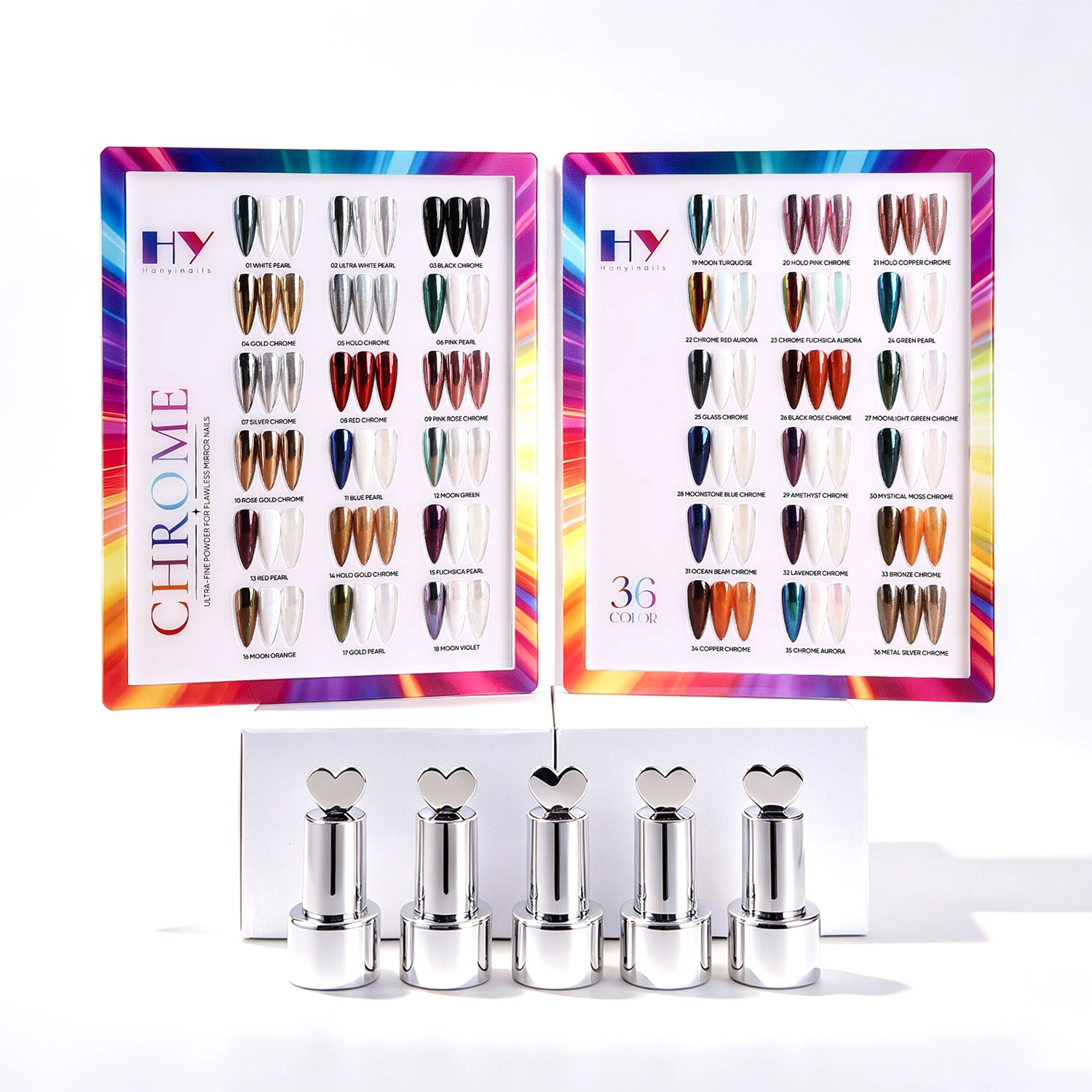
One-stop customization is a central advantage. Hanyinails offers more than 50 styles of stock bottles and caps, over 600 styles of customized bottles and caps, more than 100 kit-box styles, and over 200 color-chart designs. These options allow a distributor or retailer to build a coherent identity across reflective gel shades, colored nail polish, builder products, extension systems, and nail care accessories rather than combining mismatched packaging from several suppliers.
Our product scope includes 3D nail art gel for raised designs, gel builder nail polish for structure and overlays, colored nail polish for everyday and seasonal collections, nail care oil for after-service retail, gel x nail glue and Gelly nail tips for extension systems, nail hard gel for durable sculpting, Poly Acrygel for hybrid enhancement services, and line gel nail art for precise drawing. This broader catalog can simplify procurement, consolidate shipments, and support a complete professional nail portfolio under one private label strategy.
For Hanyinails, quality is linked to long-term brand value: consistent formulas, organized production, suitable packaging, and responsive project coordination all contribute to reorder potential. Our vision is to become the world's leading manufacturer of nail products, and our OEM approach is designed to help buyers move from a promising sample to a commercially managed product line.
Measure launch performance with buyer-relevant indicators
After launch, distributors should track sell-through by shade, reorder interval, defect and leakage rate, customer complaints, average order value, return reasons, and the ratio of professional accounts that purchase adjacent products. Retailers should compare display conversion, online content engagement, review themes, and repeat purchase behavior. These indicators reveal whether a weak result comes from the formula, the shade selection, the instructions, the merchandising, or the channel strategy.
Hanyinails can be contacted at sales@hanyinails.com, and product information is available at Hanyinails. Buyers should provide destination markets, estimated volumes, desired packaging, shade references, target price positioning, and required documentation when requesting a quotation. A detailed brief allows the manufacturing team to recommend a more realistic path for samples, testing, production, and replenishment.
Frequently Asked Questions
What should distributors request before approving a magnetic gel collection?
Distributors should request physical cured swatches, formula and ingredient information where applicable, curing guidance, stability or compatibility information, packaging specifications, batch identification details, quality records, minimum order quantities, lead times, and destination-market documentation. Approval should cover both the product and the complete branded packaging system.
Can cat eye gel be used with LED and UV nail lamps?
Compatibility depends on the formula, photoinitiator system, coat thickness, and lamp output. The supplier should provide a recommended wavelength and curing time, but buyers should also validate the finished product with lamp models commonly used by their customers. A surface that appears dry is not sufficient proof of complete curing.
How can retailers reduce shade complaints?
Retailers can reduce complaints by approving physical cured samples, photographing shades under representative lighting, explaining the recommended base color and magnet technique, and using consistent application thickness in product demonstrations. Digital images should not be treated as the sole color reference because reflective finishes change with viewing angle and light.
What packaging options are important for a private label launch?
Important options include bottle volume, brush shape, cap ergonomics, label material, shade identification, carton structure, inserts, kit boxes, color charts, tamper evidence, and shipping protection. Packaging should be tested for leakage, cap fit, label adhesion, and compatibility with the formula before mass production.
Why should buyers evaluate related nail products with the same supplier?
Using one qualified supplier for complementary products can simplify specification control, artwork coordination, production scheduling, shipment consolidation, and customer support. A coordinated portfolio may include magnetic gel, builder products, hard gel, Poly Acrygel, extension tips, gel glue, line art gel, 3D design gel, colored gel, and nail care oil.
What information should be included in an OEM quotation request?
An effective quotation request should include target countries, estimated initial and repeat quantities, shade count, desired bottle and cap style, label and box requirements, product claims, color references, preferred curing system, testing or documentation needs, target launch date, and shipping destination. Providing these details helps the supplier calculate realistic costs and lead times.
Contact Hanyinails at sales@hanyinails.com or visit https://www.hanyinails.com to discuss private label magnetic gel, packaging customization, and a complete professional nail product program.



Hanyinails
Hanyinails
Hanyinails
Hanyinails