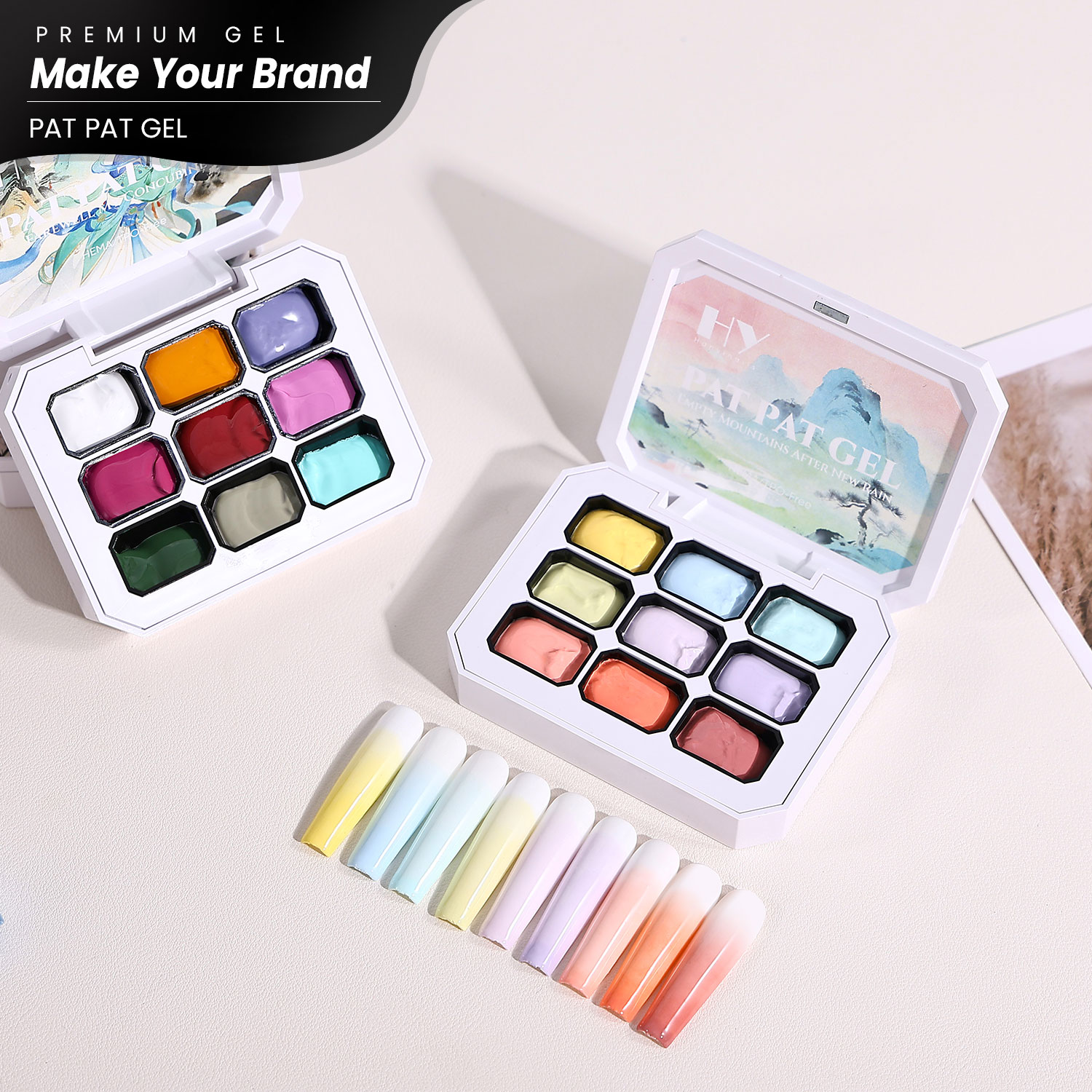
For nail professionals seeking a compact color range for dimensional gradients, semi-solid ombre gel Pat Pat Gel combines nine colors, high pigmentation, an air-cushion format, and a 3D ombre focus in one UV/LED-curable product. The listed HEMA- and TPO-free formulation may suit buyers evaluating ingredient preferences, but salons should verify the current ingredient list, safety documentation, lamp compatibility, and curing instructions with the supplier before use.
How Can a Cushion-Style Gradient Gel Improve Nail Art Workflows?
What makes the nine-color format useful for salon planning?
A nine-color collection gives nail artists a defined palette for coordinating gradient, dimensional, and accent designs without sourcing every shade separately. For salons, a set can simplify purchasing and color presentation, while distributors can assess a focused assortment before committing to a broader inventory. The product information identifies nine colors but does not specify shade names, so request a current color chart before planning client menus or wholesale listings.
How can semi-solid consistency support controlled application?
The semi-solid, air-cushion description positions this gel for controlled placement in detailed nail art, where artists need to manage pigment and create transitions rather than flood the nail with a runny layer. The consistency may help reduce uncontrolled movement during design work, but actual handling depends on temperature, brush choice, application amount, and technique. Test the material on a sample tip first to learn how it blends and layers.
Why does high pigmentation matter for ombre designs?
High pigment can help color remain visually strong in gradients and dimensional designs, which is valuable when a low-opacity product would require repeated passes. Fewer unnecessary layers can make a service easier to control, but opacity and blendability are not the same thing: a strongly pigmented gel may need careful placement to avoid a harsh edge. Build the effect gradually and follow the supplier’s application guidance rather than assuming one technique works for every shade.
What Should Buyers Verify Before Ordering HEMA- and TPO-Free Gel?
What does the HEMA- and TPO-free product description tell buyers?
The product is described as HEMA- and TPO-free, a formulation attribute that may be important to salons, distributors, and customers comparing ingredient profiles. Treat this as a purchasing specification to confirm against the current label, INCI list, and supplier documentation; do not interpret it as a claim that the gel is allergy-proof or risk-free. The U.S. FDA explains that nail products are cosmetics and provides useful context on nail care products and their use.
Which safety documents should a professional request?
Before placing a bulk order, request the product’s ingredient information, safety data sheet where applicable, labeling details, and written handling and curing instructions. These documents help purchasing teams review product identity, storage expectations, workplace procedures, and market-specific requirements. The FDA’s cosmetics safety guidance explains that cosmetic safety is a shared responsibility and that product claims should be assessed in context.
How should buyers assess regulatory and manufacturing information?
Requirements vary by sales region, so importers should check the rules that apply to their market and confirm that product labeling and documentation are suitable before distribution. In the European Union, the Cosmetics Regulation (EC) No 1223/2009 sets the framework for cosmetic products. Buyers can also ask about the manufacturer’s quality controls; ISO 22716 cosmetics good manufacturing practices describes guidance for cosmetic production, control, storage, and shipment, but a reference to the standard is not proof of certification.
How Do You Use UV/LED Ombre Gel Reliably?
How can salons reduce curing and compatibility problems?
The product is identified for UV/LED curing, but that label alone does not establish a universal lamp setting or cure time. Lamp output, wavelength, layer thickness, product formulation, and the manufacturer’s validated protocol all affect curing. Confirm the approved lamp type and exact instructions with Hanyinails, then follow them consistently; do not substitute a different lamp or extend a service based on guesswork. If the gel remains tacky or behaves unexpectedly, pause and seek supplier guidance.
What application steps help produce a cleaner 3D ombre result?
Prepare the nail using the system’s recommended base and surface preparation, then work with small amounts of gel and a clean tool suited to the design. Blend colors in controlled stages, checking the gradient before curing so you can correct uneven transitions while the product is workable. For raised or sculpted details, avoid adding more material than needed; thick applications can affect the appearance and may not cure as intended.
How should a salon test a new gel before a full launch?
Run a controlled trial on sample tips and, where appropriate, a small number of trained users before adding the gel to routine services. Record the shade, lamp model, application method, layer thickness, curing protocol, and observed finish so the team can reproduce successful results. Keep the product container closed and follow the supplier’s storage guidance. This process helps distinguish a product issue from a technique or equipment mismatch.









Hanyinails
Hanyinails
Hanyinails
Hanyinails