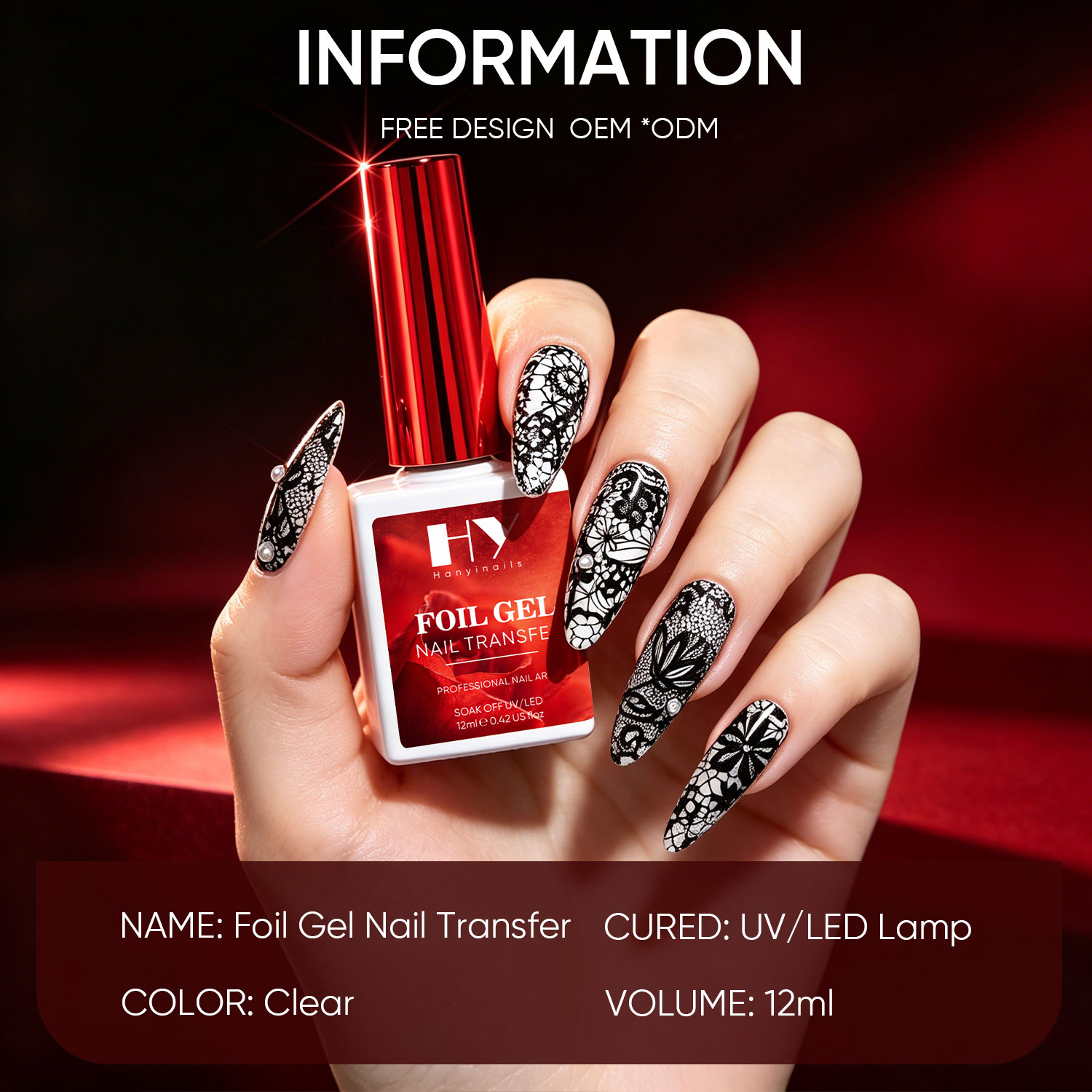
Foil transfer gel helps nail professionals create metallic, patterned, and detailed foil designs by providing a tacky layer for transfer foil to adhere to after curing. Hanyinails’ foil transfer gel is identified as a soak-off formula for UV/LED use, making it a relevant option for salons and product buyers seeking a dedicated foil application step. For consistent results, confirm lamp compatibility and curing directions on the product label, prepare the nail carefully, and test the foil and application method before offering a design to clients.
How Does a Foil Transfer Gel Support Detailed Nail Art?
What role does transfer gel play between polish and foil?
Foil designs can look uneven when transfer material is pressed onto a surface that is too slick, insufficiently cured, or not intended for foil. A dedicated transfer gel is designed to create the contact layer needed for foil to release onto the nail. This gives artists more control over where the pattern appears, whether they are making a full metallic finish, a partial accent, or fine decorative details.
Application still depends on the specific formula and the foil being used. A gel intended for transfer work should be applied as directed rather than treated like a standard color coat or top coat. Follow the manufacturer’s instructions for coverage, curing, and foil placement; changing those variables without testing can affect transfer quality. The product’s soak-off designation is also useful when planning removal, but removal should follow the label and salon protocol.
Why can a dedicated foil gel improve the salon workflow?
A separate transfer step lets technicians add foil to selected areas without relying on foil to adhere uniformly across every layer of a manicure. That can make it easier to produce varied designs from a small set of foils and base colors. For salons, the practical benefit is creative flexibility: one transfer product can support accents, line work, and broader patterns, provided the chosen foil is compatible.
Workflow efficiency depends on reliable handling, not simply on the product category. Before a client appointment, check that the bottle is closed and stored as directed, the brush distributes the gel evenly, and the curing lamp is appropriate for the product. Keep foil pieces, tools, and the work surface organized so the transfer layer does not sit exposed longer than the instructions allow. These steps help reduce avoidable rework and keep service timing predictable.
What Should Buyers Check Before Selecting UV/LED Foil Gel?
How can salons assess curing and removal compatibility?
“UV/LED” on a product description signals intended lamp use, but it does not replace checking the manufacturer’s curing directions. Lamps differ in design and output, and a product’s cure schedule should not be guessed from another brand’s instructions. Confirm the stated lamp type and curing guidance, then perform a controlled test with the lamp used in the salon. If the gel remains tacky in a way the instructions do not describe, pause use and review the process.
Removal is another buying consideration. A soak-off product may fit a salon’s existing removal workflow, but the phrase does not mean that every layer in a complete manicure can be removed in the same way. Check whether the base, color, transfer layer, and top coat have separate instructions. For broader context on professional cosmetic manufacturing practices, consult ISO 22716 guidance for cosmetics good manufacturing practices; do not interpret a general standard as proof that an individual product is certified.
Which details matter for wholesale and private-label purchasing?
Professional buyers should evaluate more than the product name. Request the current ingredient information, usage directions, storage guidance, packaging details, and documentation appropriate to the destination market. Confirm minimum order quantities, available formats, sample options, lead times, and whether private-label services are offered directly with the supplier. These questions help buyers compare suppliers on operational fit rather than on an isolated price per bottle.
Regulatory responsibilities vary by market and by the claims made for a product. In the United States, the FDA overview of nail care products explains how nail products fit within cosmetic oversight and highlights safety considerations. Buyers selling in the European Union should review the applicable requirements in the EU Cosmetics Regulation and obtain market-specific advice where needed. Ask suppliers for accurate product documentation; do not assume that one region’s requirements automatically satisfy another’s.
Packaging and storage also affect purchasing decisions. Ask how the product should be protected from light and heat, how the supplier identifies batches, and what shelf-life or use-period information appears on the packaging. These details matter for stock rotation and traceability, especially when a salon or distributor holds multiple gel products. The FDA nail care resource is a useful starting point for understanding product-specific safety considerations, but it does not replace the supplier’s directions or local rules.
How Can Technicians Get More Reliable Foil Transfers?
What application sequence helps reduce patchy transfer?
Start with a clean, prepared nail and complete the base and color layers according to their own instructions. Apply the transfer gel in a controlled, even layer, avoiding unwanted contact with skin and cuticle. Cure it using the product’s stated lamp guidance, then press the foil onto the intended area with the correct side facing the nail. Lift carefully and check the result before sealing the design with a compatible top coat.
Foil orientation and pressure can vary between foil types, so test a small sample instead of assuming every sheet behaves alike. If a design transfers only in spots, review the surface preparation, gel coverage, cure process, foil contact, and removal angle one variable at a time. Applying more pressure is not always the solution: excessive rubbing can distort a delicate pattern, while insufficient contact can leave gaps. Record successful settings for repeat services.
How should salons manage safety, training, and quality checks?
Keep uncured gel off the skin and follow the product’s safety and handling directions. Avoid using a product on irritated or damaged skin, and stop if a client reports a reaction. Nail professionals should maintain clean tools and work areas, ventilate the service space as appropriate, and follow local rules for product handling and disposal. The FDA guidance on nail care products offers general safety context, while the product label remains essential for its specific use.
Build a simple quality check into training: assess transfer coverage, pattern clarity, edge control, and the finished surface before the client leaves. If a set fails, note the lamp, foil type, gel layer, and technique rather than changing several steps at once. This makes troubleshooting more useful and helps different technicians reproduce a salon’s preferred finish. For distributors, clear instructions and consistent batch records can also support customer service after purchase.
Hanyinails’ foil transfer gel is positioned for nail-art use with soak-off and UV/LED characteristics, but buyers should confirm current product directions, packaging, and commercial terms with the supplier before ordering. Matching the gel to the salon’s lamp, removal system, foil assortment, and market requirements is the most practical way to judge fit. A sample evaluation can help a team assess application behavior before committing to a larger purchase.
Contact Hanyinails customer service to confirm current specifications, usage guidance, and wholesale or customization options for your market.









Hanyinails
Hanyinails
Hanyinails
Hanyinails