A successful cat-eye nail art kit combines a stable magnetic Nail Gel formula with packaging that protects viscosity, communicates shade performance, supports salon workflow, and remains commercially efficient at scale. For brand owners, distributors, and professional beauty operators, customization should cover magnetic effect strength, curing behavior, particle suspension, bottle compatibility, brush design, shade architecture, kit box engineering, labeling, testing, and production control. The most reliable development process links formula engineering to packaging validation rather than treating the product and container as separate purchasing decisions.
Designing a Magnetic Gel Collection for Commercial Performance
Formula characteristics that determine the cat-eye effect
The visual result comes from reflective magnetic particles dispersed through a UV or LED curable gel system. A high-quality formula must allow the particles to move when exposed to a magnet while maintaining adequate suspension during storage and transportation. If the particles settle too quickly, the technician may receive inconsistent lines, weak contrast, or an uneven reflective field. If the viscosity is excessive, the magnetic pattern may move slowly and require more manipulation; if it is too fluid, the color can flood the sidewalls and reduce application control.
Customization should therefore define measurable performance targets. These may include viscosity range, self-leveling behavior, pigment concentration, curing time under specified lamp conditions, surface tack, removal characteristics, and stability after accelerated testing. Buyers should request samples from the same production process intended for mass manufacturing, because laboratory prototypes may not represent filling-line shear, bulk mixing, or final packaging behavior.
Building a commercially coherent shade assortment
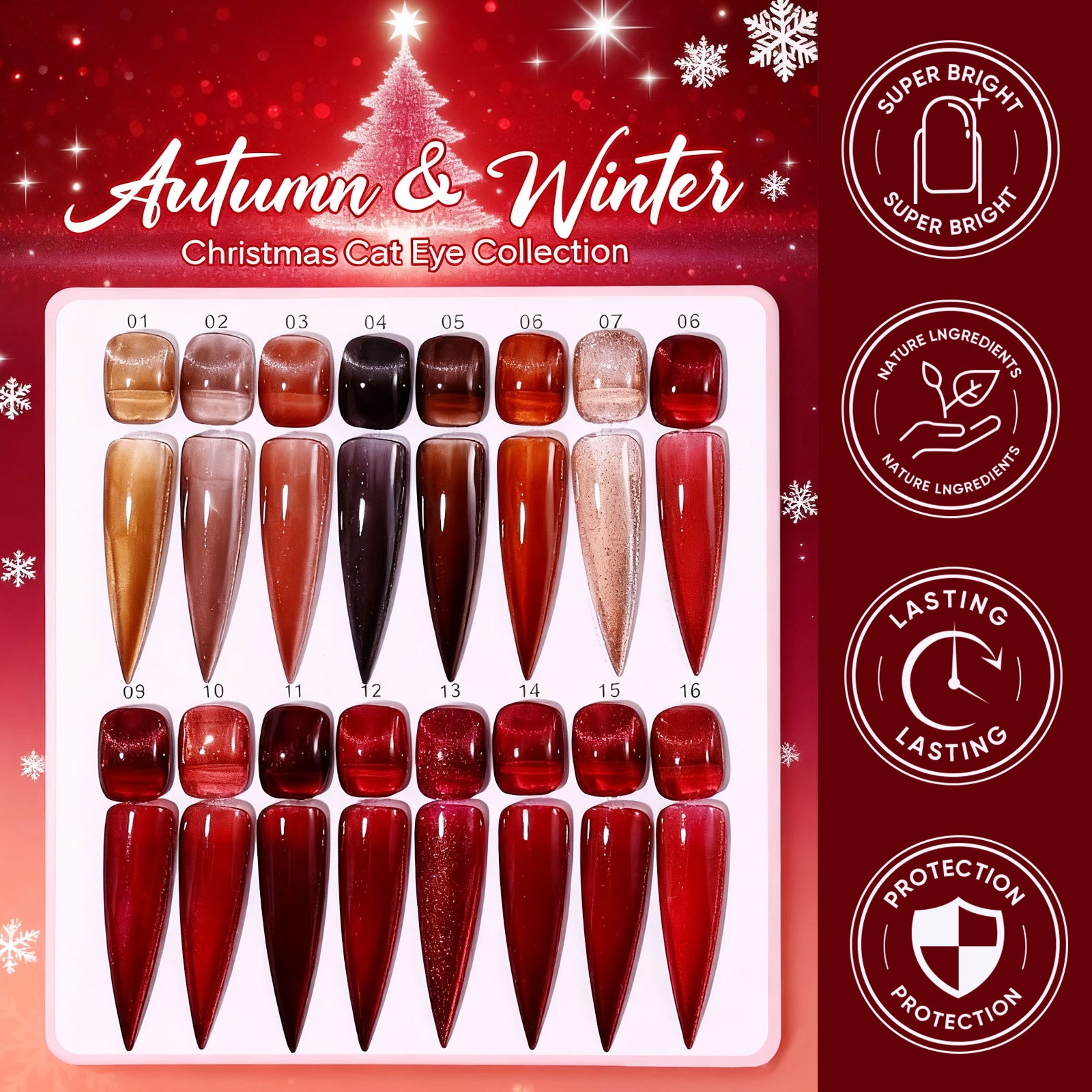
A collection should be planned as a visual system rather than a random group of colors. Core shades can include blackened ruby, emerald, sapphire, bronze, champagne, violet, silver, and multichrome variations, while seasonal shades can create limited-edition demand. Each shade should be evaluated under salon lighting, daylight, photography lighting, and different magnet angles. This matters because a color that appears distinctive in a supplier swatch may look too similar to another shade after curing over a dark base.
Shade cards, bottle labels, outer-box printing, and digital product images should use a consistent naming and numbering structure. For distributors, clear SKU logic reduces picking errors and simplifies replenishment. For salons, the same system helps technicians identify a shade quickly without opening multiple bottles. A coordinated collection can also include colored nail polish, line gel nail art, 3D nail art gel, and gel builder nail polish as complementary products, allowing the kit to support both full-coverage manicures and detailed decorative work.
Packaging Engineering for a Professional Nail Gel Set
Bottle, brush, cap, and fill-volume decisions
The primary container must protect the formula from light exposure, prevent leakage, and support controlled application. Opaque or light-resistant bottles are often preferable for light-sensitive gel systems, but the final choice depends on the formula, curing sensitivity, decoration method, and intended retail positioning. Buyers should validate bottle compatibility through fill testing, cap-torque checks, leak testing, brush immersion trials, and aging observation.
Brush selection has a direct effect on labor efficiency. A flat brush may support smooth full-nail coverage, while a narrower or more flexible brush can improve precision around the cuticle. Magnetic gel collections often benefit from consistent brush loading because uneven deposits make the reflective pattern appear irregular. The cap should provide a secure grip for technicians wearing gloves, while the wiper should remove excess product without stripping too much formula from the brush.
Kit box structure and protection during distribution
Outer packaging should be designed around the actual supply chain. A salon-focused box may prioritize quick shade visibility and easy access, while a retail-ready carton may require stronger shelf presentation, tamper evidence, barcode placement, and multilingual regulatory information. Internal inserts should stop bottles from colliding during transport and should maintain a consistent orientation for presentation.
Packaging artwork is not only a branding exercise. The design should reserve space for product name, net contents, batch or lot identification, responsible-party information where applicable, curing instructions, warnings, storage guidance, ingredient information, and country-specific labeling requirements. The U.S. FDA Cosmetics Labeling Guide explains important labeling principles for products sold in the United States. For European distribution, project owners should also review the European Union Cosmetics Regulation and obtain market-specific compliance advice.
Packaging options and procurement trade-offs
| Packaging element | Standardized option | Customized option | Procurement implication |
|---|
| Bottle and cap | Existing mold and established decoration | Custom shape, finish, or component combination | Standard parts usually shorten lead time; custom parts can strengthen brand recognition but require mold, sampling, and tooling review |
| Brush and wiper | Supplier’s proven assembly | Adjusted brush length, fiber, flexibility, or wiper design | Customized assemblies should be tested for application consistency and leakage before approval |
| Kit insert | Generic divider or paper tray | Form-fit insert matched to bottle dimensions | A tailored insert improves protection and presentation but may affect packing labor and carton cost |
| Outer carton | Stock box with label or sleeve | Printed folding carton, rigid box, or magnetic closure box | High Quality structures support positioning but increase minimum order quantity, storage space, and freight volume |
| Color identification | Printed number and name | Custom color chart, window, or shade card system | Better visual merchandising can reduce selection friction and support distributor sell-through |
The table illustrates a central purchasing principle: the most expensive option is not automatically the most valuable option. A buyer should compare tooling cost, minimum order quantity, unit economics, production lead time, damage rate, carton cube, and expected retail price. A stock bottle with High Quality decoration may outperform a fully custom bottle when the launch schedule is tight. Conversely, a distinctive container can justify investment when the product is intended for a long-term brand platform.
Quality Assurance, Compliance, and Launch Readiness
Testing the formula and finished package together
Formula testing should include appearance, odor, viscosity, curing response, adhesion, hardness, flexibility, soak-off or removal behavior, magnetic responsiveness, and shade consistency. The finished package should then be tested for leakage, cap fit, brush performance, label adhesion, print durability, and light exposure. Stability programs should examine changes in color, viscosity, sedimentation, curing, and container integrity over time and under relevant storage conditions.
Manufacturers operating a cosmetic production program should establish documented procedures for raw-material approval, batch records, in-process inspection, finished-product release, retained samples, and complaint handling. The ISO 22716 Good Manufacturing Practices standard is a recognized reference for cosmetic manufacturing and quality-control practices. It does not replace local legal requirements, but it provides a useful framework for evaluating supplier discipline and production documentation.
Buyer due diligence before purchase-order release
Before approving a supplier, project owners should request the technical data sheet, ingredient or INCI documentation as applicable, safety documentation, batch coding method, shelf-life statement, certificate or declaration documents, and a clearly defined sample approval procedure. Claims such as hypoallergenic, non-toxic, vegan, HEMA-free, or cruelty-free require precise substantiation and market-specific review; they should not be printed merely because they are commercially attractive.
Buyers should also clarify who owns the artwork, mold, formula, color database, and testing records. A written quality agreement can define acceptable viscosity tolerance, color deviation, fill-volume tolerance, defect classification, inspection sampling, corrective-action timing, and responsibility for regulatory files. For international sales, customs classification, language requirements, responsible-person obligations, and destination-market restrictions should be confirmed before mass production.
Operational details that protect margin
Magnetic gel is often sold through sets, salon back-bar programs, subscription replenishment, or seasonal launches. Each channel changes the ideal fill size and packaging format. Smaller bottles can lower the entry price and encourage shade discovery, while larger professional sizes may improve cost per application. However, larger containers can increase the risk of prolonged open-bottle exposure and may be less convenient for technicians switching among shades.
Forecasting should include primary packaging, cartons, inserts, labels, magnets, instruction cards, and replacement components. A strong project plan reserves time for artwork proofing, color approval, packaging samples, pilot filling, transit testing, and final inspection. These steps reduce the likelihood of launching a visually attractive collection that suffers from leaking caps, unreadable labels, inconsistent shades, or insufficient stock of the best-selling colors.
Why Hanyinails Supports Scalable Private-Label Development
Integrated capacity for formula and packaging customization
Hanyinails is a professional nail products manufacturer committed to supplying professional Nail Gel items for brand owners, distributors, salon groups, and project investors. Our manufacturing base includes 10 production lines, 60 production machines, 8 QA/QC inspectors, and an 8000㎡ workshop. This structure supports coordinated development from sample evaluation through filling, packaging, inspection, and shipment.
Our team provides 12 years of OEM customization experience and develops approximately 2000 new colors per year. For a magnetic-effect collection, this color-development capability can support core shade selection, seasonal palettes, matching color charts, and coordinated products across a broader nail system. Hanyinails offers more than 50 styles of stock bottles and caps, over 600 styles of customized bottles and caps, more than 100 kit-box styles, and over 200 color-chart design options. These resources allow buyers to balance speed, differentiation, tooling requirements, and target price.
A broader product platform for salon and retail programs
A private-label launch can extend beyond magnetic color gel. Hanyinails supports related categories including 3D nail art gel for raised decoration, gel builder nail polish and nail hard gel for structured overlays, colored nail polish for coordinated palettes, nail care oil for after-service retail, gel X nail glue and Gelly nail tips for extension systems, Poly Acrygel for hybrid enhancement work, and line gel nail art for precise detailing. A broader assortment helps distributors consolidate purchasing and enables brands to create complete manicure routines rather than isolated products.
International project communication and brand development
Hanyinails takes part in exhibitions in more than 10 countries every year, giving our team continued exposure to professional salon requirements, distributor expectations, packaging preferences, and regional trend shifts. Our vision is to become the world's leading manufacturer of nail products, supported by a one-stop customization approach that connects product development, packaging selection, color presentation, and production execution.
For buyers, supplier value should be measured by more than catalog breadth. The practical question is whether the manufacturer can convert a creative brief into a repeatable commercial product, preserve quality across batches, communicate clearly during approvals, and support expansion after the first launch. Hanyinails structures its service around these requirements while helping customers select suitable components, organize shade systems, and develop professional nail product portfolios.
Frequently Asked Questions
FAQ content is provided in the structured FAQ extraction fields for this article.
Contact Hanyinails at sales@hanyinails.com or visit https://www.hanyinails.com to discuss a customized magnetic gel collection, packaging program, or complete professional nail product portfolio.









Hanyinails
Hanyinails
Hanyinails
Hanyinails